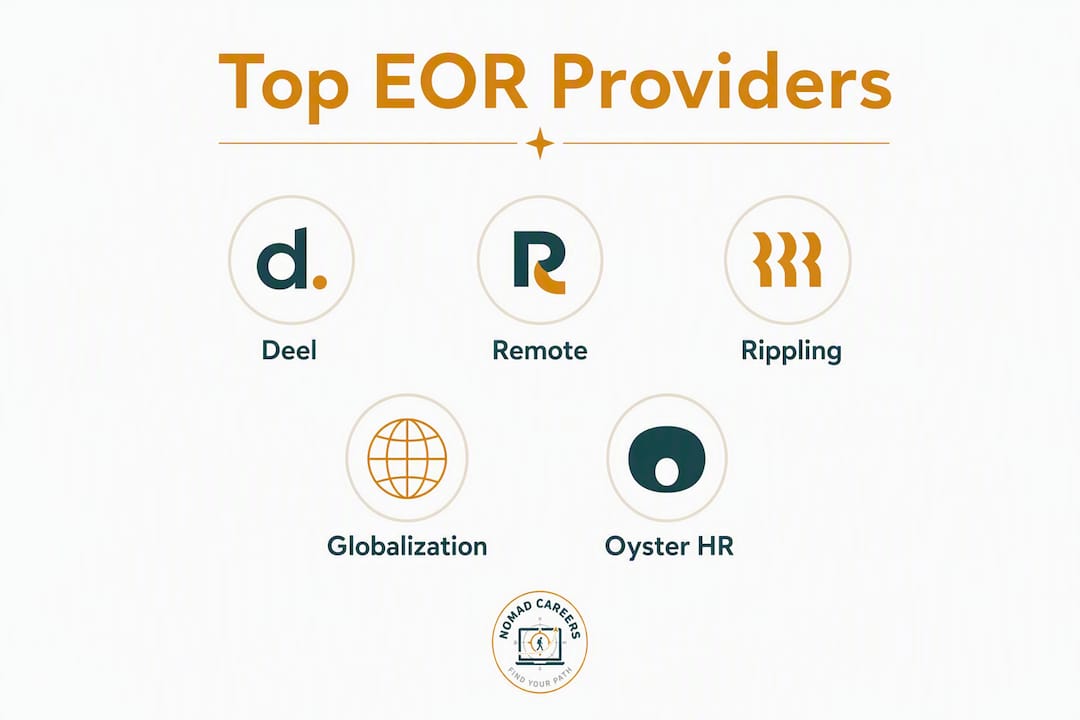
For most U.S. businesses hiring internationally, the right EOR comes down to one primary axis: speed to hire, compliance depth, platform self-serve, or enterprise coverage. No single provider wins every dimension. The shortlist below maps each top pick to the decision axis it genuinely leads on, so you can identify your best match in under two minutes.
Quick shortlist:
-
Deel — best overall for platform integrations and contractor + employee workflows
-
Remote — best for fast onboarding via owned local entities
-
Rippling — best for companies that want HRIS and EOR in one system
-
Globalization Partners (G-P) — best for large enterprises needing the widest country coverage
-
Oyster HR — best for startups and small teams needing transparent pricing
-
Papaya Global — best for enterprise payroll compliance depth
-
Remofirst — best for growth-stage companies scaling into multiple countries fast
| Provider | Countries | Pricing model | Best for | Service model | Onboarding time |
|---|---|---|---|---|---|
| Deel | 150+ | Flat fee per employee | Platform integrations + contractors | Self-serve + support | Days |
| Remote | 180+ | Flat fee per employee | Fast onboarding, owned entities | Self-serve | Days |
| Rippling | 180+ | Custom/tiered | HRIS + EOR integration | Platform-led | Days |
| Globalization Partners | 180+ | Custom enterprise | Large enterprise coverage | White-glove | 1–2 weeks |
| Oyster HR | 180+ | Flat fee per employee | Startups, transparent pricing | Self-serve | Days |
| Papaya Global | 180+ | Tiered/enterprise | Enterprise payroll compliance | White-glove | 1–2 weeks |
| Remofirst | 180+ | Flat fee per employee | Scaling SMBs, multi-country | Self-serve | Days |
TL;DR: Start with Deel or Remote if speed and platform quality are your priorities. Request a sample contract, entity paperwork for your target country, and a written quote that includes setup fees and FX terms before signing anything.
What are the best employer of record providers right now?
The providers below are ranked by the strength of their fit for common U.S. buyer profiles, not by review volume. Each entry covers what the provider actually does well, where it falls short, and who it suits.
Deel
Deel is the most widely adopted EOR platform for U.S. companies managing a mix of contractors and full-time employees across borders. Its integration catalog covers Slack, QuickBooks, BambooHR, NetSuite, and dozens more, which matters when you need EOR data flowing into existing HR and finance systems. Onboarding a new hire typically takes two to five days. Pricing is flat per employee per month, though contractor fees are separate.

Strengths: deep contractor management, broad integrations, strong self-serve portal, large country footprint. Watch for: pricing can climb when you add contractors and employees simultaneously; enterprise support tiers cost extra.
Remote
Remote owns its local entities in most of the countries it covers rather than relying on third-party partners. That ownership structure speeds onboarding, centralizes legal accountability, and strengthens IP protection for your company. For a U.S. buyer hiring in the EU or APAC, that distinction is material: you are not waiting on a subcontractor to process paperwork. Remote’s self-serve platform is clean and well-documented.

Strengths: owned-entity model, fast onboarding, clear accountability, strong compliance posture. Watch for: pricing is competitive but not the lowest; some niche markets still use partners.
Rippling
Rippling is less a pure EOR and more a unified HR and IT platform that includes EOR functionality. If your company already uses Rippling for domestic HR, adding global EOR through the same system eliminates data silos between payroll, benefits, device management, and compliance. The tradeoff is that Rippling’s EOR country coverage is narrower than dedicated EOR providers.
Strengths: single system for HR and IT, deep integrations, strong reporting. Watch for: narrower country coverage; pricing is custom and can be higher for small teams.
Globalization Partners (G-P)
G-P is the name most enterprise procurement teams encounter first, and for good reason: its country footprint spans 180+ markets, and its advisory services go beyond payroll to include immigration support and entity setup guidance. G-P’s platform is white-glove by design, meaning you get a dedicated account team rather than a self-serve portal. Onboarding typically runs one to two weeks.
Strengths: broadest enterprise coverage, advisory depth, immigration support, strong compliance infrastructure. Watch for: pricing is enterprise-tier and not publicly listed; not the right fit for a two-person startup.
Oyster HR
Oyster HR targets startups and small teams that need a fast, affordable path to international hiring. Its pricing is published openly, which is rare in this category, and its onboarding flow is designed for HR teams without dedicated legal support. Benefits administration is handled in-platform.
Strengths: transparent pricing, fast setup, user-friendly interface, good for first-time EOR buyers. Watch for: white-glove advisory support is limited compared to enterprise providers.
Papaya Global
Papaya Global is built for enterprises that need payroll infrastructure at scale across multiple countries simultaneously. Its compliance tooling and advisory depth make it a strong choice when your payroll complexity exceeds what a self-serve platform can handle. The platform also supports workforce analytics and reporting for finance teams.
Strengths: enterprise payroll scale, compliance advisory, workforce analytics. Watch for: pricing and onboarding timelines reflect an enterprise orientation; smaller teams may find it over-engineered.
Safeguard Global
Safeguard Global brings strong multi-country payroll operations and regional expertise, particularly for organizations managing workforce programs across several jurisdictions at once. It suits companies that need payroll complexity handled with regional nuance rather than a one-size platform.
Remofirst
Remofirst is designed specifically for growth-stage companies expanding into multiple countries quickly. Its flat-fee pricing and self-serve platform make cost forecasting straightforward, and its country coverage reaches 180+. A good fit for Series A and B companies building out distributed teams.
Multiplier
Multiplier targets SMBs that want a self-serve EOR with published pricing and a clean platform experience. It covers a broad range of countries and positions itself on pricing clarity, which helps finance teams model costs before committing.
Omnipresent
Omnipresent focuses on Europe and selected global markets with a managed-service orientation. If your primary expansion target is the EU and you want a provider that handles the complexity of European labor law with a dedicated team, Omnipresent is worth evaluating.
Atlas HXM
Atlas HXM blends HR experience management with cross-border payroll, positioning itself as more than a compliance vehicle. It suits companies that want HR lifecycle features alongside EOR services rather than a pure payroll-and-compliance tool.
Velocity Global
Velocity Global (formerly known for its Pebl platform) brings enterprise-grade services with particular depth in immigration support and M&A workforce transitions. For companies navigating an acquisition or restructuring that involves international headcount, its operational depth in those scenarios is a genuine differentiator.
Rivermate
Rivermate offers broad geographic coverage and operational flexibility, making it a practical option for teams that need to hire across a wide range of countries without committing to a single large-platform vendor.
Wisemonk Employer of Record
Wisemonk combines platform automation with managed services, offering a hybrid model for buyers who want some self-serve capability but also need hands-on support for complex compliance situations.
Additional providers
Several other providers serve specific niches worth knowing:
-
NES Fircroft — specialist EOR services for technical and engineering workforce programs.
-
Alpha Apex Group — EOR advisory and services for specialized hiring programs.
Pro Tip: Ask every provider whether their country coverage uses owned entities or third-party partners. Providers that own their local entities generally deliver faster onboarding and clearer legal accountability than those relying on partner networks.
On hidden costs: Published per-employee fees commonly exclude setup requirements. Security deposits equal to roughly one times a monthly charge and extra fees for contractor payments or immigration support are common. Always request a written all-in quote before comparing providers on price alone.
How do you choose the right EOR for your company?
The decision criteria below reflect what actually differentiates providers in practice, not just what looks good in a sales deck.
Core evaluation criteria
Compliance depth and legal presence. The single most important question is whether the provider owns its local entities or relies on third-party partners. Owned entities speed onboarding and centralize accountability; partner networks extend coverage but add a layer of operational risk.
Pricing model and total cost. Flat per-employee fees are the most common structure, but the published rate rarely reflects total cost. Published rates can mask setup fees, security deposits, and add-on charges. Request a written quote that itemizes every fee, including FX conversion policy and payroll spread.
Platform vs. white-glove service. Self-serve platforms (Deel, Remote, Oyster HR, Multiplier) suit teams that want to move fast without heavy vendor involvement. White-glove providers (G-P, Papaya Global, Safeguard Global) suit enterprises with complex compliance needs and dedicated HR resources to manage the relationship.
Path to local entity. Some countries impose maximum durations for EOR engagements, and long-term scale often makes a local entity cheaper than ongoing EOR fees. Require your provider to model the crossover point for each target country.
Data security certifications. SOC 2 Type II and ISO 27001 are standard procurement requirements. Several leading providers list these certifications publicly; require written proof, not just a checkbox on a sales slide.
Documents and claims to request before signing
-
Proof of local entity registration in each target country (or named partner agreement)
-
SOC 2 Type II and/or ISO 27001 certificates
-
Sample employment contract for your target jurisdiction
-
Written indemnity language covering payroll errors and statutory filing failures
-
Payroll sample showing gross-to-net calculation with FX conversion
-
SLA document covering onboarding timelines, payroll processing, and escalation paths
-
Full fee schedule including setup, deposits, contractor fees, and benefits admin
Questions to ask during vendor discovery calls
-
Do you own your local entities in our target countries, or do you use third-party partners?
-
What is your all-in monthly cost per employee, including setup, deposits, and FX fees?
-
What is your standard onboarding SLA from signed contract to first payroll?
-
How do you handle a statutory compliance change mid-engagement?
-
Who is our named account manager, and what is their response time SLA?
-
What happens to our employees if we terminate the EOR agreement?
-
Can you model the crossover point at which a local entity becomes more cost-effective?
-
What are your SOC 2 and ISO 27001 certification statuses?
Red flags to watch for
-
Vague or missing indemnity language for payroll errors
-
No published or verifiable security certifications
-
Unclear escalation paths when compliance issues arise
-
Pricing quotes that exclude deposits, FX fees, or benefits admin
-
No named account manager or support SLA in the contract
Pro Tip: Ask for the provider’s FX policy in writing before you sign. Providers that publish their FX conversion methodology and any payroll spread give you a materially clearer total cost picture than those that disclose it only after onboarding.
What does EOR pricing actually look like for U.S. buyers?
Common pricing models
Published EOR pricing typically ranges from roughly $199 to $699+ per employee per month, but that range reflects only the base fee. Three pricing structures dominate the market:
-
Flat fee per employee per month — the most common model; predictable for budgeting, but watch for add-ons.
-
Percentage of payroll — scales with salary; can become expensive for senior hires.
-
Tiered or custom enterprise pricing — common among white-glove providers; requires a formal quote.
| Fee type | Typical range | Notes |
|---|---|---|
| Base EOR fee | $199–$699+/employee/month | Published rate; excludes most add-ons |
| Setup fee | $0–$500+ | Often waived for annual contracts |
| Security deposit | roughly one times a monthly charge | Refundable; required by many providers |
| Benefits admin fee | Varies | Often a separate line item |
| Contractor payment fee | Varies | Separate from employee EOR fee |
| FX/payroll spread | Not always disclosed | Request written FX policy |
Sample cost calculation
Using a flat fee of $500/employee/month as a mid-range benchmark:
-
1 employee: $500/month ($6,000/year) plus a one-time deposit of roughly $500–$750
-
5 employees: $2,500/month ($30,000/year)
-
25 employees: $12,500/month ($150,000/year)
At a payroll-percentage model of 5% on a $60,000 annual salary, the cost is $3,000/year per employee, which looks cheaper at low headcount but scales directly with compensation increases.
Realistic onboarding timelines
- Self-serve platforms (Deel, Remote, Oyster HR, Remofirst): — 2–5 business days from signed contract to offer letter; first payroll typically within the current or next pay cycle.
SLA expectations worth requiring in writing: onboarding confirmation within 24 hours, payroll processing confirmation 5 business days before pay date, and a named escalation contact with a 4-hour response SLA for compliance issues.
How this ranking was built
Rankings in this article were built on a defined rubric applied consistently across all providers. The evaluation weighted six dimensions: pricing transparency (published rates and fee disclosure), global coverage (owned entities vs. partner network), platform quality (self-serve capability, integrations, reporting), security posture (SOC 2 and ISO 27001 certification), service model (self-serve vs. white-glove), and path-to-entity guidance (whether the provider models the crossover point).
Data collection steps:
-
Public pricing pages and published fee schedules reviewed for each provider
-
Vendor documentation reviewed where publicly available (entity lists, security certification pages)
-
Gartner Peer Insights reviews consulted for user-reported service quality signals
-
Industry comparative rubrics from independent sources reviewed for coverage and compliance depth
-
Provider websites reviewed for country coverage claims and entity ownership disclosures
Limitations: Enterprise discount tiers and negotiated pricing were not evaluated, as these are not publicly available. Providers with no public pricing were ranked on non-price dimensions only. This article does not constitute legal or HR compliance advice; confirm current rules with a qualified employment attorney for your specific jurisdictions.
What is an Employer of Record, and how does it differ from a PEO?
An Employer of Record is the legal employer of record for a company’s distributed workforce in a given jurisdiction. The EOR handles payroll, tax withholding, benefits administration, and statutory compliance, while the client company retains day-to-day management of the employee’s work and assignments. The key practical benefit: an EOR removes the need to set up a local legal entity, compressing time-to-hire from months to days in most markets.
The EOR is frequently confused with a Professional Employer Organization (PEO). The distinction matters for U.S. buyers because the two models carry different legal structures and use cases.
| Dimension | EOR | PEO |
|---|---|---|
| Legal employer | EOR is the legal employer | Co-employment: client and PEO share employer status |
| Local entity required | No — EOR provides the entity | Yes — client must have a local entity |
| Best for | International hiring without local entity | Domestic HR outsourcing with existing entity |
| Liability | EOR assumes payroll and compliance liability | Shared between client and PEO |
| Typical use case | Hiring in a new country fast | Outsourcing HR admin for existing domestic workforce |
Common EOR use cases:
-
A U.S. startup hiring its first engineer in Germany without setting up a GmbH
-
An enterprise testing a new market in Southeast Asia before committing to a local entity
-
A company converting contractors to employees to reduce misclassification risk
-
An organization managing a distributed team across five or more countries simultaneously
EORs assume liability for payroll and statutory filings, but the client remains responsible for day-to-day employee management and must maintain clear internal policies on performance and assignments. One jurisdictional note: some countries cap how long a company can employ workers through an EOR before requiring a local entity. Plan for that transition from day one.
Key Takeaways
The best EOR for your company is the one that matches your primary operational axis: speed, compliance depth, platform breadth, or enterprise coverage.
| Point | Details | ||
|---|---|---|---|
| Match provider to your axis | No single EOR wins every dimension; pick the one that leads on your top priority. | ||
| Watch total cost, not base fee | Published fees of $199–$699+/month often exclude deposits, FX fees, and benefits admin. | ||
| Owned entities matter | Providers that own local entities deliver faster onboarding and clearer legal accountability. | ||
| Plan the path to local entity | Some countries cap EOR duration; require your provider to model the crossover point. | ||
The real cost of getting EOR selection wrong
The EOR market is crowded enough that buyers often default to the provider with the most recognizable name or the lowest published price. Both shortcuts tend to produce regret.
The name-recognition trap is real. A provider that dominates enterprise sales may be genuinely over-engineered for a 10-person team testing a new market. The onboarding process, the contract terms, and the account management model are all calibrated for a different buyer. You end up paying for advisory depth you never use and waiting on approval chains designed for Fortune 500 procurement cycles.
The low-price trap is subtler. A published rate of $199/employee/month sounds like a clear win until the security deposit, the FX spread, and the benefits admin fee land in your first invoice. The total cost is often 40–60% higher than the headline number. Providers that publish their full fee schedule upfront, including FX policy and deposit terms, are doing you a genuine service, not just being transparent for marketing purposes.
The dimension that most buyers underweight is the path-to-entity question. An EOR is a fast, flexible way to enter a market. It is not a permanent solution in every jurisdiction. Some countries impose duration limits; others make long-term EOR engagement materially more expensive than a local entity once headcount crosses a threshold. The providers that model this crossover point proactively are treating you as a strategic partner. The ones that never raise it are optimizing for their own recurring revenue