U.S. citizens and resident aliens must file federal tax returns on their worldwide income regardless of where they live or work. Moving abroad does not end your U.S. tax obligation. Three things to do right now: (1) confirm whether your gross income exceeds the IRS filing threshold for your filing status, (2) start counting the days you spend outside the U.S. to determine Foreign Earned Income Exclusion eligibility, and (3) list every foreign financial account you hold to assess whether you owe an FBAR filing with FinCEN.
-
Check your filing threshold. For most single filers under 65, the gross income threshold is set by IRS guidelines. Self-employed individuals must file if net self-employment income reaches $400, regardless of total gross income.
-
Start your day count. The Physical Presence Test for the Foreign Earned Income Exclusion requires 330 full days outside the U.S. in any rolling 12-month period.
-
Audit your foreign accounts. If the combined balance of all foreign accounts ever exceeds $10,000 in a calendar year, you must file FinCEN Form 114 (FBAR). The threshold is low and easy to cross.
-
Check your state residency status. Some states continue to tax former residents who have not formally severed domicile, even years after departure.
Key Takeaways
U.S. digital nomads must file federal returns on worldwide income, use FEIE or FTC to reduce double taxation, and file FBAR separately if foreign accounts exceed $10,000 at any point in the year.
| Point | Details |
|---|---|
| Worldwide income filing | U.S. citizens and resident aliens must file on all income regardless of where they live or work. |
| FEIE reduces income tax, not SE tax | FEIE excludes a significant portion of foreign earned income but does not reduce self-employment tax. |
| FBAR threshold is low | Any year your foreign accounts collectively exceed $10,000, FinCEN Form 114 is required by April 15. |
| State domicile is the biggest surprise | Sticky states like California and New York require affirmative severance steps, not just physical departure. |
| Detailed records are non-negotiable | Day logs, boarding passes, and foreign tax receipts are required to defend FEIE, FTC, and FBAR filings. |
Do digital nomads have to pay U.S. taxes?
Yes, and the obligation is broader than most nomads expect. The United States taxes its citizens and resident aliens on worldwide income, a system shared by only a handful of countries globally. Living in Lisbon, Chiang Mai, or Medellín does not change your federal filing requirement.
Who must file
-
U.S. citizens, regardless of where they live
-
Green card holders (lawful permanent residents)
-
Individuals who meet the substantial presence test: physically present at least 31 days in the current year and 183 days over the current year plus the two prior years using the IRS weighted formula
Common filing pitfalls
-
Assuming that leaving the U.S. ends the federal filing requirement. It does not.
-
Believing the Foreign Earned Income Exclusion (FEIE) removes all U.S. tax. FEIE applies only to earned income and does not touch passive income, capital gains, dividends, or self-employment (SE) tax.
-
Missing the self-employment filing threshold. Net SE income of $400 or more triggers a filing requirement even if total gross income is below the standard threshold.
-
Overlooking foreign financial account reporting. FBAR and FATCA obligations exist independently of whether you owe any income tax.
Filing relief for nomads abroad
U.S. citizens living outside the country on April 15 receive an automatic two-month extension to June 15 for filing their return, though any tax owed is still due April 15 to avoid interest. A further extension to October 15 is available by filing Form 4868. For nomads who have fallen behind on prior-year returns, the IRS Streamlined Filing Compliance Procedures offer a reduced-penalty path to catch up, provided the failure was non-willful.
Pro Tip: The self-employment $400 threshold catches many freelancers off guard. If you earned $500 from a single client on a foreign platform, you must file a U.S. return and pay SE tax on that income, even if FEIE eliminates the income tax portion.
How does the Foreign Earned Income Exclusion work for nomads?
The FEIE is the primary federal tax relief tool for U.S. nomads with earned income. It allows qualifying taxpayers to exclude a set amount of foreign earned income from U.S. taxable income. For tax year 2025, the exclusion limit is $126,500. The foreign housing exclusion or deduction can add further relief for qualifying housing costs above a base amount.
Both benefits apply only to earned income: wages, salaries, freelance fees, and self-employment income. They do not apply to dividends, interest, rental income, capital gains, pension distributions, or income from U.S.-based sources.
Physical presence test vs. bona fide residence test
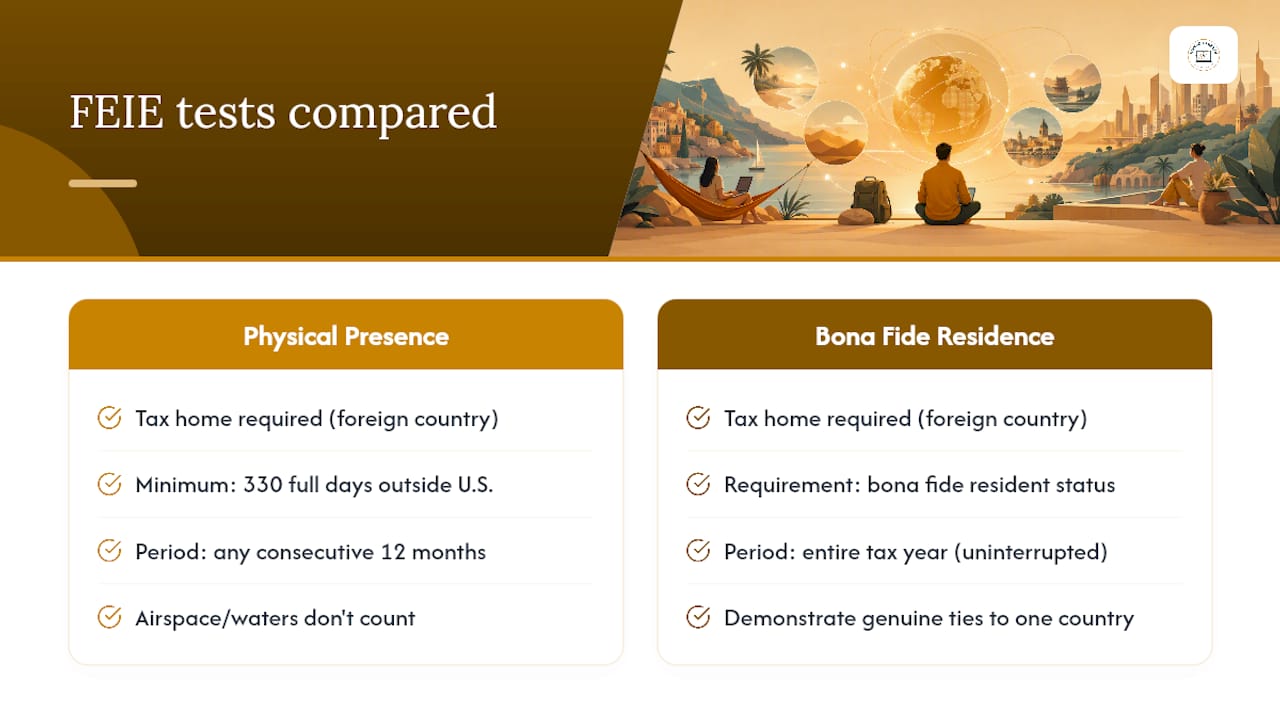
To claim FEIE, you need a tax home in a foreign country and must satisfy one of two tests.
Physical Presence Test: You must be physically present in a foreign country or countries for at least 330 full days in any consecutive 12-month period. A “full day” means a 24-hour calendar day spent entirely outside the U.S. Time in international airspace or international waters does not count as time in a foreign country. Days of transit through the U.S. break the count.
Example: You leave the U.S. on January 10 and return on December 31 of the same year. You were outside the U.S. for roughly 355 days. You easily clear the 330-day threshold and can elect the Physical Presence Test for a 12-month period within that span.
Bona Fide Residence Test: You must be a bona fide resident of a foreign country for an uninterrupted period covering an entire tax year. This test is harder to satisfy for nomads who move frequently between countries, because it requires demonstrating genuine ties to a single foreign country. Most nomads use the Physical Presence Test instead.
What FEIE does and does not cover
| Income type | FEIE eligible? |
|---|---|
| Freelance / consulting fees | Yes |
| W-2 wages from foreign employer | Yes |
| Dividends and interest | No |
| Capital gains | No |
| Rental income | No |
| U.S.-source income | No |
| Self-employment income (income tax portion) | Yes |
| Self-employment tax (SE tax) | No |
Documentation the IRS expects for FEIE claims
-
Passport stamps and entry/exit records for every country visited
-
Boarding passes or e-ticket confirmations
-
Accommodation receipts (hotel, lease agreements, Airbnb confirmations)
-
A day-by-day travel log showing country, city, and dates
-
Proof of tax home (employer letters, client contracts, or business registration in the foreign country)
-
Form 2555 filed with your Form 1040
As Fidelity’s tax guidance notes, assuming FEIE is a blanket exclusion is one of the most common and costly nomad tax errors.
Should you use the Foreign Tax Credit or FEIE?
The Foreign Tax Credit (FTC), claimed on Form 1116, and the FEIE address the same problem from different angles. FEIE excludes income from U.S. taxation; FTC credits foreign taxes you have already paid against your remaining U.S. tax bill. Choosing the right one, or the right combination, depends on your income level, the foreign tax rate you face, and the type of income you earn.
When FEIE tends to be the better choice
-
Your foreign earned income falls below or near the exclusion limit ($126,500 for 2025)
-
The country where you work has low or no income tax (e.g., the UAE, many digital nomad visa countries)
-
You want to simplify your return and avoid tracking foreign tax payments in detail
When the Foreign Tax Credit tends to be the better choice
-
You pay high foreign income taxes (above the effective U.S. rate on the same income)
-
You have significant passive income (dividends, interest, capital gains) taxed abroad, since FEIE cannot shelter those
-
Your foreign earned income exceeds the FEIE limit and you owe foreign tax on the excess
Worked example
Suppose you earn $150,000 in freelance income from foreign clients and pay $25,000 in foreign income tax.
-
FEIE route: Exclude $126,500. Remaining taxable income: $23,500. U.S. tax on $23,500 (approximate): roughly $2,700. You cannot apply FTC to the excluded portion, so the $25,000 foreign tax paid provides no additional U.S. benefit on the excluded amount.
-
FTC route: No exclusion. U.S. tax on $150,000 (approximate, single filer): roughly $28,000. Apply the $25,000 FTC. U.S. tax owed: roughly $3,000. You carry forward any unused FTC.
In this example the outcomes are close, but the FTC route preserves the ability to carry forward unused credits and avoids the “FEIE cliff” problem where exceeding the exclusion limit by a small amount creates a disproportionate tax bill.
Important interaction: If you claim FEIE, the income you exclude is removed from the FTC calculation base. You cannot double-dip. Switching between FEIE and FTC in different years requires IRS permission (Form 2555 revocation rules apply), so get CPA advice before changing elections.
-
Keep receipts and official tax assessments from every foreign jurisdiction where you pay tax.
-
Record the exchange rate used on the date of each foreign tax payment (IRS requires the official exchange rate).
-
Note that state tax returns generally do not recognize FEIE, so state taxable income may be higher than federal taxable income.
How does self-employment tax affect digital nomads?
Self-employment tax is the piece of the U.S. tax code that surprises nomads most. FEIE reduces your federal income tax on earned income, but it does not reduce SE tax. SE tax covers Social Security (12.4%) and Medicare (2.9%), totaling 15.3% on net self-employment income up to the Social Security wage base, with the Medicare portion continuing above that threshold.
If you earn $80,000 in freelance income and exclude all of it under FEIE, your federal income tax on that income drops to zero. Your SE tax on the same income remains roughly $11,304 (15.3% × $80,000 × 0.9235 net earnings adjustment). That is a significant cash-flow item to plan for.
Key forms for self-employed nomads
-
Schedule C: Reports profit or loss from your freelance or sole-proprietor business
-
Schedule SE: Calculates SE tax on net Schedule C income
-
Form 1040-ES: Used to make quarterly estimated tax payments (due April 15, June 15, September 15, and January 15)
-
Form 2555: Claims FEIE on your 1040
-
Form 1116: Claims the Foreign Tax Credit if you elect FTC instead of or in addition to FEIE
Business structure considerations
Some nomads explore forming an S corporation to reduce SE tax by splitting income between a salary and distributions. Distributions are not subject to SE tax; only the salary portion is. The trade-off is added complexity: payroll filings, state registration, and a requirement to pay yourself a “reasonable compensation.” This strategy can make sense at higher income levels, but it requires a CPA familiar with expat and nomad tax situations to implement correctly.
Comparing freelance vs. remote employment structures is worth doing before you commit to a business form, since the tax implications differ substantially.
Pro Tip: The SE tax safe-harbor rule lets you avoid underpayment penalties by paying at least 100% of the prior year’s total tax liability (110% if your prior-year AGI exceeded $150,000) in quarterly installments. Budget roughly 15–20% of net freelance income for SE tax alone, separate from any income tax.
What should you ask your employer before working abroad?
If you are a remote employee rather than a freelancer, your employer’s payroll setup and location policies directly affect your tax exposure. Working from a foreign country without HR approval can create payroll, withholding, and even corporate tax problems for your employer, which often leads employers to restrict or terminate remote arrangements retroactively.
Remote-work payroll obligations can force employers to register and withhold in additional states or countries, and many companies restrict permitted work locations specifically to limit that exposure.
Questions to ask HR before you travel
-
Which countries (or states) are you permitted to work from, and for how long?
-
Will payroll withholding change if you work from a different country or state?
-
Does the company have a payroll registration or entity in the countries you plan to work from?
-
How will benefits (health insurance, retirement contributions) be affected by working abroad?
-
Can you get written confirmation of approved work locations and the applicable withholding setup?
The convenience-of-employer doctrine
Several U.S. states, most notably New York, apply a “convenience of employer” rule. Under this doctrine, if you work remotely for a New York-based employer for your own convenience rather than because the employer requires it, New York may tax those remote work days as if you worked them in New York. This can create a situation where both your state of physical presence and New York claim the right to tax the same income. State conflicts and convenience-of-employer doctrines have produced litigation and ongoing policy uncertainty, and the rules continue to evolve.
Pro Tip: Request written confirmation from HR of your approved work locations and the withholding treatment before you leave. A short email thread is far easier to produce as evidence in a state audit than a verbal understanding.
How do you sever state tax residency as a digital nomad?
Federal tax compliance is only half the picture. State income taxes can follow you abroad if you have not formally severed domicile. Several states, including California, New York, and Virginia, are known as “sticky states” because they aggressively reassert residency over former residents who cannot prove they established a new permanent home elsewhere. Physically leaving is not enough.
Some states commonly reassert residency unless the taxpayer can demonstrate affirmative severance, and the burden of proof typically falls on the taxpayer.
Six steps to change domicile
-
Obtain a driver’s license in your new state of domicile (or an international license if you establish domicile abroad).
-
Update your voter registration to reflect your new address, or cancel your registration in the prior state.
-
Establish a new mailing address through a mail-forwarding service or a trusted contact in a no-income-tax state (South Dakota, Wyoming, and Florida are popular choices).
-
Move primary bank accounts and update financial institution addresses.
-
Sell, sublet, or otherwise relinquish your primary residence in the prior state. Maintaining a home there is one of the strongest indicators of continued domicile.
-
Transfer professional memberships, medical providers, and other personal ties to the new location.
Document every step with dated records. A sticky state auditor will look for the most recent evidence of where you considered “home.”
Reciprocity agreements and state credits
Reciprocity agreements cover 30 agreements across 16 states and the District of Columbia. If your employer state and your residence state have a reciprocity agreement, you pay income tax only in your state of residence. Without one, you may need to file in both states and claim a credit for taxes paid to the other state to avoid double taxation. Credits reduce the double-tax burden but rarely eliminate it entirely, because the credit is capped at the lower of the two states’ tax rates.
How do host-country tax rules affect U.S. nomads?
Most countries determine tax residency using one or more of three tests: physical presence (commonly 183 days in a calendar year), center of vital interests (where your family, home, and economic ties are strongest), and habitual abode (where you regularly live). Crossing a country’s residency threshold can trigger a local filing obligation and, in some cases, tax on your worldwide income from that country’s perspective.
The 183-day rule is the most widely used threshold internationally, though the exact calculation varies by country. Some count calendar-year days; others use a rolling 12-month window. A few countries count partial days as full days, which can accelerate the count faster than you expect.
How to check local rules quickly
-
Visit the local tax authority’s official website. Most publish English-language guidance for foreign residents.
-
Check the U.S. Embassy or Consulate website for the country; many maintain basic tax information for American citizens.
-
Use the IRS tax treaty database at irs.gov to identify whether a U.S. tax treaty exists with the country and what it covers.
-
Review Nomadcareers’ country-by-country visa guide for destination-specific residency and permit details that often include tax residency notes.
Totalization agreements and SE tax
The U.S. has totalization agreements with more than 30 countries. These agreements prevent double Social Security taxation for self-employed individuals working in a covered country. If a totalization agreement applies, you generally pay Social Security taxes in only one country. This is one of the few situations where SE tax can be reduced or eliminated for income earned in a covered country. Check the SSA’s list of totalization agreement countries before assuming you owe SE tax on income from a specific location.
Pro Tip: Keep official receipts and tax assessments from every country where you pay local income tax. These documents are required to support a Foreign Tax Credit claim on Form 1116, and a missing receipt can cost you the credit entirely.
What are FBAR and FATCA, and do they apply to you?
Foreign account reporting is one of the highest-risk compliance areas for nomads, because the penalties are severe and the thresholds are low. Two separate reporting regimes apply: FBAR (FinCEN Form 114) and FATCA (Form 8938, filed with your 1040).
FBAR: FinCEN Form 114
You must file an FBAR when the aggregate balance of all foreign financial accounts exceeds $10,000 at any point during the calendar year. “Aggregate” means the combined peak balance across all accounts, not the balance in any single account. A checking account in Germany with $6,000 and a multi-currency account in the UK with $5,000 triggers the requirement even if neither account alone exceeds the threshold.
The FBAR $10,000 aggregate threshold is low and frequently triggered by convenience accounts, including multi-currency wallets, local checking accounts, and foreign exchange platforms. FBAR is filed electronically with FinCEN (not the IRS) by April 15, with an automatic extension to October 15.
FATCA: Form 8938
Form 8938 is filed with your Form 1040 and covers a broader range of foreign financial assets. The thresholds are higher than FBAR: $50,000 on the last day of the year or $75,000 at any point during the year for single filers living in the U.S. For taxpayers living abroad, the thresholds rise to $200,000 on the last day of the year or $300,000 at any point. Form 8938 covers not just bank accounts but also foreign stocks, foreign partnerships, and certain foreign insurance contracts.
FBAR and Form 8938 are not mutually exclusive. Many nomads must file both. FBAR covers foreign financial accounts; Form 8938 covers a wider universe of foreign financial assets. Filing one does not satisfy the other.
Penalties for non-compliance
Non-willful FBAR violations carry penalties of up to $10,000 per violation per year. Willful violations can reach the greater amount of $100,000 or 50% of the account balance per violation. These are among the steepest penalties in the U.S. tax code, which is why FBAR is treated as a high-priority compliance item.
Pro Tip: When reconciling foreign account balances for FBAR, use the U.S. Treasury’s official exchange rates published for December 31 of the reporting year. Using a different rate is a common error that can misstate the aggregate balance and create a compliance gap.
Which forms do nomads file, and when are they due?
| Form | Purpose | Typical deadline |
|---|---|---|
| Form 1040 | U.S. individual income tax return | April 15; automatic 2-month extension to June 15 for citizens abroad |
| Form 2555 | Claims Foreign Earned Income Exclusion | Filed with Form 1040 |
| Form 1116 | Claims Foreign Tax Credit | Filed with Form 1040 |
| Schedule C | Reports self-employment income and expenses | Filed with Form 1040 |
| Schedule SE | Calculates self-employment tax | Filed with Form 1040 |
| Form 8938 (FATCA) | Reports specified foreign financial assets | Filed with Form 1040 |
| FinCEN Form 114 (FBAR) | Reports foreign financial accounts | April 15; automatic extension to October 15 |
| Form 4868 | Requests further extension to October 15 | April 15 (or June 15 if abroad) |
| Form 1040-ES | Quarterly estimated tax payments | April 15, June 15, September 15, January 15 |
Estimated tax payments and safe-harbor rules
If you expect to owe $1,000 or more in federal tax after withholding and credits, you are generally required to make quarterly estimated payments. The safe-harbor rule lets you avoid underpayment penalties by paying either 100% of the prior year’s total tax (110% if prior-year AGI exceeded $150,000) or 90% of the current year’s tax, whichever is smaller.
Streamlined Filing Compliance Procedures
Nomads who have not filed U.S. returns for prior years may qualify for the IRS Streamlined Filing Compliance Procedures. The Streamlined Foreign Offshore Procedures require filing three years of delinquent returns and six years of FBARs, with a reduced or waived penalty structure, provided the failure was non-willful. This is not an amnesty program, but it is a significantly better outcome than a standard delinquency examination.
Pro Tip: The automatic two-month extension for citizens abroad moves your filing deadline to June 15, but tax owed is still due April 15. Pay an estimate by April 15 to stop interest from accruing, then file the complete return by June 15 or request a further extension to October 15 via Form 4868.
How do you track days and keep records for FEIE?
Accurate day-counting is the foundation of a defensible FEIE claim. The IRS can and does audit Physical Presence Test claims, and a poorly documented travel log can cost you the entire exclusion.
Day-tracking template fields
Keep a running log with these fields for every trip:
-
Date (departure and arrival)
-
Country and city
-
Number of nights
-
Primary purpose of stay (work, personal, transit)
-
Mode of transport (flight number, train, etc.)
-
Notes (visa type, accommodation address)
A partial day in the U.S. counts as a U.S. day for Physical Presence Test purposes, even if you are only transiting. A full day is a 24-hour calendar day spent entirely outside U.S. territory.
Documents to retain
-
Passport copies (all pages, including entry/exit stamps)
-
Boarding passes and e-ticket confirmations for every flight
-
Hotel receipts, lease agreements, or Airbnb booking confirmations
-
Bank statements showing foreign transactions and ATM withdrawals by location
-
Client contracts and invoices showing foreign work location
-
Employer communications confirming remote work approval
-
Local tax receipts and official assessments for FTC support
-
Foreign account statements for FBAR reconciliation
Retention timelines
The IRS generally has three years from the filing date to audit a return, but that window extends to six years if you omit more than 25% of gross income. FBAR records should be kept for five years from the filing date. For state tax purposes, some states have longer statutes of limitations. A practical approach is to retain all travel and tax records for at least seven years.
Digital storage works well: scan documents immediately, store them in a cloud service with automatic timestamps (Google Drive, Dropbox), and organize by tax year. The timestamp metadata can serve as additional evidence of when records were created.
The pre-departure checklist at Nomadcareers covers broader logistics, including banking and visa setup, that complement the tax recordkeeping steps above.
Your complete digital nomad tax compliance checklist
Use this checklist before you leave, throughout the year, and at tax time.
Before departure
-
Determine whether you are changing domicile and, if so, complete the six domicile-severance steps (driver’s license, voter registration, mailing address, bank accounts, property, professional ties).
-
Notify your employer or HR department of your intended work locations and request written confirmation of approved countries and withholding treatment.
-
Set up a mail-forwarding service or designate an IRS-authorized agent for correspondence.
-
Open a multi-currency bank account or international account to manage foreign currencies. Review Nomadcareers’ international banking resources for account options that minimize FBAR complexity.
-
Confirm your visa or permit status for each destination. Check whether the country offers a digital nomad visa and whether holding one affects local tax residency.
-
Register for quarterly estimated tax payments with the IRS if you are self-employed.
Mid-year actions
-
Start your day log on day one. Do not reconstruct it from memory at year-end.
-
Monitor foreign account balances monthly. If the aggregate approaches $10,000, prepare to file FBAR.
-
Track local tax residency triggers for each country you stay in beyond 60 days.
-
Make quarterly estimated tax payments on time (April 15, June 15, September 15, January 15).
-
Check whether any country where you spend significant time has a totalization agreement with the U.S.
-
Note any digital asset transactions (crypto, NFTs). The IRS requires reporting of income from digital assets, and IRS Publication 54 covers foreign income reporting obligations for U.S. citizens abroad.
At tax time
-
Choose FEIE (Form 2555) or FTC (Form 1116) based on your income level and foreign tax rate. Get CPA advice if your income exceeds the FEIE limit or if you paid significant foreign taxes.
-
File Form 1040 by April 15, or use the automatic two-month extension to June 15 if you are abroad.
-
File FBAR (FinCEN 114) by April 15 (automatic extension to October 15 available).
-
File Form 8938 with your 1040 if your foreign financial assets exceed the applicable FATCA threshold.
-
Attach Schedule C and Schedule SE if you have self-employment income.
-
Compile foreign tax receipts and exchange rates for Form 1116 if claiming FTC.
-
Consider Bright!Tax or Greenback Expat Tax Services if your situation involves multiple countries, FEIE and FTC interactions, or prior-year delinquency. Both firms specialize in U.S. expat and nomad tax returns and are familiar with the forms and elections discussed throughout this guide.
Employer notification script
A short message to HR: “I am planning to work remotely from [Country] from [Start Date] to [End Date]. Could you confirm whether this location is approved for remote work, how payroll withholding will be handled during this period, and whether the company has any payroll registration requirements in that country? Please provide written confirmation so I can keep it with my tax records.”
Pro Tip: Nomadcareers’ verified remote job listings are manually screened for genuine work-from-anywhere eligibility, which means the employers posting there have already considered cross-border remote work. Starting with a mobility-friendly employer reduces the HR friction described above considerably.
Why tax clarity is the foundation of a sustainable nomad career
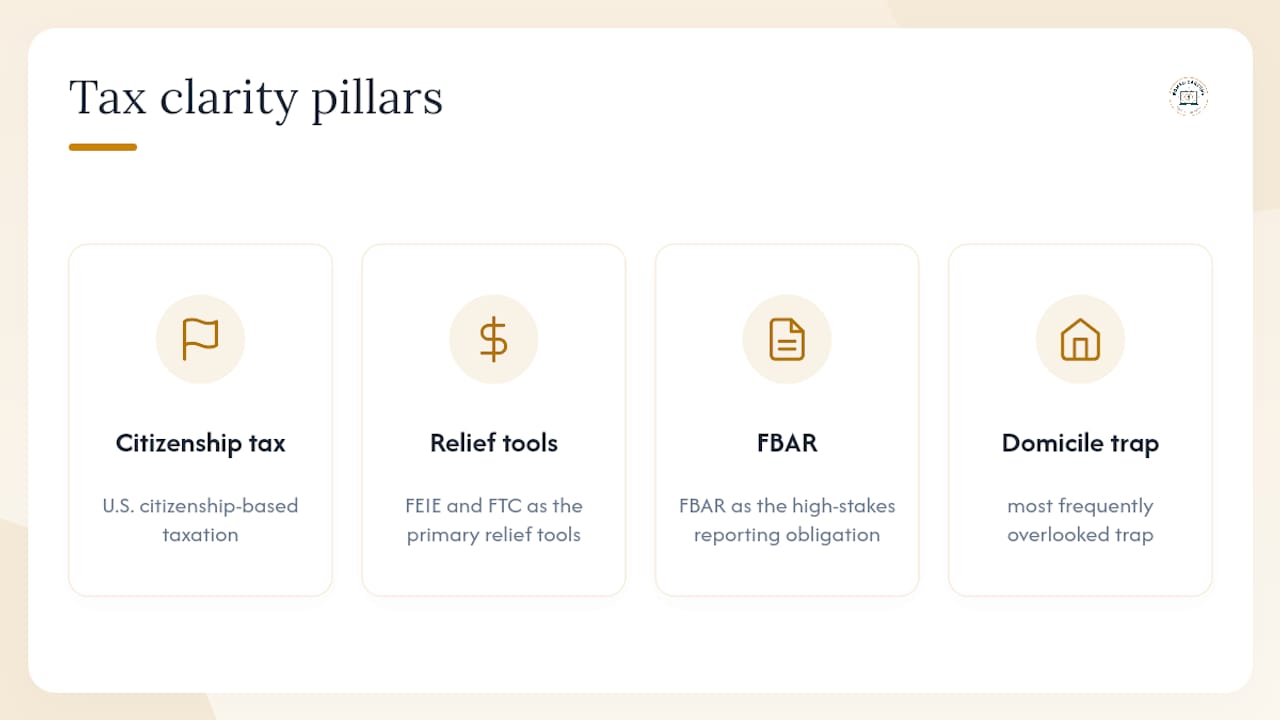
Tax uncertainty is one of the most common reasons remote workers pull back from full nomad life before they ever get started. The rules are genuinely complex, but they are also navigable once you understand the structure: U.S. citizenship-based taxation, FEIE and FTC as the primary relief tools, FBAR as the high-stakes reporting obligation, and state domicile as the most frequently overlooked trap.
At Nomadcareers, we see this pattern repeatedly. Nomads who thrive long-term are not necessarily the ones with the lowest tax bills. They are the ones who understand their obligations clearly, plan around them, and choose employers and destinations that make compliance manageable. That is why Nomadcareers manually verifies every job listing for genuine work-from-anywhere eligibility and provides resources covering visas, banking, and mobility alongside the job board itself.
If you are still building your remote career foundation, the how to become a digital nomad guide covers the broader transition, including domicile planning and employer selection, in a step-by-step format.
Sources
Primary IRS and FinCEN guidance:
-
Remote workers may face state tax obligations in both their state of residence and the state where their employer is based. While state reciprocity agreements exist (taxing income only in the state of residence), they only cover 30 agreements across 16 states and the District of Columbia. Without a reciprocity agreement, you might need to file in both states and utilize a credit for taxes paid to another state to avoid double taxation. — Tax Foundation
-
Digital nomad taxes - working remotely while traveling — Fidelity
-
Digital Nomad Taxes: FEIE, FBAR & State Tax (2026) — ClearedExpat
-
Taxing remote workers: convenience, conflict, and courts — Tax Policy Center
-
How and Where Do Remote Workers Pay Taxes? — Rippling
State and remote-work tax policy:
Practitioner and specialist resources:
This article is general information, not a substitute for advice from a qualified financial advisor. Consult a qualified financial professional about your own circumstances before acting on anything here.