Nine Asian countries currently run a workable digital nomad visa program: Thailand, Malaysia, Indonesia, Japan, South Korea, Sri Lanka, Taiwan, Kazakhstan, and Kyrgyzstan. The Philippines still has no dedicated nomad visa as of 2026. For most remote workers, Thailand’s Destination Thailand Visa is the strongest all-round option, combining a five-year validity window with a manageable savings threshold. Before applying anywhere, check three things first: your income or savings eligibility, how long the visa actually lasts and whether it renews, and what triggers local tax residency.
TL;DR:
- Thailand’s Destination Thailand Visa offers a five-year validity with 180-day stay entries, requiring 500,000 THB in savings and no work permissions for local employers.
- Malaysia’s DE Rantau Nomad Pass allows stays of up to 24 months with dependents and a flexible income threshold, typically around $24,000 annually.
- Indonesia’s remote-work routes and Bali-focused visas have shifting requirements, so applicants should verify current policies directly with immigration authorities.
- Japan’s Designated Activities visa permits up to six months for high earners, but cannot be renewed or extended beyond the initial stay.
- South Korea’s F-1-D visa is limited to approximately one year, with a tax residency risk for stays approaching 183 days in a calendar year.
Asia Digital Nomad Visas: Country-By-Country Requirements
Each program below sets its own bar for income, savings, and paperwork. Some are fully digital; others still require a trip to an embassy or immigration office. Here is what each one actually asks of you.
Thailand: Destination Thailand Visa (DTV)
Thailand’s DTV is built for remote workers, freelancers, and people pursuing “soft power” activities like Muay Thai training or culinary courses. Applicants need 500,000 Thai baht in savings, pay a 10,000 baht application fee, and receive five years of visa validity with entries allowing 180-day stays each time.
- Eligibility: 500,000 THB in savings, no minimum age specified.
- Validity: Five years, with each entry granting a 180-day stay (extendable once for another 180 days per entry).
- Fee: 10,000 THB.
- Dependents: Spouses and children can apply on the same visa category.
- Application method: Entirely online through Thailand’s e-visa portal.
- Who it fits: Freelancers and remote employees who want the longest runway with the least bureaucratic friction.
The DTV does not grant permission to work for a Thai employer or take local-market income, so keep your income streams foreign-sourced.
Malaysia: DE Rantau Nomad Pass
Malaysia’s DE Rantau Nomad Pass is a Professional Visit Pass rather than a standalone visa category, and it welcomes both tech and non-tech remote professionals. Stays run 3 to 12 months, renewable for another 12 months, for a maximum of 24 months total.
- Eligibility: Income guidance varies by applicant track, with some categories referencing thresholds around $24,000 annually.
- Validity: 3 to 12 months, renewable once for up to 24 months total.
- Dependents: DE Rantau explicitly allows spouses and children to join under a dependent pass.
- Application method: Online through the MDEC portal.
- Who it fits: Nomads who want a clear family pathway and don’t mind a shorter initial grant with a renewal step.
Malaysia’s dependent provisions are among the clearest in the region, which is part of why it pairs so often with Thailand’s DTV in nomad shortlists.
Indonesia: Remote Worker and Bali-Linked Routes
Indonesia has floated a dedicated remote-worker visa for several years, and various Bali-focused pathways (including longer-stay visit visas that tolerate remote income) have filled the gap in practice. Immigration policy here shifts often enough that anyone relying on Indonesia as a base should verify current rules directly with the Directorate General of Immigration rather than a secondhand source, and consider working with a local visa agent given how frequently local requirements move. Applicants who need a deeper walkthrough of Indonesian permit categories, including the KITAS residence permit that some remote workers use as an alternative route, can find procedural detail in Bizsquare’s KITAS application guide.
Japan: Designated Activities Status
Japan’s version of a nomad visa is a “Designated Activities” residence status rather than a purpose-built nomad category. It permits stays of up to six months for people performing remote work for a foreign employer, but the income bar is steep.
- Eligibility: Annual income expectations run high, with guidance pointing toward figures around 10 million yen for some specified visa tracks.
- Validity: Up to six months, not renewable in-country under this status.
- Dependents: Spouses can generally accompany the primary applicant under a related dependent status.
- Application method: Through a Japanese consulate or embassy; not a pure online process.
- Who it fits: High earners who want a taste of Japan without committing to a long-term residency track.
Because the six-month window can’t be renewed from inside Japan, treat this as a single extended stay rather than a repeatable annual routine.
South Korea: F-1-D Workation Visa
South Korea’s F-1-D “Workation” visa targets remote employees and freelancers who want an extended stay without switching employers. The bigger issue for most applicants isn’t eligibility. It’s the tax clock.
- Eligibility: Proof of remote employment or freelance contracts with foreign clients, plus income documentation.
- Validity: Typically issued for up to a year, with visa specifics subject to change by South Korean immigration authorities.
- Tax caution: Stays approaching 183 days in a calendar year can trigger South Korean tax residency, which pulls your global income into their tax system.
- Application method: Through a South Korean consulate.
- Who it fits: Nomads planning a shorter stint who structure their calendar to stay well under the 183-day mark.
If you’re weighing a full year in Korea, talk to a cross-border tax advisor before you book flights, not after.
Sri Lanka: Digital Nomad Visa
Sri Lanka’s Digital Nomad Visa is one of the newest entries and one of the more demanding on documentation. It requires a minimum monthly remittance of $2,000 for the primary applicant, an annual fee of $500, and currently runs as a one-year visa renewable annually.
- Eligibility: $2,000 monthly remittance to a Sri Lankan bank account, plus police clearance and a medical report.
- Validity: One year, renewable annually.
- Fee: $500 per year.
- Application method: Documentation-heavy, and the program currently expects some steps to be handled in person rather than fully online.
- Who it fits: Nomads comfortable setting up local banking infrastructure ahead of time and willing to tolerate more manual processing than Thailand or Malaysia require.
The remittance requirement trips up a lot of freelancers paid through platforms or in multiple currencies, since immigration wants to see money landing in a Sri Lankan account, not just sitting in a foreign one.
Taiwan: Digital Nomad Visa Registration
Taiwan’s digital nomad scheme launched in January 2025 and offers stays of up to two years, making it one of the longest single-grant windows in the region. Eligibility runs on tiers: younger applicants and first-time nomads face different income thresholds than experienced nomads with an established remote work history.
- Eligibility: Tiered by age and prior nomad experience; specific income documentation varies by tier.
- Validity: Up to two years.
- Application method: Online registration through Taiwan’s official digital nomad portal.
- Who it fits: Nomads who want long-term stability without committing to Taiwan’s separate Employment Gold Card, which targets a different (more permanent) category of skilled foreign worker.
Taiwan’s program is young enough that documentation requirements may tighten as the government refines it, so applying sooner rather than later can mean a simpler process.
Kazakhstan: Neo Nomad Visa
Kazakhstan’s Neo Nomad Visa opened a lesser-known but genuinely useful door into Central Asia for remote workers. Details on income thresholds and renewal terms are less standardized in public government messaging than Thailand’s or Malaysia’s programs, so applicants should confirm current figures directly with Kazakh consular authorities before planning a move.
Kyrgyzstan: Digital Nomad Visa
Kyrgyzstan also runs a digital nomad visa track aimed at remote workers and freelancers, positioning itself as one of the more affordable and accessible entries into the region. As with Kazakhstan, official published thresholds are harder to pin down publicly, and newer Central Asian programs like this one tend to launch with more manual, in-person steps that may get streamlined over time.
Philippines: No Dedicated Nomad Visa Yet
The Philippines has discussed a digital nomad visa in legislative sessions for several years without finalizing one as of 2026. Remote workers currently basing themselves in the Philippines typically rely on tourist visa extensions or other existing categories, neither of which was designed with remote income in mind. Anyone counting on a Philippine option should treat it as pending, not available, until an official program launches.
Comparing Asia’s Digital Nomad Visas Side By Side
The programs above differ most on three axes: how much money you need to prove, how long you get to stay, and whether your stay quietly turns you into a local taxpayer.
The real decision driver isn’t the fee, it’s the tax clock. South Korea’s F-1-D and any stay elsewhere pushing past roughly 183 days in a calendar year can trigger local tax residency, pulling your worldwide income into that country’s tax system regardless of how affordable the visa itself looked on paper.
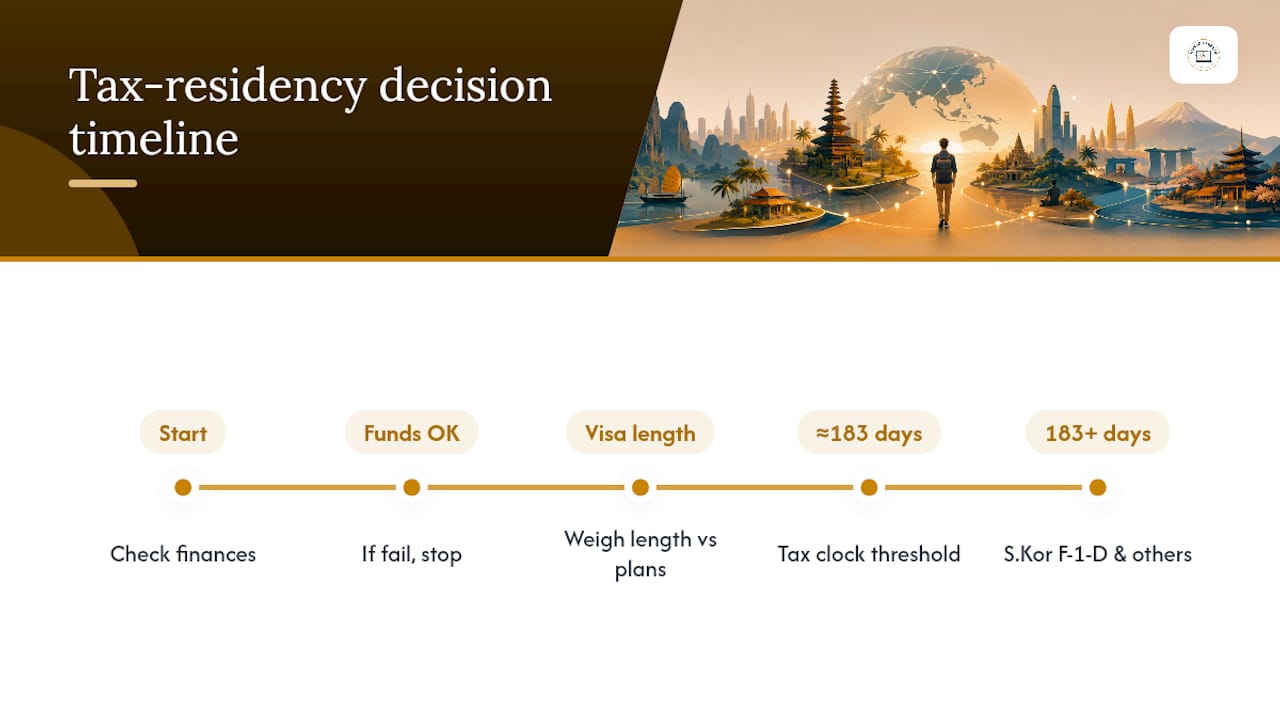
Read this table by working backward from your own numbers first. If you can’t clear a country’s income or savings bar, the rest of the row is irrelevant. Among the countries that do fit your finances, weigh validity length against your actual travel plans, then check the tax trigger line before you commit to a stay long enough to matter.
How Do You Choose the Right Asian Nomad Visa?
Matching yourself to a visa comes down to five checks, run in this order:
- Eligibility certainty. Confirm you can document the exact savings or income figure required, not an approximation.
- Family needs. If you’re relocating with a spouse or kids, prioritize programs with confirmed dependent pathways, like Malaysia’s DE Rantau or Thailand’s DTV.
- Duration fit. Match the visa’s validity to how long you actually intend to stay, not the maximum theoretically available.
- Tax exposure. Map your planned days in-country against that country’s residency trigger, generally in the 183-day range.
- Application logistics. Weigh online-only processes against programs requiring embassy visits or in-person document submission.
Common red flags worth avoiding: tax traps from underestimating how long you’ll actually stay, manual-only application steps that stretch timelines without warning, health insurance that doesn’t meet the visa’s minimum coverage requirement, and a passport with too little validity remaining, since most programs want at least six months of runway on your passport at the time of application.
Three quick scenarios:
- The solo freelancer testing a base: Thailand’s DTV fits best. Five years of validity means you’re not reapplying every few months while you figure out if a location works.
- A family relocating together: Malaysia’s DE Rantau offers the clearest dependent structure, even with its shorter initial grant.
- A high-income urban nomad: Japan’s Designated Activities status suits someone who clears the income bar easily and wants a short, high-quality stay rather than a long-term base.
Pro Tip: Apply for the visa with the longer validity window first if you’re choosing between two you qualify for equally. Reapplying costs time you could spend working, not just money.
What Documents Do You Need to Apply?
Most Asian nomad visa applications converge on a similar document set, even though the exact combination varies by country.
- Valid passport with at least six months of remaining validity.
- Bank statements proving savings or income over the required period (often three to six months of history).
- Proof of foreign-sourced income, such as employment contracts or freelance invoices.
- Health insurance meeting the destination’s minimum coverage requirement.
- Proof of accommodation, ideally a signed lease rather than a cancellable hotel booking, since immigration officers frequently expect the former.
- Police clearance and medical reports, required for programs like Sri Lanka’s DNV.
Build in lead time. Online programs like Thailand’s DTV can move quickly once documents are ready, but manual programs like Sri Lanka’s DNV or newer Central Asian visas can take weeks longer due to in-person steps. If your target program requires remittance to a local bank account, open that account and complete at least one incoming transfer before you submit anything. Immigration officers reviewing remittance-based applications often ask for proof the account is already active, and a missing transfer history is one of the most common causes of delay. Budget for fees ranging from roughly $500 (Sri Lanka’s annual fee) up to whatever Malaysia’s specific track requires, plus health insurance premiums and a housing deposit that could run one to three months of rent depending on the market.
Cost of Living Across Asia’s Nomad Destinations
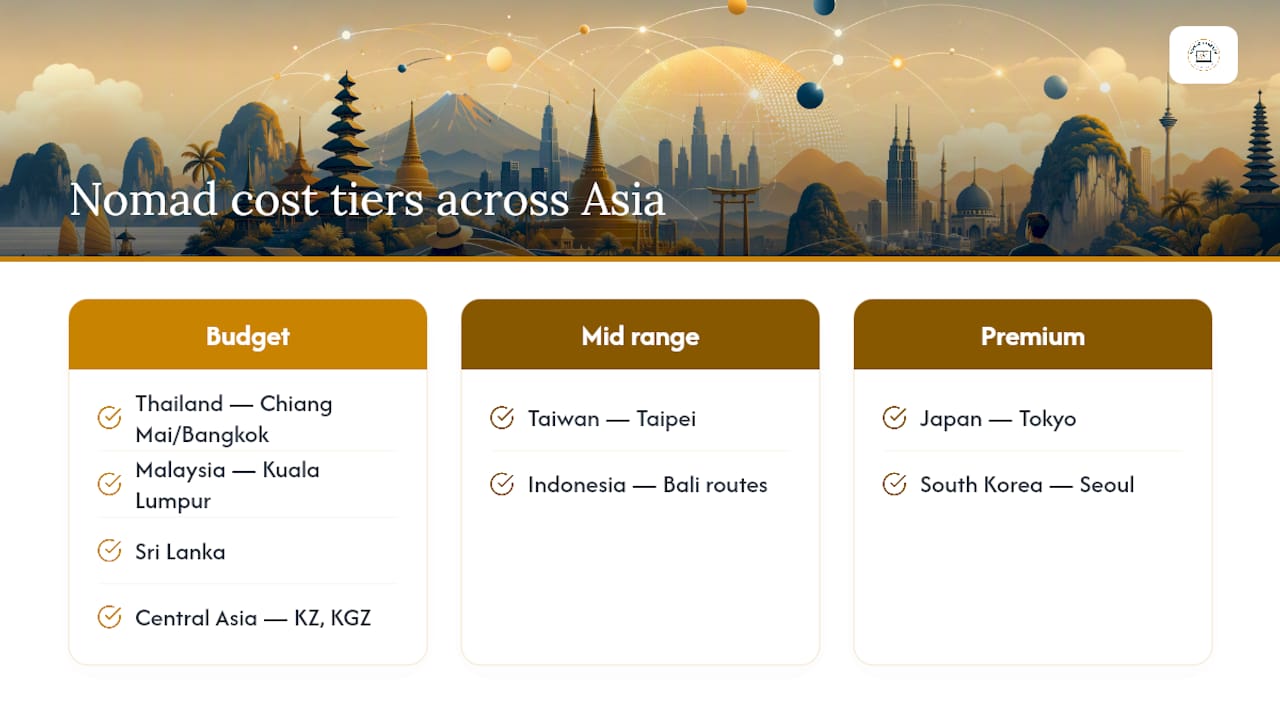
Thailand and Malaysia remain the budget leaders among live nomad visa countries, with Thailand’s second-tier cities like Chiang Mai often running cheaper than Bangkok while still offering strong nomad infrastructure. Malaysia’s Kuala Lumpur delivers a similar value proposition, with rents and dining costs well below regional hubs like Tokyo or Seoul.
Japan and South Korea sit at the opposite end. Tokyo and Seoul carry costs closer to Western European capitals, which makes sense given their income eligibility thresholds are also the steepest in this roundup. Taiwan lands in the middle, with Taipei more affordable than Tokyo but pricier than Southeast Asian capitals.
Sri Lanka and the Central Asian entries (Kazakhstan, Kyrgyzstan) tend toward the lower end of the cost spectrum, though infrastructure and amenity availability vary more by neighborhood than in the more established nomad hubs. Bali-linked routes in Indonesia remain a perennial value pick for nomads who don’t need visa certainty as urgently as income efficiency.
Match your visa choice to your budget realistically. A high validity window in an expensive city can cost more over its lifespan than a shorter stay somewhere cheaper, even after factoring in reapplication fees.
How Good Is Internet Access in Each Country?
Connectivity quality varies more by city than by country across this list. Bangkok, Chiang Mai, Kuala Lumpur, Taipei, and Seoul all deliver fast, reliable broadband and mobile data suitable for video calls and heavy remote work without much friction.
Tokyo’s infrastructure is excellent, though coworking space density outside major business districts can be thinner than in Bangkok or Kuala Lumpur. Sri Lanka’s connectivity has improved substantially in Colombo and coastal nomad hubs like Ella, but rural stretches still lag behind Southeast Asia’s urban centers.
Kazakhstan and Kyrgyzstan present more variability. Almaty and Bishkek offer workable urban connectivity, but infrastructure thins out quickly outside capital regions, which matters if your visa plans involve exploring beyond the main cities. Indonesia’s Bali-linked routes benefit from years of nomad-driven demand pushing coworking and fiber infrastructure investment in areas like Canggu and Ubud, even without a dedicated visa backing that growth.
If your work depends on consistent video calls, prioritize cities with established nomad communities over ones with cheaper rent but thinner digital infrastructure.
Is It Safe to Live and Work in These Countries?
Thailand, Malaysia, Taiwan, Japan, and South Korea all rank among the more predictable destinations for foreign remote workers, with established expat communities and cultural norms that are generally welcoming to long-term visitors. Petty theft and scooter accidents remain the most common practical risks in Southeast Asian hubs, more than any serious crime concern.
Sri Lanka’s nomad-friendly regions, particularly around Colombo and the southern coast, are generally safe but recovering from economic volatility that occasionally affects prices and services. Cultural norms across the region reward a bit of homework. Dress modestly at temples in Thailand, respect Ramadan-related business hours if your Malaysia stay overlaps with it, and expect a more conservative baseline in Sri Lanka than in Bali’s nomad enclaves.
Kazakhstan and Kyrgyzstan are less trodden by long-term nomads, which means fewer English-speaking services outside capital cities but also fewer of the tourist-driven friction points that show up in more saturated hubs. A little cultural research before arrival, especially around local customs and appropriate dress, goes a long way toward smoother interactions with landlords, immigration officers, and neighbors alike.
Meet Visa Income Requirements With Verified Remote Work
Every program on this list shares one requirement underneath the paperwork: proof that your income is real, foreign-sourced, and stable enough to sustain your stay. That’s harder than it sounds when your current job is unstable, underpaid, or not actually remote-friendly despite the title.
Nomadcareers exists for exactly that gap. Every listing on the platform is manually verified as a genuine work-from-anywhere role, which means the income documentation you’d submit for Thailand’s DTV or Malaysia’s DE Rantau comes from an employer relationship that’s already been checked for legitimacy rather than a listing that turned out to be a scam or a hybrid role in disguise. Browse verified remote job listings to find roles that match the income thresholds these visas require, and if you want faster access to new postings and application tools, the Nomad Pro plans start with a 7-day trial before moving to $9.99 a month or $69.99 a year. Start by checking current listings against the savings and income figures in the comparison table above, and apply to roles that give you documentation you can actually hand to an immigration officer.
Where This Information Comes From
Every eligibility figure, fee, and validity window in this guide traces back to a government or immigration source, not a secondhand summary.
- Immigration Bureau of Thailand — Destination Thailand Visa (DTV)
- Taiwan Digital Nomad Visa registration (official)
- Sri Lanka Digital Nomad Visa Category — Department of Immigration & Emigration (PDF)
- DE Rantau — MDEC
- Ministry of Justice (Japan) — Status of Residence of “Designated Activities” (Digital Nomad)
Rules on these programs shift, sometimes without much public notice, so check the relevant official page again in the weeks before you actually submit an application.
Sources
- Immigration Bureau of Thailand — Destination Thailand Visa (DTV)
- Taiwan Digital Nomad Visa registration (official)
- Sri Lanka Digital Nomad Visa Category — Department of Immigration & Emigration (PDF)
- DE Rantau — MDEC
- Ministry of Justice (Japan) — Status of Residence of ‘Designated Activities’ (Digital Nomad)
FAQ
Which Country Has the Easiest Digital Nomad Visa in Asia?
Thailand’s Destination Thailand Visa is generally considered the most accessible, thanks to its fully online application, moderate 500,000 THB savings requirement, and five-year validity. Malaysia’s DE Rantau runs a close second, especially for applicants who want a confirmed dependent pathway.
Which Asian Countries Will Offer Digital Nomad Visas in 2026?
As of 2026, live programs include Thailand, Malaysia, Indonesia (through Bali-linked routes rather than a dedicated visa), Japan, South Korea, Sri Lanka, Taiwan, Kazakhstan, and Kyrgyzstan. The Philippines has discussed a dedicated program but has not launched one yet.
How Much Money Do You Need for a Digital Nomad Visa in Asia?
Requirements vary widely: Thailand’s DTV asks for 500,000 THB in savings, Sri Lanka requires a $2,000 monthly remittance, and Japan’s Designated Activities status expects annual income near 10 million yen for some tracks. Always check the exact figure against your specific visa category before applying.
Can US Citizens Get Digital Nomad Visas in Asia?
Yes, US citizens are eligible for every program covered in this guide, provided they meet the income, savings, and documentation requirements each country sets. None of these visas restrict eligibility by nationality beyond standard passport validity rules.
What Nomad Careers Offers Besides Visa Information
Nomadcareers runs a job board of manually verified, work-from-anywhere positions along with resources on visas, taxes, banking, and insurance for remote workers. Current pricing and plan details, including the Nomad Pro trial and paid tiers, are listed on the site.