Croatia offers the region’s most formal digital nomad permit, Serbia gives you a practical entrepreneur-based residence route, and Bulgaria has announced a new long-stay program worth checking before you commit elsewhere. Most other Balkan countries still rely on 90-day visa-free stays rather than dedicated permits. Start by opening the official immigration page for whichever country fits your income and timeline, then gather your bank statements and criminal-record certificate before you apply.
TL;DR:
- Serbia allows entrepreneurs to apply for residency by registering as a sole proprietor, with processing times typically between 30 and 60 days and lower taxes for small-scale business owners.
- Bulgaria is preparing a two-year long-stay visa, but applicants must verify eligibility and timing directly with official consular resources due to unsettled details.
- Most Balkan countries outside Schengen rely on 90-day visa-free stays, but Croatia’s permit exempts you from the Schengen 90-day limit, enabling rotation between countries for up to a year.
- Essential application documents include proof of remote income, six months of financial statements, health insurance, a criminal record certificate, and proof of accommodation, with additional registration steps in Croatia, Serbia, and Bulgaria.
Digital Nomad Visa Balkans: Schengen vs Non-Schengen Explained
Understanding your 90-day clock matters more in the Balkans than almost anywhere else in Europe, because the region splits between Schengen members and countries that run their own separate entry rules. Croatia is inside Schengen, so time spent there counts against your 90-out-of-180-day Schengen allowance. Serbia, Albania, North Macedonia, Kosovo, and Bosnia and Herzegovina sit outside Schengen, and many Western passport holders get a separate 90-day visa-free allowance there that runs on its own independent clock.
That separation is what makes the region genuinely useful for mobile workers:
- Burn through your Schengen 90 days, then cross into Serbia or Albania and start a fresh 90-day non-Schengen window.
- Use Croatia’s formal digital nomad permit specifically to bypass the Schengen countdown while staying inside the EU.
- Treat Bosnia and Herzegovina or Albania as low-cost bases between formal visa applications elsewhere.
This dual-track system is why a Balkans-based rotation strategy can stretch a full year of legal stay without a single formal visa, though it takes real calendar discipline to avoid overstaying either clock.
Which Balkan Countries Offer a Digital Nomad Visa?
Five countries dominate the conversation, and each works differently enough that picking the wrong one can cost you months.
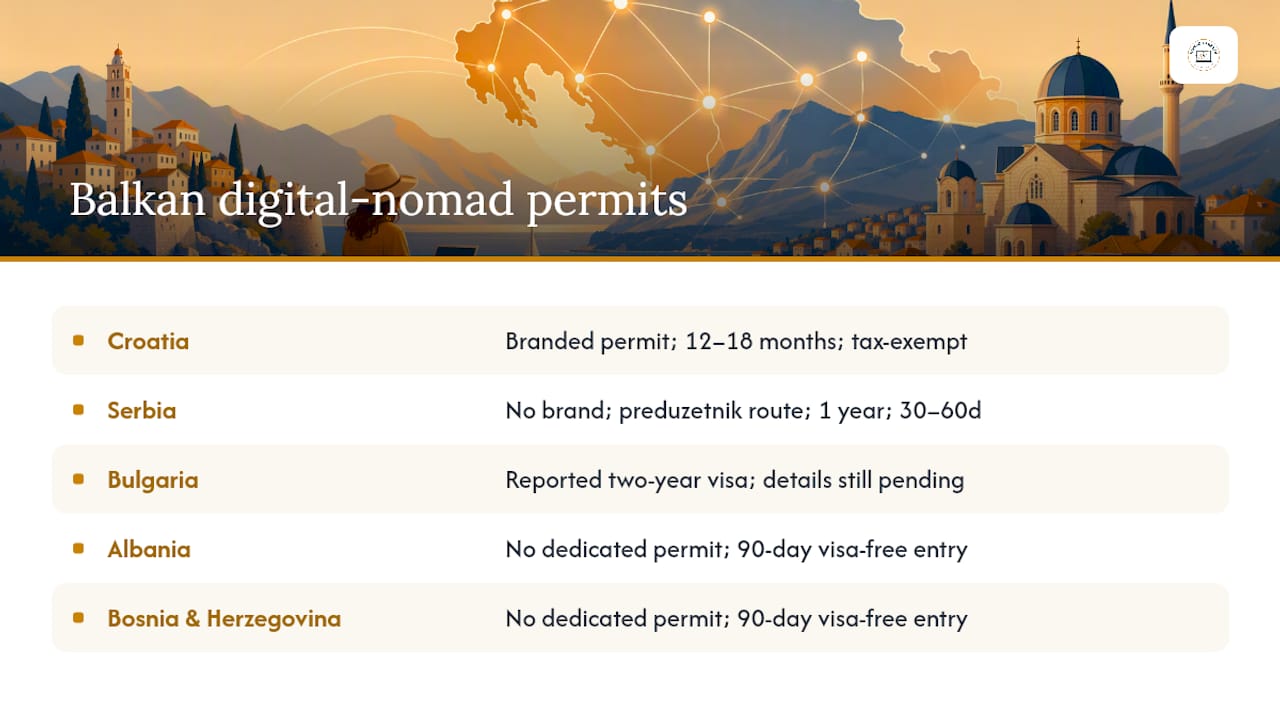
Croatia runs the region’s only fully branded digital nomad residence permit. You need income at 2.5 times the average net monthly salary, which lands at €3,622.50 per month in 2026, or lump-sum savings of €43,470 for a 12-month stay. The permit runs up to 18 months total, but Croatia enforces a mandatory cooling-off period of several months once it expires, meaning you cannot simply renew back-to-back. Foreign-sourced salary earned while on the permit is exempt from Croatian income tax, and applications go through Croatia’s Ministry of Interior (MUP) portal, where you also register your temporary address.
Serbia skips the branded marketing entirely. Instead, most nomads register as a preduzetnik, a sole entrepreneur, then use that registration as the legal basis for a temporary residence permit. This route can often be initiated remotely through a power of attorney, which matters if you don’t have a Serbian address yet. Residence is typically issued for up to a year and renewable, with flat-tax rates that make small-scale entrepreneurship cheap. Processing commonly runs 30 to 60 days.
Bulgaria entered the conversation with a reported two-year long-stay visa aimed at remote workers, positioned as one of the more affordable EU nomad options. Details are still settling, so confirm eligibility and launch timing directly with Bulgaria’s consular pages before assuming the program applies to your situation.
Albania and Bosnia and Herzegovina have no dedicated digital nomad permit as of this writing. Both rely on 90-day visa-free entry for most Western passports. If you want to stay longer, your realistic options are registering a local business or applying for a standard residence permit unrelated to remote work, neither of which is designed with nomads in mind.
What Documents Do You Need for a Balkan Digital Nomad Visa?
Applications across the region ask for a fairly consistent document set, though the exact combination and translation requirements shift by country.
- Proof of remote employment or freelance income — an employment contract, client agreements, or company registration documents showing your work is performed for a business outside the country you’re applying to.
- Financial evidence — typically six months of bank statements or payslips demonstrating you meet the income or savings threshold.
- Health insurance — a policy valid for the full length of your intended permit, covering the specific country, not just travel insurance with vague regional coverage.
- Criminal-record certificate — usually apostilled and, in Croatia’s case, translated by an authorized translator before submission.
- Proof of accommodation and address registration — Croatia requires you to register your temporary residence address with local authorities shortly after arrival, a step that trips up applicants who assume a hotel booking alone is sufficient.
Serbia and Bulgaria layer on their own registration steps, so treat this list as a baseline, not a final checklist. A tool like international banking documentation can help you organize the statements most immigration officers expect to see.
How Does Visa Status Affect Your Taxes?
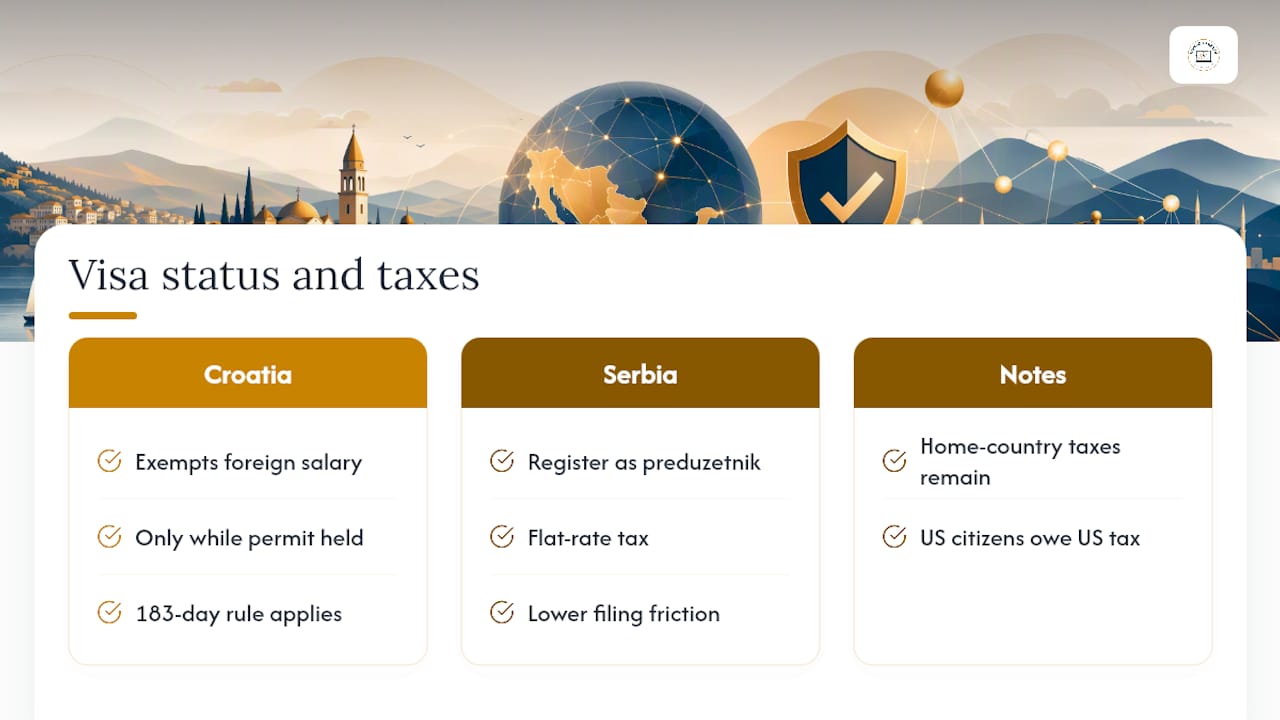
Your permit type and how long you stay both determine what you owe, and the two countries with the clearest rules sit at opposite ends of the spectrum. Croatia gives digital nomad permit holders a categorical exemption from Croatian income tax on foreign-sourced salary, which is the single biggest draw of the program. That exemption applies only while you hold the permit, and spending more than 183 days in Croatia under other circumstances can trigger standard tax residency rules regardless of your visa status.
Serbia works differently. Registering as a preduzetnik opens you up to flat-rate taxation designed for small entrepreneurs, which tends to be lower friction than filing as a foreign employee. Neither country’s exemption erases your home-country obligations. US citizens in particular still owe federal taxes on worldwide income no matter where they’re based, so check with a tax professional before assuming a Balkan exemption solves everything.
How Long Does the Application Take and What Does It Cost?
Croatia’s process moves through the MUP system with biometric card issuance following approval, while Serbia’s entrepreneur-plus-residence route commonly clears in 30 to 60 days. Fees vary by country and change often enough that you should confirm the current schedule on the relevant government page rather than trust a secondhand number.
The mistakes that cause real delays are avoidable:
- Submitting a criminal-record certificate without the required apostille or authorized translation.
- Missing Croatia’s address registration window after arrival, which can stall your biometric card.
- Assuming you can take on local clients while on a permit designed strictly for foreign-sourced income.
What Should You Do Three Months Before Applying?
Give yourself a real runway. Immigration paperwork in this region rewards patience and punishes last-minute scrambling.
- Confirm whether your passport qualifies for 90-day visa-free entry or whether you need a D visa before travel.
- Pull six months of bank statements or income documentation matching your target country’s threshold.
- Start your criminal-record check and apostille process immediately. It’s often the slowest step.
- Book temporary accommodation you can use for address registration on arrival.
- Purchase private health insurance valid for your full intended stay.
- Order certified translations for any document not already in the local language.
Pro Tip: Set a calendar reminder for your permit’s cooling-off date the moment you receive approval. Croatia’s six-month gap after an 18-month stay catches people off guard because the clock starts from expiry, not from when you actually leave.
How We Verified This Guide
We prioritized official government portals and 2026 program updates, cross-checked against lawyer guides for Croatia and Serbia, and Nomadcareers verified every linked resource before publishing.
Need Proof of Remote Income for Your Application?
Every Balkan permit above hinges on one thing: documented proof that you work remotely for a company or clients outside the country you’re moving to. Nomadcareers is built around that exact problem. Every listing is manually verified before it goes live, so the job offer or contract you use to support your application is backed by a real, checked employer rather than a posting that vanishes when an immigration officer calls to confirm it.
If you’re still job hunting before you apply, browse verified remote work-from-anywhere jobs directly on Nomadcareers, or check the remote resume guide to strengthen the employment documentation your visa file will need. Employers hiring for Balkan-friendly remote roles can also post a verified job listing to reach nomads actively searching for exactly this kind of opportunity.
Where to Confirm the Latest Rules
- Croatia’s MUP digital nomad page for current income thresholds and permit terms.
- Serbia’s official Welcome to Serbia guidance for entrepreneur registration and residence steps.
- The Balkan Guide’s regional overview for non-Schengen visa-free mobility rules.