An employer of record (EOR) is a third-party organization that becomes the legal employer of your workers, handling payroll, taxes, benefits, and local compliance so your company can hire in new countries or states without setting up a local entity. It benefits businesses expanding across borders, testing new markets, or hiring one employee in a country where forming a subsidiary would take months and cost far more than the hire is worth.
TL;DR:
An EOR is ideal when you need quick international employment without establishing a local entity, especially for pilot projects or urgent hires.
The EOR handles payroll, taxes, benefits, and compliance, but you retain daily management and supervision of employee work.
Costs vary with country and headcount, generally favoring small numbers in one country but potentially becoming more expensive as scale grows.
Choosing a reputable provider requires verifying legal entity registration, understanding full costs, and reviewing their compliance scope and track record.
An EOR is most suitable for short-term, small-scale, or immediate international staffing needs in markets where entity formation is not justified.
Table of Contents
- What Is an Employer of Record and How Does the Relationship Work?
- What Does an Employer of Record Actually Handle?
- How Does an Employer of Record Work in Practice?
- Employer of Record vs. PEO, Staffing Agencies, and Contractors
- What Are the Benefits of Using an Employer of Record?
- Where Does an Employer of Record Fall Short?
- When Should You Actually Use an Employer of Record?
- How Do You Choose the Right Employer of Record?
- What Do Employer of Record Services Cost, and How Long Does Setup Take?
- Is an Employer of Record the Right Move for Your Company?
- Sources
What Is an Employer of Record and How Does the Relationship Work?
Once you understand what an employer of record actually is, the mechanics come down to a three-way relationship. The EOR is the legal employer on paper. It appears on the employment contract, the payroll registration, and every government filing tied to that worker. Your company, the client, keeps full control over what the person does day to day: assigning work, setting goals, running performance reviews. The employee shows up, does the job for your team, and never has to think twice about which entity technically signs their paycheck.
This structure differs sharply from co-employment models. An EOR acts as the sole legal employer, not a co-employer sharing liability with the client. That distinction matters when disputes arise over termination, benefits, or tax withholding. The EOR handles backend employment administration while the client retains daily managerial control, a split that keeps you in charge of the work without inheriting the legal exposure of local employment law.
Don’t confuse an EOR with a payroll vendor or a broker. A payroll vendor processes paychecks for employees you already legally employ. An EOR is the legal employer. It carries the liability, not just the paperwork.
What Does an Employer of Record Actually Handle?
The value of an EOR is really a checklist of administrative burdens it takes off your plate. By handling these functions, the EOR absorbs the regulatory risk that would otherwise fall on a company with no local legal presence.
-
Payroll processing, tax withholding, and filings. The EOR calculates gross-to-net pay, withholds income tax and social contributions, and files everything with the correct local tax authority on schedule.
-
Statutory and voluntary benefits administration. This covers mandated items like paid leave, pension contributions, and health coverage, plus voluntary perks your company wants to offer to stay competitive.
-
Compliant local employment contracts and onboarding. Contract templates get built around each country’s labor code, covering notice periods, probation rules, and termination clauses that a generic U.S.-style offer letter would miss entirely.
-
Workers’ compensation, unemployment claims, and local filings. When something goes wrong, whether it’s a workplace injury or a layoff, the EOR manages the claim process according to local rules.
-
Ongoing compliance monitoring and recordkeeping. Labor laws change. A good EOR tracks amendments to minimum wage, leave entitlements, and reporting requirements so you don’t find out about a new rule after you’ve violated it.
The scope here isn’t a checkbox exercise. By mid-2026, the primary roles of an EOR span payroll, tax withholding, statutory benefits, compliant contracts, and ongoing labor-law compliance monitoring, which is a fuller mandate than most first-time buyers expect.
Pro Tip: Ask a prospective EOR exactly which filings they submit under their own entity versus which ones still require action from your internal payroll or legal team. Some providers quietly leave gaps in secondary filings, like local business registrations tied to remote work locations.
How Does an Employer of Record Work in Practice?
The sequence from sourcing a candidate to full onboarding follows a fairly predictable path, even though the specific paperwork changes by country.
-
You source and select the candidate. Recruiting, interviewing, and the hiring decision stay entirely with your team; the EOR isn’t involved in this stage.
-
You extend a compliant local offer. The EOR reviews compensation and benefit terms against local labor law before the offer goes out, catching mismatches like an unpaid probation period that isn’t legal in that jurisdiction.
-
The EOR drafts the contract and collects documentation. This includes tax IDs, bank details, and any work authorization documents required for the role.
-
The EOR runs onboarding and becomes the legal employer of record. From this point, payroll and benefits administration run through the EOR’s registered entity in that country.
-
Payroll and benefits go live on a recurring cycle. The EOR manages the ongoing withholding, contributions, and statutory reporting for as long as the employment continues.
-
Your team manages performance day to day. Goal-setting, feedback, promotions, and culture stay under your direct oversight throughout.
-
Offboarding or transfer happens when the relationship ends. If you eventually open a local entity, the EOR can often transfer the employee’s contract over without a gap in employment.
Expect the administrative front end, contract drafting and tax registration, to take longer than most teams assume. HR leaders should plan extra lead time for country-specific setup tasks even when the EOR is handling the heavy lifting.
Employer of Record vs. PEO, Staffing Agencies, and Contractors
Picking the wrong employment model is one of the most common and expensive mistakes companies make when they expand internationally. Each option trades off legal exposure, control, and speed differently.
A PEO (professional employer organization) creates co-employment: you and the PEO share legal responsibility for the worker, and the PEO typically requires you to already have a registered entity in that state or country. An EOR, by contrast, is the sole legal employer, which is why it works in places you have no entity at all.
Staffing agencies or leased employees suit short-term or project-based labor where the worker is fundamentally the agency’s employee on a temporary assignment, not someone you’re trying to integrate into your core team long-term.
Independent contractors seem like the fastest, cheapest option until misclassification becomes the problem. Government guidance on independent contractor status versus employee status exists precisely because companies routinely misjudge this line, and the penalties for getting it wrong can include back taxes, fines, and benefit liabilities.
A quick decision checklist:
-
Need a legal employer in a country where you have no entity? Choose an EOR.
-
Already have a local entity and just need HR outsourcing? A PEO may fit.
-
Need short-term, project-based labor? A staffing agency works.
-
Hiring someone who sets their own hours, uses their own tools, and serves other clients? A contractor relationship may be appropriate, but verify it against local classification rules first.
What Are the Benefits of Using an Employer of Record?
Speed is the headline advantage. Forming a legal entity abroad can take significant time and cost in legal and accounting fees before you’ve hired a single person. An EOR lets you hire quickly without forming local entities, often putting someone on payroll within days or a few weeks depending on the country.
Reduced compliance risk follows close behind. The EOR model shifts legal employment risk to the provider while the client keeps control over day-to-day work, which is exactly why it appeals to companies running international pilots or hiring a single employee in a new market.
You also get access to localized benefits administration that would otherwise require hiring local HR expertise or outside counsel in every country. And internally, your team stays focused on recruiting, managing, and growing people instead of chasing tax registrations and statutory filing deadlines across a dozen jurisdictions.
Where Does an Employer of Record Fall Short?
No model is free of trade-offs, and an EOR has real ones worth weighing before you sign a contract.
Cost is the biggest one. At small headcounts in a single country, an EOR is almost always cheaper than forming an entity. However, scale past a certain number of employees in that same country, and the EOR’s per-employee fee can exceed what a locally staffed entity would cost you.
Benefit packaging is sometimes rigid. Some EORs offer a narrower set of benefit options than you’d design yourself, which can matter for retention in competitive talent markets.
There’s also a perception issue. Some employees notice their contract names a company they’ve never heard of, which can feel disconnected from the brand they thought they were joining. An EOR generally can’t replace company-led culture or development programs; that responsibility stays with you.
Read the contract closely. Indemnities, service-level agreements, and exit terms determine how much risk actually transfers to the provider versus what quietly stays with you.
When Should You Actually Use an Employer of Record?
Certain scenarios make the case for an EOR almost automatically.
-
Testing a new market with a single hire. You want to know if there’s demand for your product in a country before committing to a legal entity.
-
An urgent hire while entity formation is still underway. Entity setup can take months; an EOR lets the person start now instead of waiting.
-
Short-term projects or post-acquisition coverage. If you’ve acquired a company with employees in a country you don’t operate in, an EOR can maintain their employment while you decide on a longer-term structure.
-
Small-scale international expansion. A handful of hires spread across several countries rarely justifies the cost of several separate entities.
-
Roles that don’t legally qualify as contractor work. If the person needs set hours, company equipment, or ongoing supervision, contractor classification likely won’t hold up, and an EOR becomes the compliant path.
How Do You Choose the Right Employer of Record?
Vendor selection is where most of the real risk in this decision lives, so treat it like the legal and financial decision it is, not just a procurement checkbox.
-
Confirm actual legal entity registration in each target country. Ask for proof, not just a claim on a sales page, that the provider has a registered entity where you plan to hire.
-
Ask about payroll and HRIS integration. Find out how employee data flows between the EOR’s systems and yours, and who owns that data.
-
Understand the full pricing model. Get specifics on setup fees, monthly per-employee costs, and what happens financially if you terminate the relationship early.
-
Request references and a sample contract. A provider confident in its work will show you redacted contracts and connect you with existing clients in similar countries.
-
Verify insurance and indemnity provisions. Confirm what happens if the EOR makes a compliance error, whose insurance covers the resulting penalty, and how liability is split contractually.
-
Watch for vague compliance language. Phrases like “we handle compliance” without specifics on which filings, which country regulations, or which reporting cadence are a red flag worth pressing on directly.
Pro Tip: Before signing, ask the EOR to walk you through what happens on day one if an employee needs to be terminated in a country with strict severance rules, like France or Brazil. Their answer tells you more about their real expertise than any sales deck will.
What Do Employer of Record Services Cost, and How Long Does Setup Take?
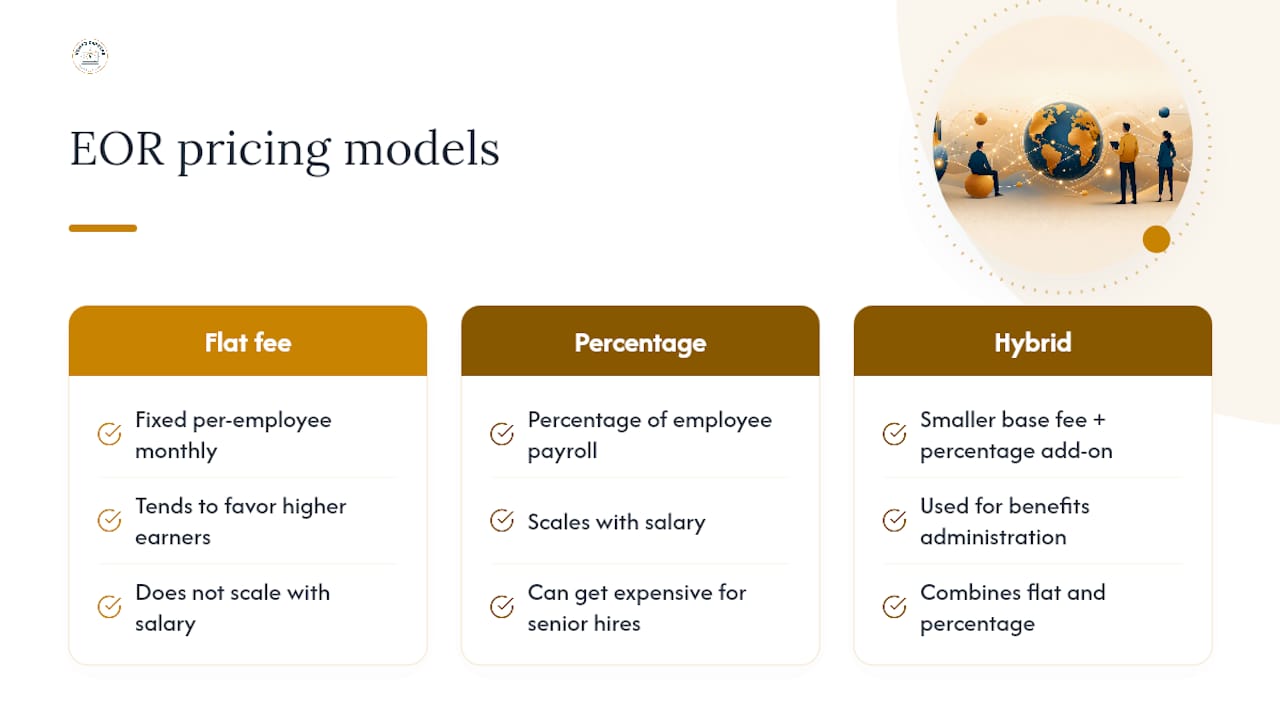
Pricing generally falls into three models: a flat per-employee monthly fee, a percentage of the employee’s payroll, or a hybrid combining a smaller base fee with a percentage add-on for benefits administration. Flat fees tend to favor companies hiring higher earners, since the fee doesn’t scale with salary; percentage models can get expensive fast for senior hires.
One-time setup fees are common and usually cover contract drafting, initial tax registration, and onboarding logistics for that specific country. These fees vary depending on how complex the jurisdiction is.
Timelines vary just as much. Straightforward markets with established EOR infrastructure can have someone on payroll within a week or two. Jurisdictions with more complex statutory benefit and leave requirements or unusual registration steps can stretch that to several weeks. When comparing costs against forming your own entity, factor in indirect costs too: the HR coordination time and integration work needed to connect the EOR’s systems to yours often shifts the math more than the headline fee does. Headcount and country count both affect unit economics; a single hire in one country rarely gets volume pricing, while ten hires across three countries usually will.
Is an Employer of Record the Right Move for Your Company?
An EOR makes sense the moment you need legal employer coverage in a country where building an entity isn’t worth the time or cost, especially for pilots, urgent hires, or small-scale expansion. Start by auditing your current international headcount plans against the checklist above, then shortlist two or three providers and compare their country coverage and pricing directly. If you’re sourcing the talent itself, Nomadcareers lists verified remote roles worth reviewing as you plan who to hire next.