The fastest reliable way to find remote developers is to run a targeted sourcing funnel: post on verified remote job boards, scout active contributors in developer communities, and close with a paid 2-week technical trial before extending a full offer. That sequence filters for both technical skill and remote-work discipline simultaneously, which is the combination that predicts long-term success.
To act in the next 24–72 hours:
- Post on a verified remote job board such as Nomadcareers where every listing is manually reviewed, so your posting reaches candidates already committed to work-from-anywhere roles.
- Search GitHub and GitLab for active contributors in your stack’s repositories; tools like GitHunt can surface high-activity profiles for direct outreach.
- Message two or three developer Slack communities or Discord servers relevant to your tech stack (e.g., Reactiflux for React, Elixir Slack for Elixir) with a concise role summary and a link to your job post.
- Triage incoming applications in one pass: discard any resume with no public repo, no deployment history, and no mention of async communication tools.
- Draft a short outreach message (three sentences: what you build, the role, and one specific technical question) to send to GitHub profiles you identify.
The sections below cover each stage in detail: writing a job post that filters for remote fit, a three-step screening funnel, U.S. hiring models and contracts, realistic costs and timelines, and an onboarding plan that reduces early turnover.
Table of Contents
- Key Takeaways
- Where can you find remote developers who are actually qualified?
- How do you write a remote developer job post that attracts the right applicants?
- How do you screen and evaluate remote developer candidates effectively?
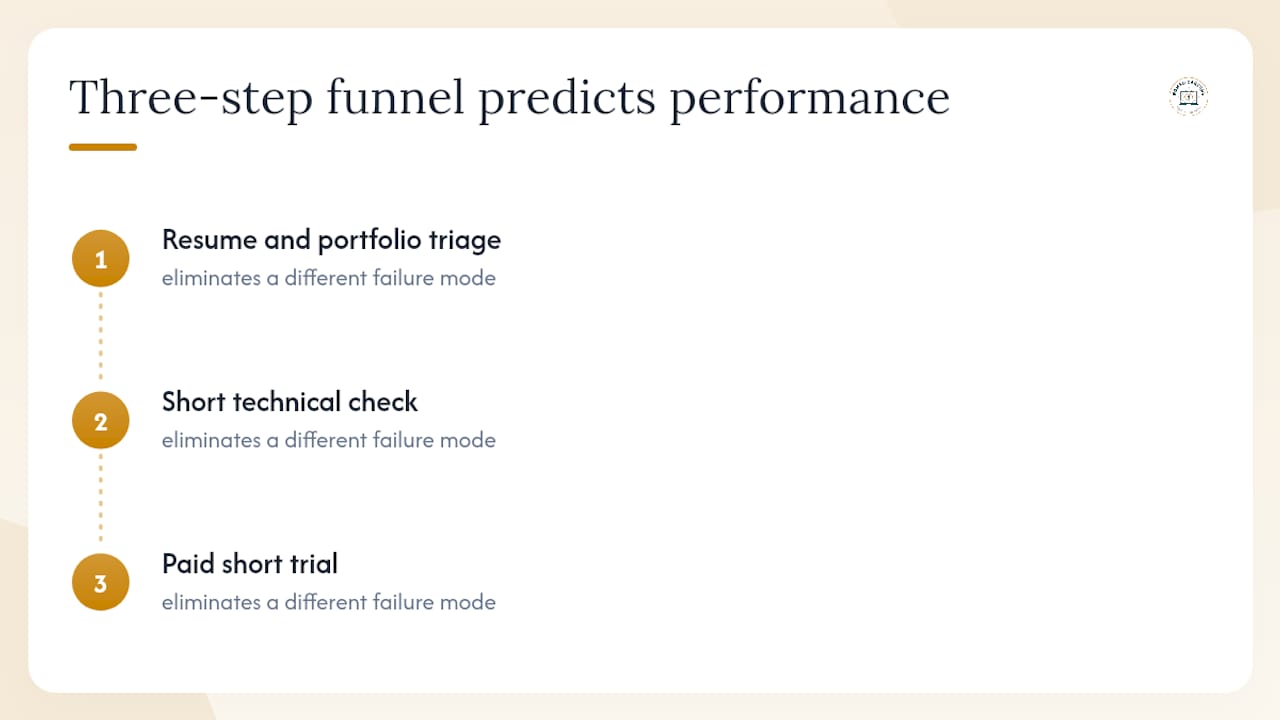
- Step 1: Resume and portfolio triage
- Step 2: Short technical check (15–30 minutes)
- Step 3: Paid short trial
- Which hiring model should you use, and what must your contract include?
- What do remote developers cost, and how long does hiring take?
- How do you onboard and manage remote developers for long-term success?
- 30/60/90-day onboarding plan
- What hiring managers get wrong when hiring remote developers
- Sources
Key Takeaways
The most reliable way to hire remote developers is to combine verified sourcing channels with a paid technical trial and a structured 30/60/90-day onboarding plan.
| Point | Details |
|---|---|
| Start with verified channels | Post on manually verified remote boards and scout GitHub to reach candidates already committed to remote work. |
| Publish compensation and overlap hours | Listings with a salary range and a specific overlap window attract higher-quality applicants and accelerate offer acceptance. |
| Use a three-step screening funnel | Triage portfolios, run a 15–30 minute technical check, then close with a paid 5–10 business day trial before extending an offer. |
| Match hiring model to engagement type | Use W-2 for long-term U.S. employees, 1099 for genuine contractors, and an EOR for global hires without a local entity. |
| Nomadcareers for verified remote listings | Nomadcareers manually verifies every listing and requires transparent hiring details, reducing triage time and improving match quality. |
Where can you find remote developers who are actually qualified?
Not all sourcing channels deliver the same candidate quality, and the right channel depends on how quickly you need to hire and how specialized the role is.
Verified remote job boards are the highest-signal starting point. Boards that manually verify listings and require employers to show compensation, hiring model, and timezone expectations attract candidates who have already filtered themselves for remote-first roles. This matters because unmoderated boards accumulate spam and misclassified listings, which wastes screening time on candidates who expect on-site work.
Specialist developer communities are the second channel to activate in parallel. Slack workspaces, Discord servers, and subreddits organized around specific stacks (e.g., r/forhire, Reactiflux, Elixir Slack, the Rust community Discord) contain developers who are actively building and often open to new opportunities. A concise, technically specific post in these spaces typically generates faster responses than a generic job board listing.
GitHub and GitLab scouting works well for senior or niche roles where you need demonstrated output rather than a polished resume. AI-assisted tools like GitHunt can scan public repositories and rank contributors by recent activity, making targeted outreach more efficient than passive resume review.
Talent marketplaces offer pre-vetted pools with faster time-to-interview, though they typically charge a placement fee or markup on hourly rates. They suit urgent contract needs where speed outweighs cost.
Employee referrals consistently produce the highest retention rates of any channel. If your current team includes remote engineers, a structured referral incentive is worth activating before you pay for any external channel.
Staffing firms and recruiting agencies are the right escalation when a role is highly specialized, the search has stalled after three weeks, or you need an Employer of Record (EOR) arrangement for a global hire. Expect higher cost but faster access to passive candidates.
When to use each channel:
- Urgent contract (under 2 weeks): talent marketplace or staffing firm with a pre-vetted bench
- Strategic full-time hire: verified remote job board + community outreach + referrals, running in parallel
- Niche senior role: GitHub scouting + agency, with community outreach as a supplement
- Global hire without a U.S. entity: EOR provider combined with a verified remote board
Pro Tip: When sourcing globally, filter first for candidates whose working hours overlap with your core team by at least 3–4 hours daily. A technically excellent developer in a non-overlapping timezone creates coordination debt that compounds over months. Apply this filter during sourcing, not after the offer.
How do you write a remote developer job post that attracts the right applicants?
The single most important element of a remote developer job post is clarity on three things at once: the hiring model (contractor or employee), the compensation range, and the required overlap hours. Candidates who are serious about remote work screen job posts on these three signals before reading anything else. Omitting any one of them increases mismatched applications and slows time-to-hire.
Use Nomadcareers’ remote job checklist to prepare your posting before you publish. The checklist covers the fields that most improve conversion on verified remote boards.
Job post checklist:
- Role scope: one paragraph describing what the developer will own, not just a list of technologies
- Required tech stack: separate must-have from nice-to-have; three to five hard requirements, not fifteen
- Communication expectations: async-first or sync-heavy, which tools (Slack, Linear, Notion), and expected response time
- Timezone and overlap window: state the specific overlap hours required (e.g., “10 AM–2 PM ET daily”)
- Compensation range: hourly rate for contractors, annual salary band for employees; publishing the range improves applicant quality and accelerates offer acceptance
- Trial or hiring process: describe the technical check and whether a paid trial is part of the process
- Benefits (if applicable): health, equipment stipend, learning budget, PTO policy
- Visa and work authorization: state clearly whether the role requires U.S. work authorization or is open to global contractors
Screening-first language reduces low-quality applications. Include one specific instruction that requires effort to follow:
- “Include a link to a GitHub repository or a deployed project you built.”
- “In your first message, describe one technical decision you made recently and why.”
- “Attach a brief note (three to five sentences) on how you handle async communication across timezones.”
Applicants who skip these instructions self-select out, which cuts triage time significantly.
Place a “verified remote” or “work from anywhere” badge prominently in the listing header, not buried in the body. Candidates filtering for genuine remote roles use that signal to decide whether to read further. On boards like Nomadcareers that apply this badge through manual verification, the badge carries more weight than a self-reported label on an unmoderated board.
How do you screen and evaluate remote developer candidates effectively?
A three-step funnel works reliably: resume and portfolio triage, a short technical check, then a paid short trial. Each step eliminates a different failure mode, and together they predict on-the-job performance better than any single assessment.
Step 1: Resume and portfolio triage
Look for these signals, in order of weight:
- Active public repository: recent commits, meaningful commit messages, evidence of code review participation
- Deployment history: live projects, not just local demos; a developer who ships to production regularly is demonstrably different from one who does not
- Focused contributions: depth in your required stack rather than a shallow list of every language ever touched
- Async communication artifacts: README files, documented pull requests, written issue comments; these predict how the developer will communicate on your team
Developer portfolio sites often show explicit timezone and overlap commitments alongside project history, which is a strong signal of remote-work maturity.
Step 2: Short technical check (15–30 minutes)
Keep this stage short and specific. Options:
- Live code review: share a small, realistic code snippet from your actual codebase and ask the candidate to walk through it on a video call; assess reasoning, not just correctness
- Recorded async walkthrough: ask the candidate to record a 10–15 minute Loom or equivalent video explaining a recent project decision; this also tests async communication directly
- Score on three dimensions: technical accuracy, communication clarity, and how they handle uncertainty (do they ask clarifying questions or make assumptions?)
Avoid generic LeetCode-style algorithm puzzles for roles that do not require algorithmic work. They measure interview preparation, not job performance.
Step 3: Paid short trial
A paid trial of one to two weeks is the most reliable predictor of remote-work success. Structure it as follows:
- Scope: one well-defined, self-contained task that mirrors real work (a small feature, a bug fix with a test, a documented refactor)
- Duration: 5–10 business days
- Acceptance criteria: written in advance, shared with the candidate before they start
- IP and NDA: for U.S. engagements, have the candidate sign a simple NDA and an IP assignment clause before the trial begins; this is standard practice and protects your codebase
Red flags during a trial: missed check-ins without notice, deliverables that do not match the written spec, no questions asked despite ambiguity in the brief, and code with no comments or documentation.
Remote-specific interview questions to ask before or during the trial:
- “How do you document a decision when you cannot get a teammate on a call immediately?”
- “Describe how you handled a production incident while working remotely.”
- “What does your daily async update look like, and who reads it?”
- “How do you flag a blocker when your manager is in a different timezone?”
Experienced remote-first engineers typically describe async-first workflows with recorded walkthroughs, written updates, and scheduled overlap windows as their default mode, not as an exception.
Pro Tip: Keep the trial task scoped to 8–12 hours of realistic work. A task that takes longer than that increases the risk of losing strong candidates who are currently employed. A well-scoped trial also gives you a cleaner signal: if a candidate cannot complete a 10-hour task to spec, a longer engagement will not improve the outcome.
Which hiring model should you use, and what must your contract include?
The choice between W-2 employee, 1099 independent contractor, and Employer of Record depends on three variables: where the developer is located, how long the engagement will last, and how much control you need over their work.
W-2 (direct employee): Use this for long-term, full-time hires based in the United States. You withhold federal and state income taxes, pay employer-side FICA (Social Security and Medicare), and are responsible for benefits if offered. The developer works under your direct supervision and uses your tools and processes. State nexus rules apply: hiring a remote W-2 employee in a state where your company has no existing presence may create a tax nexus in that state, which carries payroll and potentially income tax obligations.
1099 (independent contractor): Use this for project-based or short-term engagements, or when the developer operates as a genuine independent business. The contractor sets their own hours, uses their own tools, and works for multiple clients. You issue a Form 1099-NEC for payments over $600 in a calendar year. Misclassifying a W-2 employee as a 1099 contractor carries IRS penalties and back-tax liability, so apply the IRS behavioral and financial control tests before choosing this model.
EOR (Employer of Record): Use this when hiring a developer located outside the United States, or in a U.S. state where you lack the infrastructure to run payroll. An EOR becomes the legal employer of record, handles local payroll, taxes, and compliance, and bills you a management fee. This is the most practical path for global remote hires without establishing a foreign entity. For candidates’ location flexibility and visa considerations, Nomadcareers’ nomad visa guide covers country-specific rules that affect where a developer can legally work.
Contract checklist (all models):
- Payment terms: rate, currency, invoicing schedule, and net payment window
- Scope and deliverables: what is in scope, what is explicitly out of scope
- IP assignment: all work product created during the engagement is assigned to the company
- NDA: covers codebase, client data, and business information
- Termination terms: notice period for both parties, conditions for immediate termination
- Trial period language: for W-2 hires, a 30–90 day introductory period with defined performance criteria
- Tax responsibility note: for 1099 contractors, a clause confirming the contractor is responsible for their own self-employment taxes
Pro Tip: For trial-to-hire arrangements, include a clause in the initial contractor agreement that converts the engagement to a full-time offer upon mutual agreement at the end of the trial. This avoids renegotiating terms from scratch and reduces the friction that causes strong candidates to accept competing offers during the transition.
What do remote developers cost, and how long does hiring take?
Pay ranges for remote software developers in the United States vary by seniority, stack, and hiring model. Glassdoor’s aggregated salary data provides a practical baseline for benchmarking offers and setting job post ranges.
These ranges reflect U.S.-based remote roles. Contractors hired internationally through an EOR arrangement typically fall below these ranges, though EOR management fees (commonly $300–$600/month per employee) offset part of that savings.
Budgeting for total cost of hire:
- Interview time: budget 4–8 hours of internal engineering time per finalist for technical review and debrief
- Trial pay: at the contractor rate above, a 10-business-day trial costs $2,800–$8,800 for a mid-level developer at $65–$110/hr
- EOR fees: if applicable, factor in the monthly management fee for the duration of the engagement
- Counteroffer contingency: senior developers in active searches often hold competing offers; budget for a 5–10% salary premium if your preferred candidate receives a counteroffer during the offer stage
To compress the timeline for urgent roles:
- Run sourcing channels in parallel, not sequentially
- Conduct the technical check within 48 hours of the resume triage pass
- Shorten the trial to 5 business days with a tightly scoped task
- Prepare the offer letter before the trial ends so you can send it within 24 hours of trial completion
How do you onboard and manage remote developers for long-term success?
Early turnover in remote developer hires almost always traces back to the same root cause: unclear expectations in the first 30 days. A structured 30/60/90-day plan combined with a one-page working agreement (covering communication norms, overlap hours, and delivery cadence) addresses this before it becomes a problem. Gallup’s research on hybrid and remote work consistently shows that structured onboarding and defined overlap windows are among the strongest predictors of remote employee engagement and retention.
30/60/90-day onboarding plan
Days 1–30 (orient and ship something small):
- Provision all access and accounts on day one: code repository, issue tracker, CI/CD pipeline, communication tools, and documentation system
- Assign a codebase orientation task: read the architecture doc, run the local dev environment, and submit a small pull request within the first week
- Pair the new developer with a senior team member for daily 20-minute check-ins during the first two weeks
- Share the working agreement document: overlap hours, async update format, code review turnaround expectation, and escalation path for blockers
Days 31–60 (own a feature):
- Assign a self-contained feature or bug fix with written acceptance criteria
- Shift check-ins to three times per week; introduce the full team in a weekly demo
- Conduct a 30-day retrospective: what is working, what is unclear, what needs adjustment
Days 61–90 (operate independently):
- Assign a project with a two-week delivery window and minimal supervision
- Evaluate against three metrics: velocity (story points or equivalent), code review turnaround time, and responsiveness to async messages within agreed SLA
- Conduct a 90-day performance conversation with written notes
Tools and cadence that work for remote developer teams:
- Issue tracking: Linear, Jira, or GitHub Issues for task visibility
- Async updates: a daily written standup in Slack or a dedicated channel, not a mandatory video call
- Weekly demo: a 30-minute recorded or live session where the developer shows what shipped
- Incident response: a documented runbook the developer can follow without waiting for a manager
When velocity drops, code review turnaround slows, or async response time increases without explanation, address it in a one-on-one within 48 hours. These are early indicators of disengagement, not performance failure, and they respond well to a direct conversation about workload or unclear expectations.
What hiring managers get wrong when hiring remote developers
The most expensive mistakes in remote developer recruitment are not technical. They are process failures that compound across the hiring funnel.
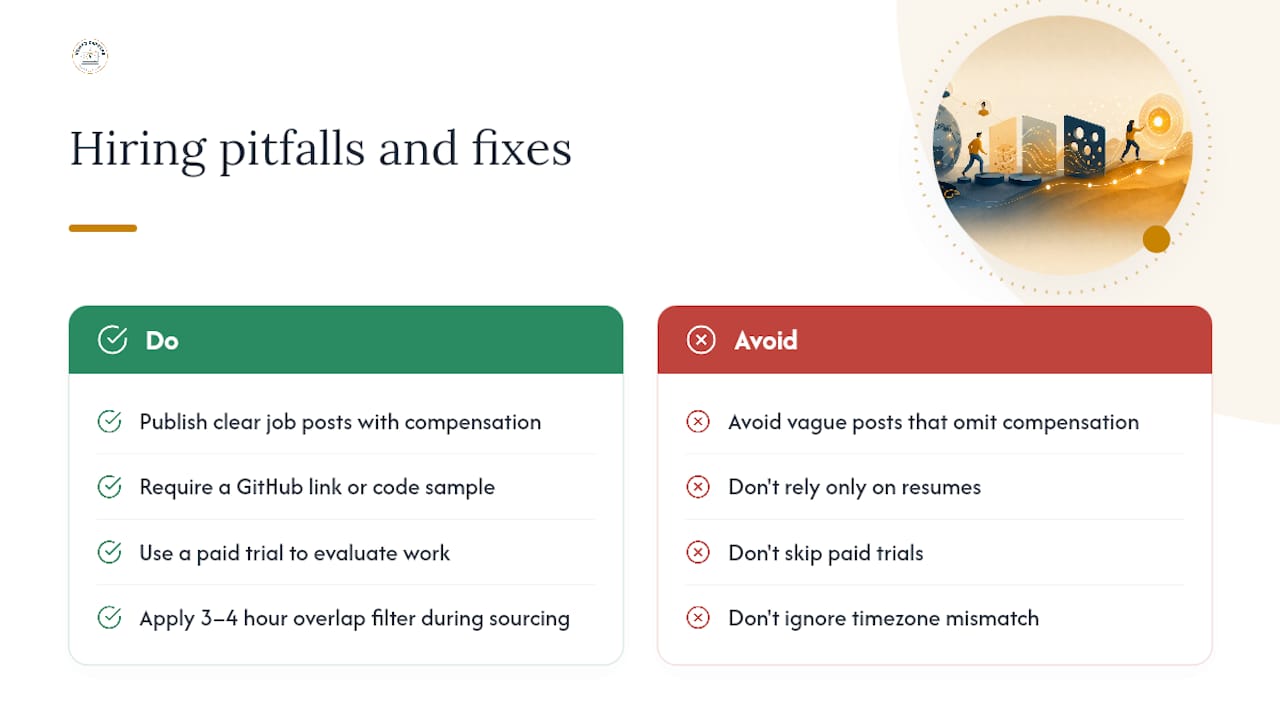
Pitfall 1: A vague job post. A posting that lists fifteen technologies, omits compensation, and says “remote OK” without specifying overlap hours attracts volume, not quality. The remedy is the checklist in the job post section above, applied before you publish.
Pitfall 2: Over-reliance on the resume. A polished resume with no public code, no deployment history, and no async communication artifacts is a weak signal for remote work. Require a GitHub link or code sample in the application, and treat its absence as a filter, not a minor omission.
Pitfall 3: Skipping the paid trial. Interviews measure how well someone interviews. A paid trial measures how well someone works. For remote roles specifically, the trial also reveals async communication habits, self-direction, and documentation quality that no interview question can reliably surface.
Pitfall 4: Ignoring timezone mismatch. A developer who is technically excellent but shares only one hour of overlap with your core team will create coordination debt that affects the entire team’s velocity. Apply the 3–4 hour overlap filter during sourcing, not after the offer.
Pitfall 5: Weak onboarding. Dropping a new remote developer into a Slack channel with a “let us know if you have questions” message is not onboarding. The 30/60/90 plan above, with a working agreement and a paired mentor, is the minimum viable structure.
When to escalate to an agency or EOR: If your in-house search has produced fewer than five qualified applicants after three weeks of active sourcing across multiple channels, or if the role requires a stack so specialized that your team cannot evaluate candidates independently, an agency or EOR is the right next step. The cost is real, but so is the cost of a three-month vacancy.
Pro Tip: If a strong candidate is struggling in the first 30 days, schedule a direct conversation before the 30-day mark, not after. Ask specifically: “What is the one thing that would make your work easier right now?” The answer almost always reveals a process gap or missing access that is straightforward to fix, and addressing it early prevents the disengagement that leads to early resignation.