For most U.S. employers, the right approach to global remote hiring is this: use an Employer of Record (EOR) to enter new markets quickly, establish a local legal entity once you plan a higher sustained headcount in a single country, and engage vetted independent contractors for short-term or project-based work. Your immediate next step: map your first three international hires to one of these three models before you post a single role. With 70% of HR leaders reporting that sourcing qualified talent is harder now than three years ago, widening your hiring geography is no longer optional. Platforms like Nomadcareers give you a starting point by connecting you with manually verified, work-from-anywhere candidates.
What does global remote hiring actually require from U.S. employers?
Choosing the wrong legal model is the most expensive mistake in cross-border recruitment. Each of the three primary structures carries different legal responsibilities, cost shapes, and risk profiles.

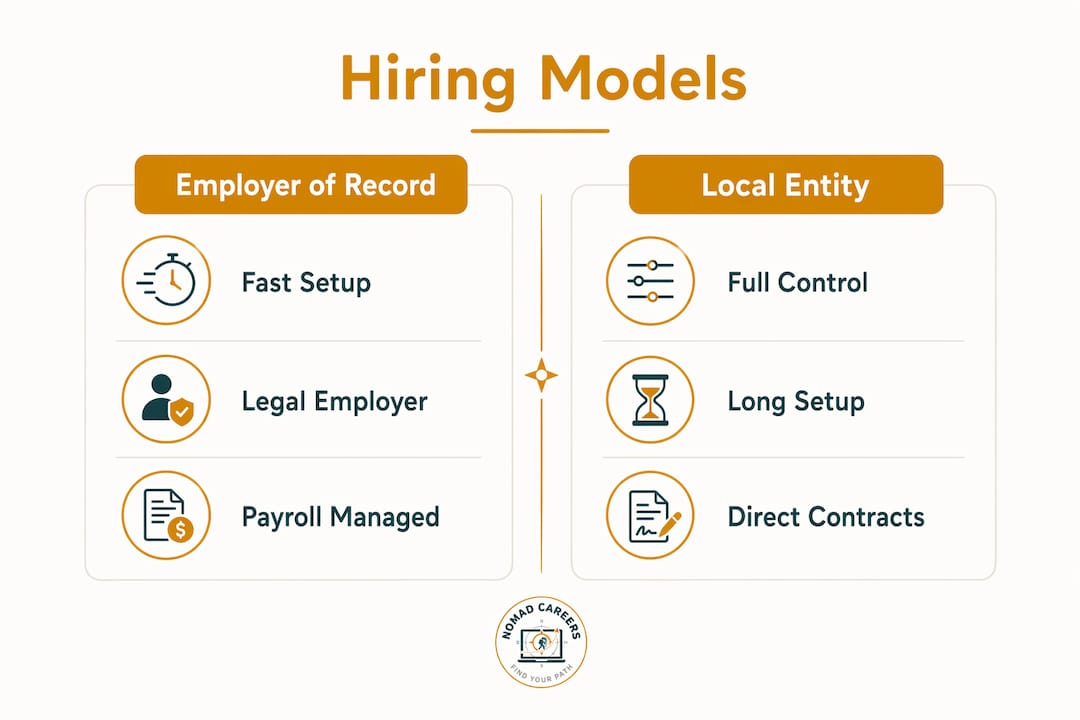
Employer of Record (EOR). An EOR acts as the legal employer in the target country. It handles employment contracts, payroll, statutory benefits, and tax filings on your behalf. You direct the worker’s day-to-day tasks; the EOR owns the compliance obligation. The key advantage: you can skip local entity setup, saving several months of incorporation time. EOR is the right choice for market tests, single-country pilots, or any situation where you need a hire in place within weeks.
Local legal entity. Incorporating a subsidiary or branch office gives you full ownership and control. You handle payroll, benefits, and HR directly. Setup typically takes 6–12 months depending on jurisdiction, and the fixed overhead only makes financial sense once recurring headcount justifies it. The threshold most practitioners use: 10 or more employees in one country, or a long-term strategic presence.
Independent contractors. Contractors are fast to engage (often 2–6 weeks from offer to start) and cost-efficient for project work. The risk is misclassification: if a contractor functions like a full-time employee, local labor authorities may reclassify the relationship, triggering back taxes, penalties, and benefits liability.
| Dimension | EOR | Local Entity | Contractor |
|---|---|---|---|
| Speed to hire | 4–6 weeks | 6–12 months setup | 2–6 weeks |
| IP protection | Moderate (via EOR contract) | Strong (direct control) | Variable (requires explicit assignment clause) |
| Misclassification risk | Low | Low | High if mismanaged |
| Best use case | Market entry, fast tests | Scale, long-term presence | Short-term, project-based |
Signs that push you from EOR to a local entity include sustained headcount above 10, local leadership signing contracts on your behalf, or revenue generated primarily in that country. On the contractor-to-employee conversion path, use platforms that support both Contractor of Record and EOR services to avoid re-onboarding complexity across jurisdictions.
Pro Tip: When evaluating EOR providers, ask whether they own their in-country entities or operate through partner networks. Providers with owned local entities offer stronger accountability and cleaner IP protection than reseller networks.
What compliance risks should U.S. employers prioritize first?
Six risk categories demand attention before you hire internationally. Misclassification and payroll errors sit at the top.
Misclassification is the highest-cost compliance failure in global hiring. When a contractor is treated as an employee, local authorities can impose back-payment of employer social contributions, statutory benefits, and penalties that dwarf the original cost savings. U.S. employers are particularly exposed because domestic contractor norms do not translate to most European, Latin American, or Southeast Asian labor frameworks.
Permanent establishment (PE) risk is the second priority. PE can be triggered when a contractor or employee habitually signs contracts locally, when EOR use extends beyond typical thresholds, or when senior staff operate as de facto local representatives. Once PE is established, the IRS and the foreign tax authority may both claim taxing rights on that country’s revenue.
Additional risks to address in vendor selection and contracts:
-
Payroll tax obligations: Each country has distinct employer contribution rates for social security, pension, and health insurance. Errors compound monthly.
-
IP protection: Without an explicit IP assignment clause in every employment and contractor agreement, work product created abroad may not automatically belong to your company under local law.
-
Data and privacy: GDPR (EU), LGPD (Brazil), and PIPL (China) impose data-handling obligations that affect how you store and process employee records.
-
Benefits and leave entitlements: Statutory minimums for paid leave, parental leave, and severance vary widely and cannot be waived by contract.
Red flags when evaluating EOR or payroll partners: unknown subcontracted entities handling your workers, no named in-country legal counsel, and contract templates with no IP transfer language. Require audit rights, named counsel, and IP assignment language in every SLA before signing.
How do payroll, contracts, and timelines work across hiring models?
Operational planning requires concrete timelines and cost visibility. The table below reflects typical ranges from offer acceptance to first payroll run.
| Hiring Model | Offer to Contract Signed | First Payroll Run | Total Onboarding |
|---|---|---|---|
| EOR | 1–2 weeks | 4–6 weeks | 5–10 weeks |
| Contractor | 1–2 weeks | 2–4 weeks | 3–6 weeks |
| Local Entity | 1–2 weeks (post-setup) | After entity live | 6–12 months total |
Key cost drivers to budget for:
-
EOR monthly fees: Typically charged per employee per month; rates vary by provider and country.
-
Entity setup fees: Legal, notarial, and registration costs vary by jurisdiction and can run into tens of thousands of dollars.
-
Employer statutory contributions: Social security, pension, and health contributions are mandatory and country-specific. These are not optional add-ons.
-
Currency conversion: Multi-currency payroll introduces FX spread costs on every pay cycle.
-
Local legal fees: Contract drafting, translation, and compliance reviews add to first-year costs.
Four contract clauses HR should require in every international agreement: IP assignment (all work product transfers to the company), governing law (specify jurisdiction), termination notice (aligned with local statutory minimums), and reimbursement of statutory contributions if the worker is later reclassified.
Where do you find verified global remote talent?
Sourcing channels matter as much as the legal model. The most effective approach for global talent acquisition combines specialized job boards, async hiring tools, and recruiter-plus-EOR bundles.
Nomadcareers is built specifically for this use case. Every listing is manually verified, which means you reach candidates who have already self-selected for genuine work-from-anywhere roles rather than hybrid or office-optional positions. The platform’s curated directory and categorized job alerts help HR teams target candidates by role type and location flexibility. For context on how candidates evaluate remote opportunities, the Nomadcareers guide on negotiating remote work abroad reflects what your best candidates are thinking before they accept an offer.
Roles that are commonly 100% remote:
-
Software engineering, DevOps, and QA
-
Product management and UX/UI design
-
Content, SEO, and performance marketing
-
Customer success (async-first teams)
-
Data analysis and business intelligence
-
Finance and accounting (non-signatory roles)
Roles that generally require local presence include sales leadership with contract-signing authority (PE risk), HR business partners managing in-country employees, and operations roles tied to physical infrastructure.
Screening checklist for remote candidates:
-
Confirm timezone overlap requirements in writing before the offer stage.
-
Request documented remote work history (prior fully remote roles, not hybrid).
-
Verify equipment and connectivity standards meet your async workflow requirements.
-
Include NDA and IP assignment language in the offer letter, not just the final contract.
-
Confirm the candidate’s country of residence for tax and payroll classification purposes.
For a broader view of which roles command the strongest demand in the global remote job market, Nomadcareers publishes updated role and salary data annually.
How should you roll out your first global hires in 30, 90, and 180 days?
A phased approach prevents the two most common failures: moving too fast without compliance infrastructure, and moving too slowly to capture talent.
30 days:
-
Map your first three target roles to a hiring model (EOR, contractor, or local entity).
-
Select one country to pilot, choosing a market with strong talent supply and manageable regulatory complexity.
-
Evaluate and contract with an EOR or contractor platform; confirm entity ownership and in-country counsel.
-
Post roles on verified channels, including Nomadcareers, and begin shortlisting candidates.
90 days:
-
Complete first cohort hires and run at least one full payroll cycle through your chosen platform.
-
Audit misclassification indicators: are contractors working set hours, using company equipment, or reporting to a single manager exclusively?
-
Track time-on-EOR per country to monitor PE exposure.
-
Refine offer templates, benefits packages, and onboarding documentation based on first-cohort feedback.
180 days:
-
Assess whether headcount in any single country is approaching the 10-hire threshold that typically justifies a local entity.
-
Build a 12-month headcount and benefits cost forecast by country.
-
Establish local HR processes: performance review cadence, async communication norms, and a remote team coordination framework.
-
Set conversion guardrails: define the conditions under which contractors will be offered EOR employment rather than contract renewal.
Key Takeaways
Compliance-first global remote hiring requires matching each role to the right legal model, building IP and payroll protections into every contract, and using a phased 30/90/180-day rollout to manage risk and cost.
| Point | Details |
|---|---|
| Match roles to models | Use EOR for fast entry, local entity at 10+ hires per country, contractors for short-term projects. |
| EOR saves 6–12 months | An EOR bypasses entity setup, cutting time-to-hire from months to 4–6 weeks. |
| Misclassification is the top risk | Contractor misclassification triggers back taxes, penalties, and benefits liability under local law. |
| Verify provider infrastructure | Require proof of entity ownership and named in-country counsel before signing any EOR agreement. |
| Nomadcareers for sourcing | Post roles on Nomadcareers to reach manually verified, work-from-anywhere candidates with no spam. |
Why compliance-first hiring is the only strategy that scales
The conventional wisdom in global hiring is to move fast and fix compliance later. That approach works until it doesn’t, and when it fails, the consequences are not minor. A single misclassification finding in Germany or Brazil can result in years of back-paid employer contributions, statutory severance, and regulatory scrutiny that affects your ability to hire in that market at all. The reputational cost with candidates is harder to quantify but equally real.
What practitioners who have built distributed teams across multiple jurisdictions consistently report is that the compliance infrastructure you put in place in the first 90 days determines whether your global hiring program scales or stalls. An EOR with owned entities and named in-country counsel is not a premium option; it is the baseline for operating without legal exposure. IP assignment language in every contract is not a negotiating point; it is a condition of doing business internationally.
Nomadcareers reinforces this by applying the same verification standard to job listings that HR should apply to compliance partners. Every role on the platform is manually reviewed, which means the candidates you reach have already been filtered for genuine remote readiness. That is one less variable to manage in an already complex process.
Useful sources and further reading
-
Global Recruitment Strategy: RemotePeople — sourcing difficulty data, PE risk guidance, and timeline benchmarks for EOR, contractor, and entity models.
-
EOR Services: Rippling — EOR mechanics, misclassification risk mitigation, and IP protection through integrated platforms.
-
Recruitment + EOR: RemotePeople — contractor-to-employee conversion guidance and integrated platform recommendations.
-
Global Employment Infrastructure: Remote — entity ownership vs. partner network comparison and in-country counsel requirements.
-
Can you work remotely from another country? — Nomadcareers guide on legal and practical considerations for employees working across borders.
-
Best digital nomad jobs in 2026 — role demand signals and salary data for globally remote positions.
-
Employer posting checklist — what to include in a verified remote job listing to attract qualified, location-independent candidates.