Start your search at Nomadcareers, a platform built exclusively for work-from-anywhere roles where every listing is manually verified before it goes live. That single distinction matters more than it sounds: no recycled postings, no region-locked “remote” roles disguised as global, and no anonymous employers, as explained in this remote rental application process guide. Here is what to do right now:
- Search now: Browse verified, work-from-anywhere listings on Nomadcareers, filtered by timezone, contract type, and salary range.
- Set alerts immediately: Subscribe to one or two category alerts so new verified roles reach your inbox the moment they post. Candidates who apply within the first 24–48 hours of a listing going live consistently see higher reply rates.
- Prefer verified boards: Platforms that manually vet listings report fewer duplicate or expired postings and higher employer transparency, which means your time goes toward real opportunities rather than dead ends.
A strong profile with portfolio links and documented remote experience also improves your match rate on modern platforms, so build that before you start applying.
Table of Contents
- What actually qualifies as a global remote job board?
- The four types of global remote job boards and when to use each
- How do you choose a global remote job board?
- How to search, apply, and stand out for global remote roles
- Why Nomadcareers is the recommended place to start
- A brief note for employers posting global remote roles
- Key Takeaways
- The current state of global remote job boards: what the data misses
- Nomadcareers: verified work-from-anywhere jobs, ready when you are
What actually qualifies as a global remote job board?
Not every board that uses the word “remote” is genuinely global. A true global remote job board lists roles explicitly labeled “work from anywhere” or carrying a permissive, location-neutral hiring policy. The employer is not restricting candidates to a specific country, time zone block, or region. That is the defining criterion.
The distinction matters because many boards mix three very different categories without flagging them clearly. “Remote” can mean fully location-independent, or it can mean “you must live in the EU,” or even “you work from home but must commute to the office twice a month.” Only the first category qualifies as genuinely global.
When evaluating any listing on an international job board, look for these metadata fields before you apply:
- Timezone or location policy: Does it say “work from anywhere,” name a specific country, or list a timezone overlap window (e.g., “4 hours overlap with US Eastern”)?
- Salary range: Transparent pay signals a professional employer and lets you triage quickly.
- Contract type: Full-time, part-time, or contract. Each has different tax and visa implications for nomads.
- Relocation or visa notes: Some employers sponsor visas or exclude certain nationalities. Knowing this upfront saves time.
Listings that include all four fields let you triage in under a minute. Listings that omit them are asking you to invest time in an application that may disqualify you on the first screening call.
The four types of global remote job boards and when to use each
Understanding board types helps you allocate your search time. Each category has a different trade-off between volume, quality, and fit.
| Board Type | What It Is | Best For | Update Frequency |
|---|---|---|---|
| Curated/verified boards | Manually vetted listings, spam-free, clear metadata | Selective applicants, senior roles | Daily or rolling |
| Company-direct careers pages | Employer’s own site, no middleman | Targeted outreach, specific companies | Varies widely |
| Aggregated marketplaces | High volume, open submission, minimal vetting | High-volume search, early-career roles | Continuous |
| Community/niche boards | Tribe-specific roles (design, writing, dev) | Niche skills, culture-fit roles | Weekly or rolling |

Curated and verified boards are the highest-signal option. Because listings are reviewed before posting, you spend less time filtering noise. Nomadcareers operates in this category, with manual checks on every listing before it appears in search results.
Company-direct careers pages work best when you have already identified specific employers you want to work for. The trade-off is time: you are researching and checking individual pages rather than searching a single index.
Aggregated marketplaces offer the widest volume of listings, which suits early-career job hunters who need exposure to many opportunities. The downside is that open-submission boards attract recycled and expired postings. Check timestamps carefully; listings without a “posted X days ago” indicator are a red flag.
Community boards serve niche audiences well. A developer-focused board or a writing-specific community will surface roles that general boards rarely carry. The volume is lower, but the fit tends to be stronger for specialized skills.
Pro Tip: Set up alerts on one curated board and one niche community board simultaneously. You get verified quality from the first and specialized fit from the second, without duplicating effort across five platforms.
How do you choose a global remote job board?
Run any board through this checklist before you invest time in it. You can complete this scan in under two minutes.
Scope and verification:
- Does the board explicitly filter for “work from anywhere” or “global” roles, or does it mix region-locked listings without labeling them?
- Are listings manually reviewed, or is posting open to anyone without checks?
Job metadata completeness:
- Do listings show salary ranges, timezone requirements, and contract type?
- Are employer profiles linked so you can verify the company is real?
Freshness:
- Are timestamps visible (“posted 3 days ago”)?
- Do new listings appear daily, or does the board look the same week to week?
Search and alert power:
- Can you filter by timezone, contract type, and skill category simultaneously?
- Does the board offer email or push alerts for new matching roles?
Red flags to walk away from:
- Anonymous employers with no company profile or website link.
- No visible timestamps, or listings dated months ago still appearing at the top.
- Repeated identical postings from the same employer with no updates.
- No salary information across the majority of listings.
Trust signals that should reassure you include manual vetting disclosures, salary ranges on most listings, recent timestamps, and visible company profiles with external links. Platforms that manually vet listings report fewer duplicate or expired postings and measurably higher employer transparency.

How to search, apply, and stand out for global remote roles
A methodical approach to searching and applying separates candidates who get replies from those who do not.
-
Filter before you browse. On any board, apply the “work from anywhere” or “global” filter first. Then layer timezone and contract type. This eliminates region-locked listings before you read a single description.
-
Prioritize by metadata quality. A listing with salary range, timezone window, and contract type is more likely to come from a professional employer who has thought through remote hiring. Apply to those first.
-
Set targeted alerts. Choose one or two specific categories (e.g., “product management, async, work from anywhere”) and subscribe to alerts. Applying within the first 24 hours of a posting going live gives you a measurable advantage.
-
Write a remote-first resume. Lead each bullet with an outcome, not a task. Add a one-line note in your summary confirming your timezone and async availability. Include links to a portfolio or work samples. For detailed guidance, the portfolio building guide on Nomadcareers walks through exactly what employers look for.
-
Tailor your cover note using the listing’s own metadata. If the listing specifies a 4-hour overlap with US Eastern, mention your availability in that window. If it lists async collaboration tools, name the ones you use. Generic cover letters are the fastest way to be filtered out.
-
Use AI tools carefully. AI-driven profile polish and mock interview tools are now common on remote platforms and can sharpen your application. Use them to identify gaps and improve phrasing, then review every output yourself. An AI-generated cover letter that does not reflect your actual experience will show in an interview.
-
Check your resume against ATS requirements. Many employers use applicant tracking systems before a human reads your file. The remote resume tips resource covers ATS formatting, template choices, and bullet rewrites specific to remote roles.
If you are entering the remote market without a technical background, the guide on landing a remote job without a degree covers practical positioning strategies that apply across industries.
Why Nomadcareers is the recommended place to start
Nomadcareers is built around one problem: most job boards label roles “remote” without confirming they are genuinely location-independent. Every listing on Nomadcareers is manually reviewed before it appears, which removes spam, expired postings, and region-locked roles that misuse the remote label.
The platform’s core features for job seekers:
- Manual verification: Each listing is checked for authenticity, employer legitimacy, and genuine work-from-anywhere eligibility before it goes live.
- Clear job metadata: Salary ranges, timezone requirements, and contract types are standard fields, not optional extras.
- Company directory: A searchable index of employers actively hiring for global remote roles, so you can research companies before applying.
- Categorized alerts: Subscribe by job category and receive new verified listings as they post.
- Nomad resources: Guides covering lifestyle tips, visas, banking, and insurance for location-independent workers.
Quick start on Nomadcareers:
- Create a profile and upload portfolio links or work samples.
- Subscribe to one or two category alerts matching your skills.
- Use the company directory to identify employers you want to target directly.
The remote job checklist on the site gives you a structured way to evaluate each listing before you apply, which is worth bookmarking for ongoing use.
A brief note for employers posting global remote roles
Employers who post vague listings attract mismatched applicants and waste screening time on both sides. A well-structured global remote listing should include:
- Timezone expectations: State the required overlap window explicitly (e.g., “must overlap 3 hours with CET”). Do not leave candidates guessing.
- Salary range: Pay transparency reduces drop-off at the offer stage and signals a professional hiring process.
- Eligibility and visa notes: If the role is restricted to specific countries or requires work authorization, say so upfront. If it is genuinely open to all nationalities, state that too.
- Async expectations: Specify which tools the team uses (Slack, Notion, Loom) and whether the role is fully async or requires some synchronous availability.
On Nomadcareers, employers can choose between standard and featured listings, with visibility add-ons available to increase placement in search results and category alerts. Listings that include complete metadata consistently attract more qualified applicants and shorter time-to-first-interview. For guidance on structuring location flexibility into an existing role, the article on negotiating remote work abroad is a useful reference for both employers and employees navigating that conversation.
Key Takeaways
The most reliable way to find genuine work-from-anywhere roles is to start on a manually verified board, set targeted alerts immediately, and apply with a remote-first profile that documents your async experience.
| Point | Details |
|---|---|
| Start on a verified board | Nomadcareers manually vets every listing, removing spam and region-locked roles before you see them. |
| Check four metadata fields | Salary range, timezone policy, contract type, and visa notes tell you whether a listing is worth your time. |
| Set alerts before browsing | Targeted category alerts surface new verified roles fast; early applicants see higher reply rates. |
| Build a remote-first profile | Portfolio links, async examples, and a timezone note in your summary improve employer match rates. |
| Nomadcareers as your starting point | Use the remote job checklist and company directory to evaluate listings and target employers systematically. |
The current state of global remote job boards: what the data misses
The conversation around remote work has shifted noticeably over the past two years. Employers who once posted “remote-friendly” roles as a perk are now designing roles from the ground up for async, distributed teams. That shift has raised the quality floor for what a serious global remote listing looks like, and it has also raised the competition level for candidates.
What most guides do not say plainly: the board you use matters less than the quality of your profile and the speed of your application. A verified board gives you a cleaner pool of listings, but a weak profile on a great board still loses to a strong profile on a mediocre one. The candidates getting hired in 2026 are the ones who treat their profile as a living document, update it after every project, and apply within hours of a verified listing going live.
Pay transparency is also accelerating. More employers are including salary ranges not because they are required to, but because listings without them are increasingly ignored by experienced candidates. That is a meaningful shift in negotiating power, and it is one reason metadata completeness has become the most reliable proxy for employer seriousness. Watch for boards that enforce salary disclosure as a posting requirement rather than leaving it optional. That policy choice tells you a great deal about the board’s standards.
Nomadcareers: verified work-from-anywhere jobs, ready when you are
Nomadcareers gives you something most remote job sites do not: a guarantee that every listing you see has been manually checked for authenticity and genuine location independence. No region-locked roles hiding behind the remote label, no anonymous employers, no recycled postings from six months ago.
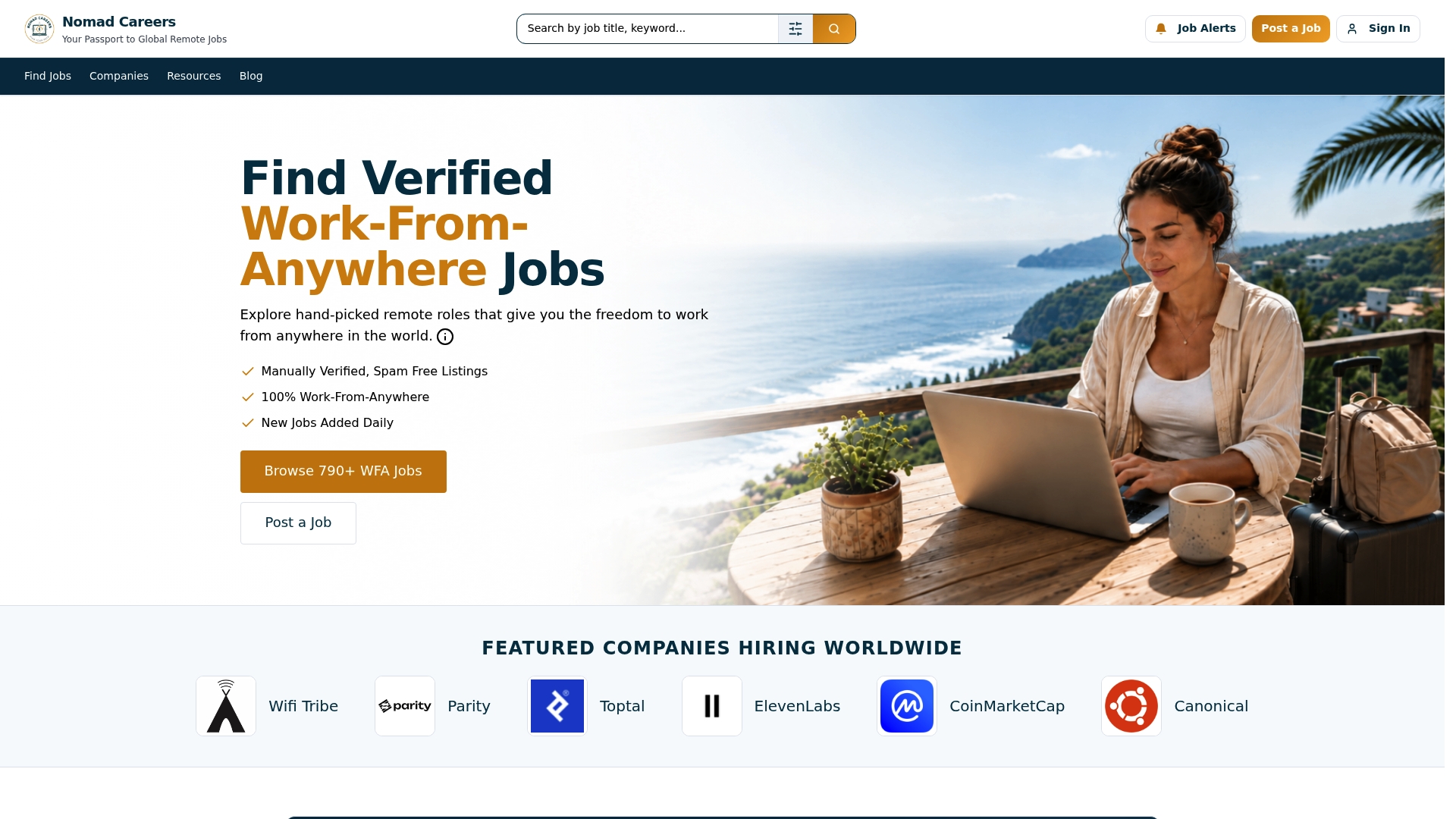
Build your profile, subscribe to category alerts for your skill set, and use the remote job checklist to evaluate each listing before you apply. If you are ready to go deeper on your application materials, the portfolio building guide walks you through exactly what employers hiring for global remote roles want to see. Start there, and you will spend less time filtering noise and more time in conversations with employers who are genuinely hiring.