Stabilize your core client income before you build anything new: convert your best clients to retainers, tighten your payment terms, and set aside one month of living costs this week. Only 6% of self-employed workers carry income protection insurance, which means most freelancers are one lost client away from a real cash crisis. About 28% of freelancers now work while traveling, so the risk isn’t hypothetical for anyone reading this from an apartment in Lisbon or a co-working space in Chiang Mai.
Do these three things before you do anything else:
- Ask your top three clients whether they’ll commit to a retainer or a confirmed volume of work.
- Require an upfront deposit or shorten your payment terms on every open invoice.
- Move one month of living expenses into an account you can reach in 24 hours.
Table of Contents
- Key Takeaways
- What Is a Risk-First Approach to Income Protection for Freelancers?
- Your Risk-First 6-Week Action Plan
- Where Can You Find Steadier Remote Work?
- Which Contract Changes Actually Reduce Payment Risk?
- How Much Emergency Runway Do You Actually Need?
- What Should You Do in the First 30 Days After Losing a Client?
- Selected Resources to Act On This Plan
- Frequently Asked Questions
- Sources
- Recommended
Key Takeaways
Income protection for freelancers depends less on insurance and more on stabilizing core clients, tightening contracts, and building a 6 to 12 month cash runway before adding new revenue.
| Point | Details |
|---|---|
| Stabilize before diversifying | Secure retainers and confirmed work from top clients before launching new income streams. |
| Fix contracts this week | Add deposits, shorter payment terms, and late fees to cut payment risk immediately. |
| Build real runway | Target 6 to 12 months of living expenses in an accessible, liquid account. |
| Move fast after a loss | Use the first 30 days for triage, outreach, and locking in one new steady contract. |
What Is a Risk-First Approach to Income Protection for Freelancers?
Income protection for freelancers isn’t primarily about insurance policies. It’s about the operational habits, contract terms, and cash cushions that keep money flowing when a client disappears or work slows down. Experts increasingly frame this as a risk-first approach to diversification: stabilize the income you already have before layering on new revenue streams that depend on an audience, a product launch, or unproven demand.
That ordering matters more than it sounds. A risk-first path also cuts burnout, because you’re not trying to build a course or a newsletter business on top of income that could vanish next month. Fix the foundation first. The digital products and passive income ideas can wait until your core client revenue is boring and predictable, including exploring platforms designed to sell online features that support digital product sales.
Your Risk-First 6-Week Action Plan
The order here isn’t arbitrary. Each phase reduces a specific kind of downside before you add anything new.
Weeks 1 and 2: Stop the bleeding.
- Audit every active client: payment reliability, contract terms, and likelihood of renewal.
- Fix your invoicing immediately: add late fees, shorten payment windows, and require deposits on new work.
- Build a starter cash buffer by moving 10% of every incoming payment into a separate account.
- Contact your top three clients directly and propose a retainer or a confirmed volume commitment.
Weeks 3 and 4: Tighten the system.
- Set up automated invoicing so nothing slips through on your end.
- Build a simple 30/60/90-day cash flow view (a spreadsheet works fine).
- Apply to three verified, steady remote roles or fractional positions to test the market.
Weeks 5 and 6: Add a second layer.
- Pursue one part-time steady role or expanded retainer to diversify your income sources.
- Automate at least one recurring revenue item, like a monthly maintenance package or a small subscription offering.
- Write down a 3 to 6 month runway plan with a specific dollar target and a monthly savings rate.
Set measurable targets as you go: converting one client into a retainer worth a specific dollar amount, or hitting a defined runway number by a set date, keeps this from becoming a vague intention.
Pro Tip: Prioritize changes that reduce your downside, like better payment terms and deposits, over speculative upside like audience funnels or new digital products. Downside protection pays off immediately; upside bets take months to prove out.
Where Can You Find Steadier Remote Work?
You don’t need a full-time job to stabilize your income. You need predictable hours and predictable pay, which can come from part-time remote roles, ongoing retainer contracts, or fractional positions where a company pays you a fixed monthly rate for a defined scope.
Look for listings that explicitly state fixed hours and recurring pay, rather than one-off project posts. Curated, manually verified boards cut down the time you’d otherwise waste filtering out vague or spammy listings, and industry-specific communities often surface retainer opportunities before they’re posted publicly. Don’t overlook your own client list either. A tailored, well-timed outreach message to a past client often converts faster than a cold application.
When you apply, keep proposals short, state your availability windows clearly, and have a simple retainer pricing template ready so you’re not improvising terms mid-conversation.
Pro Tip: Set a billable-hour cap for any new steady role before you accept it. The goal is income stability, not a second full-time job that crowds out the freelance work paying your best rates.
Which Contract Changes Actually Reduce Payment Risk?
Your contracts and invoices are doing more work protecting your income than any insurance policy will. A few clauses make an outsized difference:
- A deposit clause requiring 20 to 50% upfront before work begins.
- Clear scope language with a defined change-order process for anything outside the original agreement.
- A deliverable schedule tied to payment milestones, not just a final due date.
- A minimum-notice termination clause, so a client can’t vanish without warning.
On payment terms, shorten your net terms to Net 7 or Net 14, automate follow-up reminders, and set a clear late fee policy stated on every invoice. Offer multiple payment methods, card, ACH, or PayPal, since friction at checkout delays payment more often than clients admit.
Your invoice itself should itemize every deliverable, include a direct payment link, state the late fee plainly, and, where it fits, mention a retainer option. Require payment before releasing major milestones, and keep a digital archive of every signed contract in case a dispute arises later.
Pro Tip: Add one sentence to your standard contract: “Work resumes upon receipt of payment for outstanding invoices.” It’s simple, it’s enforceable, and it stops the slow bleed of unpaid work in progress.
How Much Emergency Runway Do You Actually Need?
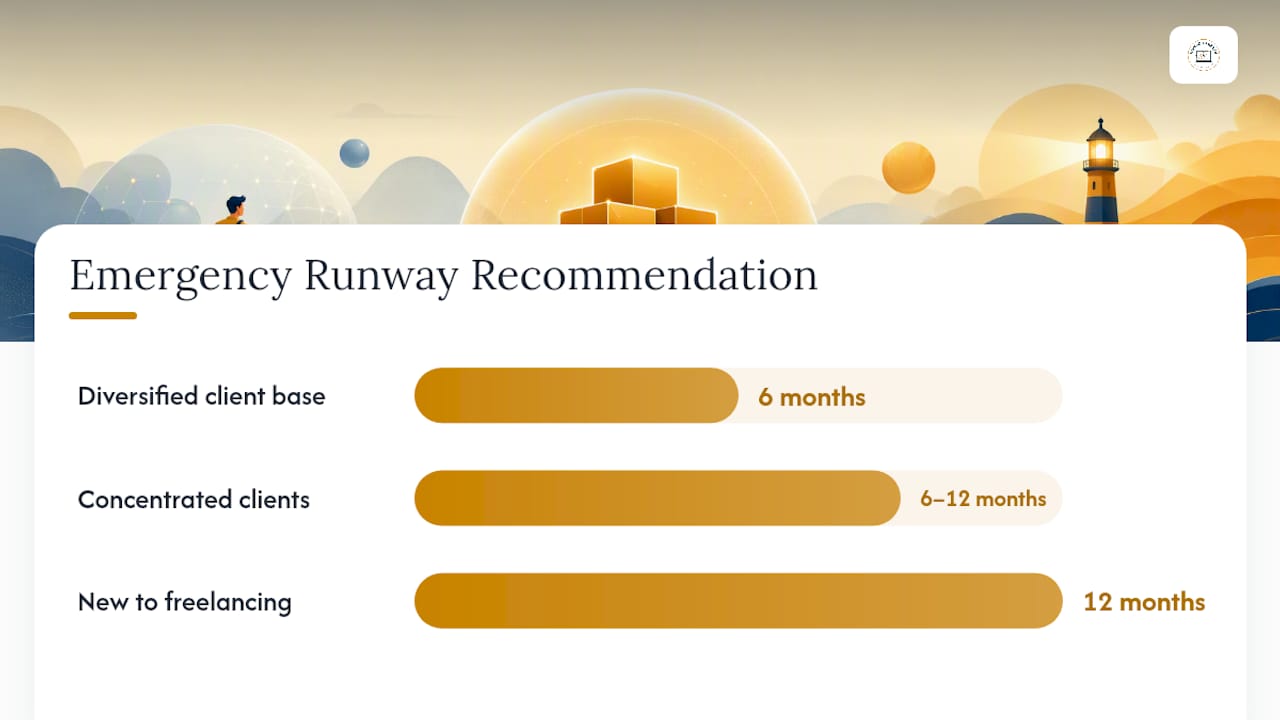
Financial guides for location-independent workers generally recommend 6 to 12 months of core living expenses in accessible savings. One to three months sounds reasonable until you consider that losing a major client can take 60 to 90 days to replace, and that’s before you account for a slow month layered on top.
Here’s a rough way to size your target: take your average monthly essential expenses (rent, food, insurance, minimum debt payments) and multiply by 6 for a conservative floor, or by 12 if your client base is concentrated in one or two accounts.
| Situation | Recommended Runway |
|---|---|
| Diversified client base, stable niche | 6 months of expenses |
| Concentrated clients (1 to 2 pay most bills) | 6 to 12 months of expenses |
| New to freelancing, unpredictable income | 12 months, built gradually |
Automate 10 to 20% of every incoming payment into a dedicated savings account, ideally a high-yield or multi-currency account if you’re earning and spending across borders. Keep runway funds liquid. This money needs to be reachable in a day, not locked into a CD or investment account.
What Should You Do in the First 30 Days After Losing a Client?
Losing a major client stings, but a fast, structured response limits the damage.
Days 0 to 3: Triage.
- Calculate the exact size of the income gap and how many months it covers.
- Invoice any outstanding work immediately.
- Pause nonessential spending for the next 30 days.
Days 4 to 14: Outreach blitz.
- Reach out to three past clients you haven’t worked with recently.
- Apply to 10 targeted, steady remote listings.
- Publish two short posts or send direct pitches highlighting recent work.
Days 15 to 30: Lock in stability.
- Secure at least one retainer or steady contract.
- Ask an existing client about a short-term advance if cash is genuinely tight.
- Write a 90-day cash flow plan based on your updated client mix.
Keep your outreach direct: “Quick question, do you have capacity for [specific service] this month?” beats a vague check-in every time.
Selected Resources to Act On This Plan
- Digital nomad financial management guide: runway math and account setup.
- Freelance income protection basics: why standard travel insurance won’t cover lost income.
- Nomad insurance guidance: complementary protections beyond runway and contracts.
- Remote job checklist: steps for applying to verified steady roles.
Frequently Asked Questions
What does income protection for freelancers actually mean if it’s not insurance? It means the combination of stable client income, solid contract terms, and cash runway that keeps you financially secure without relying on a formal insurance policy.
How much emergency savings should a freelancer have? Aim for 6 to 12 months of core living expenses, with 12 months as the target if your income relies heavily on one or two clients.
Should freelancers still consider income protection insurance at all? It can complement your runway and contract protections, especially for medical or liability risks, but underwriting for variable freelance income remains difficult for many applicants.
What’s the fastest way to reduce income risk this week? Shorten your payment terms, require deposits on new work, and ask your top clients whether they’ll commit to a retainer.
This article is general information, not a substitute for advice from a qualified financial advisor. Consult a qualified financial professional about your own circumstances before acting on anything here.