Yes, most international ATM withdrawals stack multiple fees, often three at once. The fastest fix is opening a travel-friendly account before you leave, one with no foreign transaction fee and ATM-fee reimbursement, and always declining dynamic currency conversion at the machine. Nomad Careers tracks these travel-finance basics because they matter as much as the visa you’re traveling on.
TL;DR:
Most international ATM withdrawals can incur three separate fees from your home bank, the ATM operator, and currency exchange markups, adding up quickly.
Flat fees like $2 to $5 do not decrease as withdrawal amounts grow, making larger, less frequent withdrawals more cost-effective.
Using partner network ATMs, declining dynamic currency conversion, and choosing larger withdrawals can significantly reduce overall costs.
Opening an account that waives foreign transaction fees and reimburses ATM surcharges simplifies fee management during travel.
Mapping local bank branches and using fee lookup tools before traveling help avoid the most expensive machines and hidden charges.
What Fees Apply to an International ATM Withdrawal?
Every time you pull cash from a foreign machine, up to three separate charges can hit your account, and they come from three different parties.
Your home bank usually charges a flat out-of-network fee for using an ATM outside its system, often $2 to $5 per transaction. The ATM operator, the bank or company that actually owns the machine you’re standing at, adds its own surcharge on top, commonly $3 to $8.
A typical international withdrawal can include all three charges stacked together: the home-bank flat fee, the operator surcharge and the conversion percentage. You’ll usually see the operator surcharge disclosed on the ATM screen before you confirm the transaction. The other two fees, your bank’s flat charge and the conversion percentage, typically show up later on your statement, which is exactly why so many travelers underestimate what a “quick cash run” actually costs.
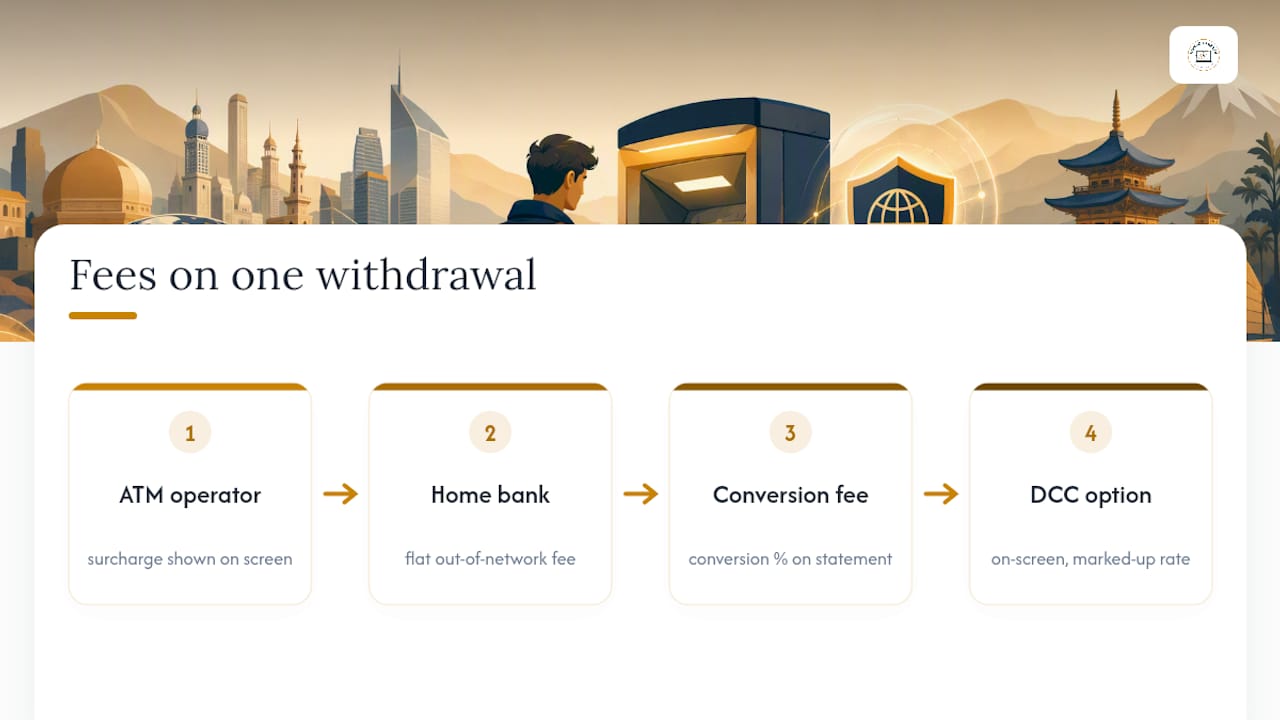
Then there’s dynamic currency conversion, or DCC. When a machine asks “Would you like to be charged in US dollars instead?”, it’s offering to convert the amount for you on the spot, usually at a marked-up exchange rate that’s worse than what your card network would give you automatically.
How Much Do International ATM Fees Actually Cost?
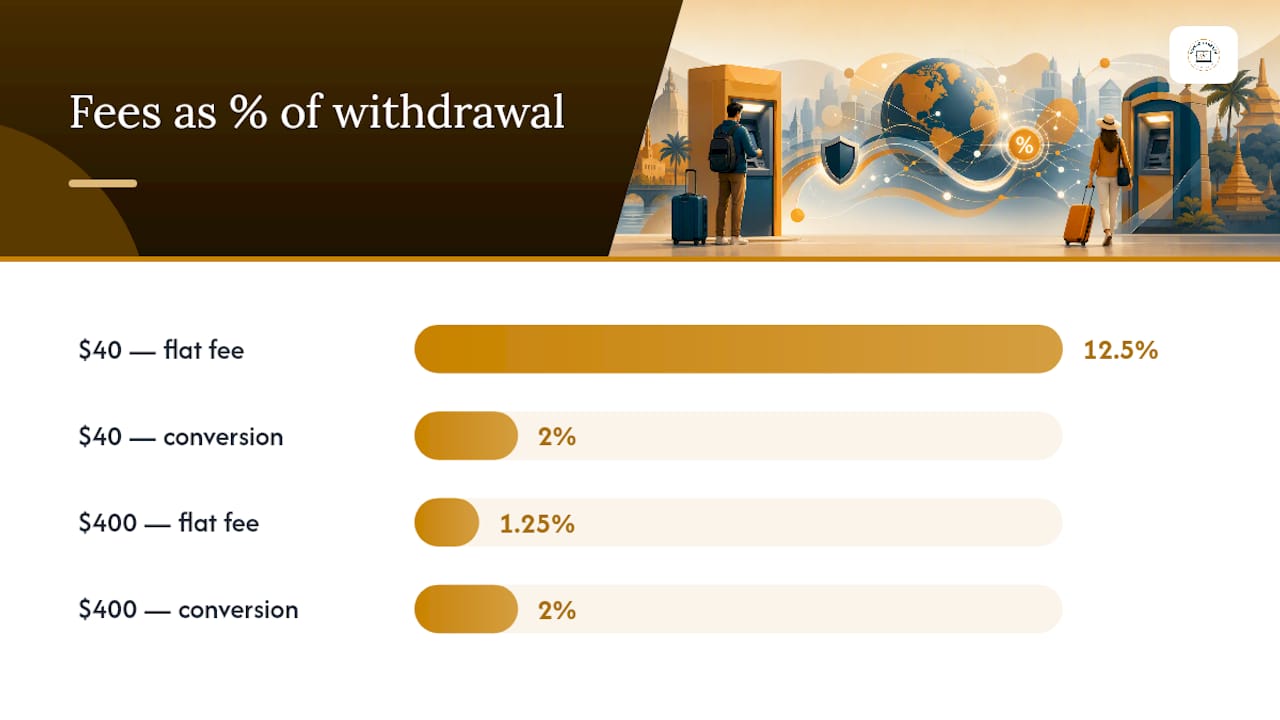
Numbers make this real. Banks commonly charge foreign transaction fees around 1% to 3% and flat, out-of-network fees near $2 to $5, though the exact combination depends entirely on your card issuer and the local ATM operator.
Here’s where withdrawal size changes everything:
-
A $40 withdrawal with a $5 flat fee and a 2% conversion charge costs $5.80 in fees, roughly 14.5% of the cash you get.
-
A $400 withdrawal with the same $5 flat fee and 2% conversion charge costs $13, only about 3.25% of the total.
Flat fees don’t scale with your withdrawal amount, so pulling more cash less often almost always saves money in percentage terms. And surcharges vary wildly by country and operator, some regions and independent kiosks charge far above the typical range, so it’s worth checking local fee data before you land.
How Can You Avoid or Reduce International ATM Fees?
Cutting these costs comes down to preparation, not luck. Here’s the order of priority that actually moves the needle:
-
Open a travel-friendly account before you leave. Look for checking accounts or debit cards that waive foreign transaction fees entirely or reimburse ATM surcharges. Confirm the reimbursement timing, some credit it monthly, others per transaction, and check whether the conversion percentage is waived too, since a reimbursed surcharge doesn’t always mean a fee-free withdrawal.
-
Use bank-branch ATMs, not standalone kiosks. Independent machines in airports, train stations, and tourist strips carry the highest surcharges, while ATMs attached to major bank branches tend to be cheaper or free for cardholders. Check whether your bank belongs to a partner network like the Global ATM Alliance, since partner-network machines can waive your bank’s out-of-network fee even when a small conversion charge remains.
-
Always decline dynamic currency conversion. When the screen asks whether you want to be charged in your home currency, choose the local currency every time. It’s a small tap that can save you several percentage points.
-
Withdraw less often, in larger amounts. Since flat fees don’t scale, fewer withdrawals mean fewer flat charges. Check your daily withdrawal limit ahead of time and set mobile alerts so you notice unusual activity fast.
-
Consider alternatives for purchases. A no-foreign-transaction-fee travel credit card handles in-store purchases without touching cash at all, and multi-currency fintech accounts often offer competitive conversion rates for withdrawals, though ATM-owner surcharges still apply and some impose monthly withdrawal caps.
Pro Tip: Before booking your trip, check a fee-lookup tool like ATM Fee Saver, which lists operator charges and limits across more than 180 countries, so you know which machines to avoid before you’re standing in front of one.
What Should You Look for in a Bank Account?
The right account does most of the fee-fighting for you. Prioritize these features when comparing options:
-
No foreign transaction fee on the card itself, not just the account.
-
Global ATM-fee reimbursement, ideally with monthly crediting and no cap, or a generous one.
-
Partner ATM networks that let you withdraw fee-free at allied banks overseas.
-
A low currency-conversion margin, since even reimbursed accounts can still apply a hidden percentage.
-
24/7 emergency support for card replacement if your card is lost or blocked abroad.
Some brokerage-linked checking accounts reimburse ATM fees globally, which makes them worth a look if you travel often. Before you commit, call your bank and ask directly: When are ATM fees reimbursed? What’s the partner network list? What’s my daily withdrawal limit? How fast can you replace a card if it’s stolen overseas? Nomad Careers’ guide to international banking choices breaks down how to compare these features side by side.
Pre-Trip and On-the-Ground ATM Checklist
Run through this before you leave and while you’re on the ground:
-
Notify your bank of travel dates and confirm the current fee schedule.
-
Ask your bank to raise your daily withdrawal limit if needed.
-
Pack a backup debit card in a separate bag or pocket, along with saved emergency contact numbers.
-
Map bank-branch ATMs near your arrival point and skip airport or tourist-strip machines when you can.
-
Put cash away immediately after withdrawing, set mobile transaction alerts, and log each withdrawal so nothing slips by unnoticed.
Pro Tip: A mobile travel app that tracks your itinerary alongside your banking alerts makes it far easier to spot an unexpected charge before it snowballs.
Where to Verify Bank Policies and ATM Fees
Bank terms shift, so confirm current policies before you travel. Useful starting points: NerdWallet’s foreign transaction fee guide for bank-by-bank comparisons, Bankrate’s ATM fee guide for traveler tactics, and ATM Fee Saver for country-specific fee lookups.
Getting your banking sorted is one piece of a larger puzzle if you’re planning an extended stay abroad. If you’re weighing a longer-term move, Nomad Careers’ guide to digital nomad visas covers the country-by-country requirements worth checking before you commit to a destination, and pairs naturally with the banking groundwork you lay here.