No single platform replaces Rippling exactly, and that is by design. Analysts describe the switch as “generalist to specialist”: most organizations split Rippling’s pillars across two or three focused tools rather than finding one direct substitute. The right path depends on your legal model and total cost of ownership, not just feature parity.
Quick verdict by use case:
- Domestic U.S. payroll only: Gusto or Paychex for transparent, predictable pricing
- Hiring contractors globally: Deel or a contractor-focused platform with clear compliance workflows
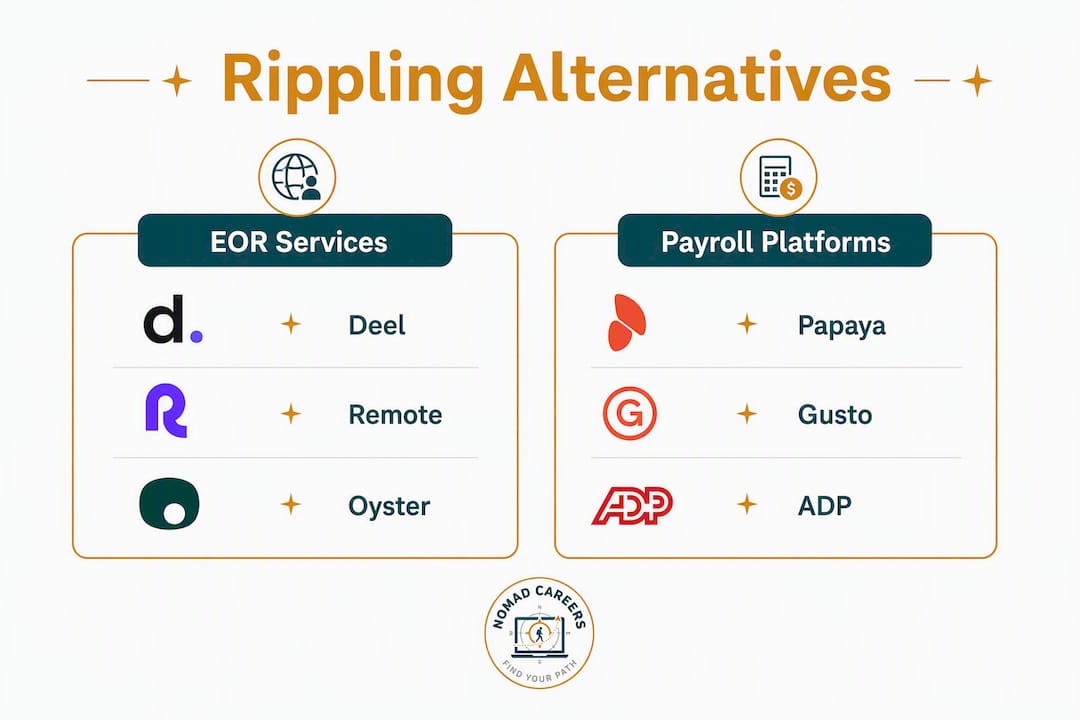
- Hiring employees where you lack a local entity: Deel EOR, Remote, or Oyster for Employer of Record coverage
- Hiring at scale with your own local entities: Papaya Global for multinational payroll orchestration
- Bundled HR, benefits, and payroll (U.S.): Justworks, TriNet, or Insperity as PEO options
- Enterprise-grade HR and global HCM: ADP for large organizations needing broad compliance services
- Sourcing verified, location-independent candidates: Nomadcareers as a curated sourcing channel alongside any payroll or EOR stack
Three immediate next actions:
- Confirm whether you have a legal entity in each target country (this determines EOR vs. global payroll).
- Request a full TCO estimate from shortlisted vendors, including onboarding, integrations, and compliance support.
- Run a 60–90 day pilot with one country or team before committing to a full migration.
Table of Contents
- Which Rippling alternative fits your hiring model?
- Key Takeaways
- Why this guide takes a legal-model and TCO-first approach
- Nomadcareers helps you source verified remote candidates during migration
- Official references and useful reading
Which Rippling alternative fits your hiring model?
Rippling’s modular pricing typically starts around $8 per employee per month for the “Unity” base layer, with per-module charges commonly ranging from $4 to $12 each. Median annual contracts in verified transactions have been reported near $45,668, but actual amounts vary widely depending on active modules and company size. Companies typically leave not because Rippling fails, but because they need specialist financial planning, deeper local compliance, or dedicated PEO services that a generalist platform cannot match at scale.
Confusing “global payroll” with “Employer of Record” is one of the most common evaluation errors. EOR legally employs workers through its own local entity; global payroll assumes you already own that entity. Getting this wrong creates compliance exposure, not just a billing surprise.
| Platform | Best for | Pricing model | Global reach | EOR / PEO | Payroll capabilities | Compliance & entity support | Integrations | Support & SLA | Migration complexity |
|---|---|---|---|---|---|---|---|---|---|
| Nomadcareers | Sourcing verified remote candidates; pilot hires across countries | Job posting packages; free for candidates | Global (location-independent roles) | Sourcing channel, not EOR | Pairs with your existing payroll stack | Manually verified listings; visa and tax guides | Works alongside any HR/payroll stack | Dedicated employer support | Low; no data migration required |
| Deel | Contractor management or EOR across multiple countries | Global payroll from ~$29/employee/mo, contractor management from ~$49/contractor/mo, EOR from ~$599/employee/mo (negotiated rates are common for larger volumes) | — | EOR and contractor | Global payroll and contractor filings | Local entity ownership in key markets | Slack, Xero, QuickBooks, HRIS APIs | Dedicated CSM at higher tiers | Moderate; data export from Rippling needed |
| Remote | International employees without local entities | EOR pricing not publicly listed; contractor plans available | — | EOR and contractor | Local payroll and tax filings | Entity-backed EOR in selected markets | HRIS, ATS, accounting integrations | Standard SLA; dedicated support at enterprise tier | Moderate |
| Oyster | Startups hiring internationally without opening entities | EOR pricing varies by country; contractor plans available | — | EOR and contractor | Local payroll, taxes, benefits | Remote-first EOR design | HRIS and ATS integrations | Standard support; enterprise options | Moderate |
| Papaya Global | Multinational payroll across multiple owned entities | Payroll orchestration pricing varies by volume | — | Global payroll (entity required) | Payroll orchestration, tax filings | Compliance monitoring across jurisdictions | SAP, Workday, NetSuite, ADP | Dedicated CSM; enterprise SLA | High; complex data mapping |
| Gusto | Small U.S. teams wanting predictable payroll costs | Published tiered pricing; per-employee per-month | U.S. only | No EOR; no PEO | Full U.S. payroll, taxes, filings | U.S. compliance; no international | QuickBooks, Xero, Slack, BambooHR | Standard support; phone at higher tiers | Low; straightforward U.S. data migration |
| ADP | Large enterprises needing broad HR and global HCM | Custom enterprise pricing | Global | PEO (TotalSource) and global HCM | Enterprise payroll, benefits, filings | Global compliance; broad entity support | SAP, Workday, Oracle, major HRIS | Dedicated enterprise support | High; complex implementation |
| Justworks | U.S. companies wanting HR, payroll, and benefits bundled | Per-employee per-month PEO pricing | U.S. only | PEO | U.S. payroll and benefits admin | U.S. PEO compliance | Xero, QuickBooks, select HRIS | Standard support; phone available | Low to moderate |
| TriNet | Mid-market U.S. employers seeking benefits and HR outsourcing | Per-employee per-month PEO pricing | U.S. only | PEO | U.S. payroll and benefits | U.S. PEO compliance; industry-specific | Select HRIS and accounting tools | Dedicated HR specialist per account | Moderate |
| Insperity | U.S. employers wanting comprehensive HR outsourcing | Custom PEO pricing | U.S. only | PEO | U.S. payroll, benefits, compliance | Full PEO compliance support | Proprietary HRIS; select integrations | Dedicated service team | Moderate |
| Paychex | U.S. small and mid-sized businesses needing flexible payroll | Flexible per-employee plans; custom pricing | U.S. primarily | PEO option available | U.S. payroll, taxes, filings | U.S. compliance; limited international | QuickBooks, Xero, major accounting tools | — | Low to moderate |
Vendor notes and trade-offs
Deel covers the widest contractor and EOR use cases in one platform, with separate pricing tiers for each service type. The EOR starting rate of approximately $599 per employee per month is negotiable at volume, but the cost adds up quickly for large headcounts.
Remote and Oyster both target companies hiring internationally without owned entities. Remote emphasizes entity-backed coverage in specific markets; Oyster’s product design is built explicitly for remote-first teams. Neither replaces a domestic HRIS for U.S.-only operations.

Papaya Global suits organizations that already have entities in multiple countries and need payroll orchestration rather than EOR. The implementation complexity is real: expect significant data mapping work and a longer go-live timeline.
Gusto is the clearest choice for U.S.-only payroll. Its published pricing and predictable cost structure make it a reliable Rippling substitute for small domestic teams, though it offers no path to international employment.
ADP covers the most ground at enterprise scale, including a PEO option (TotalSource) and global HCM services. Implementation complexity and custom pricing make it better suited to organizations with dedicated HR operations teams.
Justworks, TriNet, and Insperity all operate as PEOs, co-employing your U.S. workforce to deliver pooled benefits and simplified compliance. TriNet has deep benefits administration capabilities; Insperity offers broad HR operations support; Justworks is the most accessible entry point for growing teams.
Paychex covers U.S. payroll with flexible plan structures and strong accounting integrations, making it a practical choice for companies that want established payroll infrastructure without a full PEO arrangement.
TCO callout: Replacing Rippling with two or three best-of-breed tools often increases operational overhead through hidden integration costs and fragmented data, which can offset apparent subscription savings. Budget for onboarding services, IT provisioning replacements, and country-level compliance support before comparing base fees. Rippling’s IT and device management is a genuine differentiator; teams that remove it must add a separate provisioning solution or outsource that function entirely.
Key Takeaways
Legal model and total cost of ownership determine the right Rippling alternative, not feature lists alone; most organizations end up with a two-tool stack rather than a single replacement.
| Point | Details |
|---|---|
| Legal model first | Confirm entity status in each target country before choosing EOR vs. global payroll vs. PEO. |
| TCO over base fees | Request a full cost breakdown including integrations, onboarding, IT provisioning, and compliance support. |
| Pilot before committing | Run a 60–90 day pilot with one country or team to validate vendor performance before full migration. |
| Verify EOR entity proof | Ask every EOR vendor for country-level entity documentation during due diligence. |
| Nomadcareers for sourcing | Use Nomadcareers to source verified, location-independent candidates alongside any payroll or EOR stack. |
Pro Tip: When interviewing EOR vendors, ask specifically for proof of legal entity ownership in each target country, not just a list of supported countries. A vendor that “supports” a country through a third-party partner carries different compliance risk than one with a wholly owned entity there.
Red flag to avoid: Vendors that quote only base platform fees without disclosing per-module, per-country, or onboarding costs are underquoting. Always request a fully loaded annual estimate before signing.
Why this guide takes a legal-model and TCO-first approach
The most common mistake employers make when evaluating HR software like Rippling is treating the decision as a feature comparison. It is not. The legal question of whether you have a local entity in your target country determines your entire vendor category before you look at a single pricing page.
Nomadcareers publishes guides like this one because the employers posting on the platform face exactly this decision: they want to hire verified, location-independent talent across multiple countries, and they need to understand the compliance implications before they post a role. Every listing on Nomadcareers is manually verified to confirm it is genuinely location-independent, which means the candidates applying already understand what working remotely across borders requires. Pairing that sourcing channel with the right payroll or EOR partner reduces hiring risk on both sides.
Nomadcareers helps you source verified remote candidates during migration
Switching payroll or EOR platforms is the right moment to also fix your sourcing pipeline. The alternatives listed above handle compliance and payments; they do not find you candidates who are genuinely prepared to work from anywhere.
Nomadcareers is a manually verified remote job marketplace where every listing is confirmed location-independent before it goes live. Employers posting on the platform reach candidates who already understand cross-border work arrangements, which shortens the screening process during a migration period when your HR team has less bandwidth. You can post verified remote roles or browse the candidate pool while your new payroll or EOR stack is being configured, so hiring does not stall during the transition.
Official references and useful reading
Use these sources to verify vendor claims, pull compliance documentation, and build your TCO worksheet during evaluation.
| Source | What it provides |
|---|---|
| Treegarden: Best Rippling Alternatives | Verified pricing data, TCO analysis, and modular cost breakdowns |
| Workology: Gusto vs. Rippling | Feature and pricing comparison; buyer switching rationale |
| WorkMotion: Rippling Competitors Compared | EOR vs. global payroll legal model guidance; entity verification advice |
| 4dev: Best Rippling Alternatives | Contractor-focused platform recommendations |
| G2: Gusto vs. Rippling | Verified buyer reviews and ease-of-use scores |
| Gartner Peer Insights: Rippling Alternatives | Enterprise buyer evaluations and competitive context |
Due diligence checklist: Before finalizing any vendor, pull the EOR contract sample, request country-level entity proof for every target market, obtain a fully loaded TCO worksheet, and verify the migration checklist covers payroll history export and employee communications.
Consult qualified legal counsel before finalizing any international hiring model. Tax treatment, employment classification, and entity requirements vary by country and change regularly.