The Schengen 90/180 rule limits most non-EU visitors to 90 days inside the Schengen Area within any rolling 180-day period, and that window moves with every day you spend there. Two things to do right now: run your dates through the European Commission’s official short-stay calculator, or count backward 180 days from your travel date using your passport’s entry and exit stamps.
Before you book anything else, work through this short checklist:
- Pull out your passport and find your most recent Schengen entry and exit stamps.
- Plug those dates into the official calculator, or count them manually against your planned trip.
If the math is tight, the rest of this guide walks through exactly how the window behaves, how to count it by hand, and what happens if you get it wrong.
Table of Contents
- Key Takeaways
- Understanding the Schengen 90/180 Rule and Its Rolling Window
- How to Count Your Schengen Days Step by Step
- Using the Official Short-Stay Calculator Correctly
- Planning Multiple Trips Without Losing Track
- What Happens If You Overstay, and Why EES Changes the Risk
- Exceptions That Commonly Confuse Travelers
- Legal Options If You Need More Than 90 Days
- An Editorial Take on Playing It Safe With the 90/180 Rule
- Sources
- Recommended
Key Takeaways
The Schengen 90/180 rule caps non-EU short stays at 90 days within any rolling 180-day window, and that window recalculates every day rather than resetting on a fixed date.
| Point | Details |
|---|---|
| The rule in one line | No more than 90 days in any rolling 180-day period across the entire Schengen Area. |
| Counting method | Count back 180 days from your check date, include entry and exit as full days, and total your stays. |
| Official tool | Use the European Commission’s calculator in planning mode before booking, control mode to verify past stays. |
| Enforcement reality | EES biometric tracking now automates overstay detection, replacing manual passport stamp checks. |
| Longer stays | National D visas, residence permits, and digital nomad visas remove the 90/180 limit entirely, and Nomad Careers’ visa directory and job listings help travelers qualify for them. |
Understanding the Schengen 90/180 Rule and Its Rolling Window
The confusion almost never comes from the number 90. It comes from the 180. Most travelers assume the 180-day clock resets on January 1, or the moment they leave Schengen territory, or after some fixed calendar quarter. None of that is how it works.
The 180-day period is a moving reference window, not a fixed block. For any day you’re checking, you look back exactly 180 days and add up every day you spent in the Schengen Area during that span. If the total is 90 or fewer, you’re compliant. If it’s higher, you’ve overstayed. This structure comes directly from Regulation (EU) 2016/399, the Schengen Borders Code, which defines the short-stay concept using this exact rolling mechanism rather than a calendar-year allowance.
Here’s the detail that trips up even careful planners:
The rolling window means your available days change every single day. A trip you took five months ago can suddenly “fall out” of the 180-day lookback and hand you fresh days you didn’t have yesterday. There’s no reset button. There’s just math that shifts as time passes.
A few practical points make the mechanics click:
- Both your entry day and your exit day count as full days toward the 90, even if you arrive at 11:50 PM or leave at 6:00 AM.
- The clock applies across the entire Schengen Area as one unit, not per country. Ten days in Portugal and ten days in Poland both draw from the same 90-day pool.
- The Schengen Area includes 29 countries as of 2026, but not every EU country is inside it, and not every Schengen country is an EU member. Ireland and Cyprus sit outside the Schengen zone entirely, so time spent there doesn’t count against your 90 days there, though it may fall under separate visa rules for that country.
- Border officers, not the calculator, make the final call. The tool projects the rule; the officer at passport control enforces it.
That last point matters more than it sounds. The calculator is a planning aid built on the same legal formula immigration authorities use, but it can’t see your visa sticker, your bilateral agreements, or your specific entry stamps the way a border officer can.
How to Count Your Schengen Days Step by Step
Counting by hand is not complicated once you have the method down, and it’s worth knowing even if you plan to lean on the official tool for double-checking.
- Pick your check date. This is usually either today or your planned entry date for an upcoming trip.
- Count back exactly 180 days from that date to establish your lookback window.
- List every day you were physically inside the Schengen Area during that window, using entry and exit stamps from your passport as your source of truth.
- Count entry and exit days as full days, not half-days or transit exceptions.
- Add up the total. If it’s 90 or fewer, you have room. If it’s already 90, you need to leave before your next planned entry, or wait for older days to roll out of the window.
Two worked examples make this concrete.
Example A: One long stay. Say you enter Portugal on March 1 and stay through May 20, a stretch of 81 days. On May 20, your 180-day lookback (going back to late November) shows exactly 81 days used, leaving 9 days free. But check again on July 1: some of those March days have now rolled outside the 180-day window, so your available balance climbs back up even though you haven’t left Schengen territory since March.
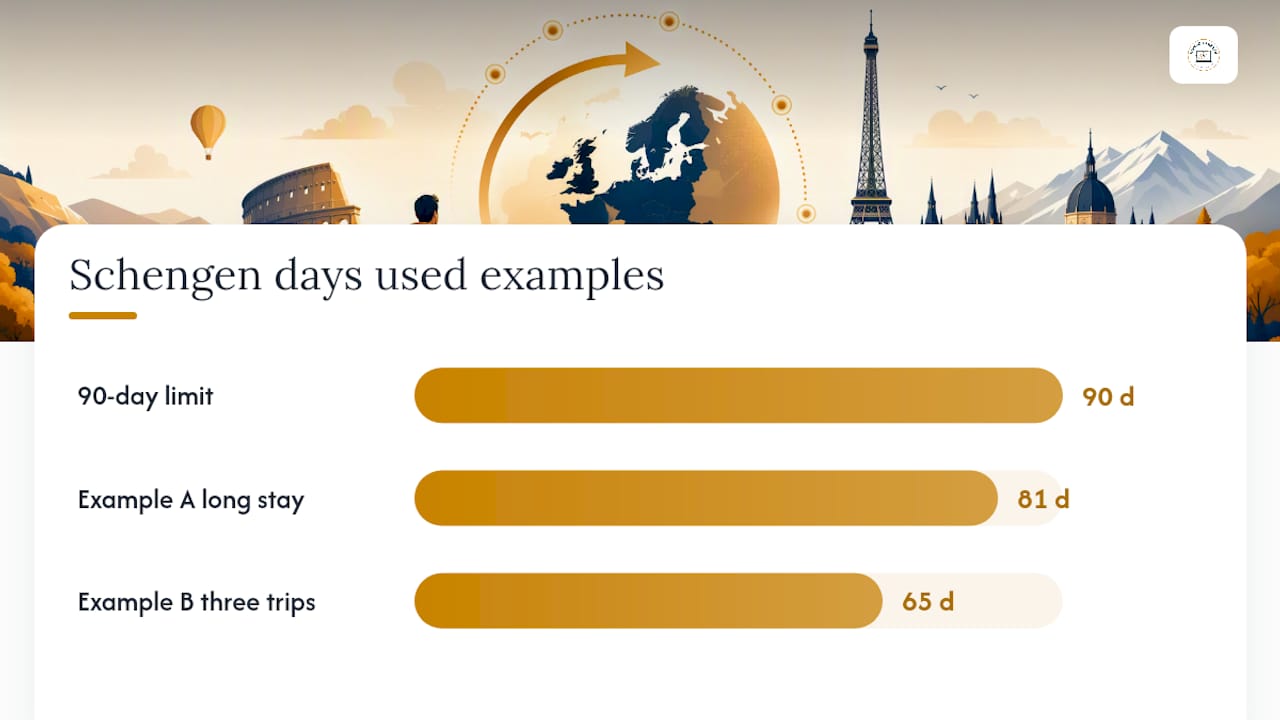
Example B: Multiple short trips. Suppose you take a 15-day trip to Spain in January, a 20-day trip to Italy in March, and a 30-day trip to Germany in June. By late June, that’s 65 days used. Before booking a fourth trip in August, count back 180 days from your planned August entry date. If the January trip has already aged out of that window by then, you’ll have more room than a simple running total suggests, which is exactly why the rolling structure rewards planning rather than guessing.
Pro Tip: Log your entry and exit dates the day they happen, not weeks later when you’re trying to reconstruct a trip from memory. A simple spreadsheet with one row per trip and a formula that subtracts 180 days from any target date will save you from a stressful recount at the airport.
One more warning worth flagging here: airside transit, where you never pass through immigration control, generally doesn’t count as a day in Schengen. The moment you clear passport control and enter the territory, though, that day counts, even if you’re only there for a layover-length visit.
Using the Official Short-Stay Calculator Correctly
Manual counting works, but the European Commission’s short-stay calculator exists specifically so travelers don’t have to do that math under pressure. It runs on two distinct modes, and knowing which one to use changes what the results actually tell you.
Control mode checks whether a stay you’ve already taken, or one you’re currently on, complies with the 90/180 rule. You enter your past entry and exit dates, and the tool tells you whether you were, or currently are, within the limit.
Planning mode projects forward. You enter a future entry date, and the calculator tells you the maximum number of days you could legally stay starting from that date, given your travel history. This is the mode worth using before you book flights, because it answers the actual question travelers care about: “If I land on this date, how long can I legally stay?”
| Mode | What it answers | When to use it |
|---|---|---|
| Control | Was/is this stay compliant? | After a trip, or mid-trip, to verify status |
| Planning | How many days can I stay starting on a future date? | Before booking an upcoming trip |
The calculator’s official user manual documents both functions in detail and specifies a dd/mm/yy date format for entries, so double-check formatting before you submit dates, especially if you’re used to writing dates the American way. Results typically show your possible stay through a specific date, total days used within the current 180-day window, and, if applicable, how many days you’ve overstayed.
Here’s the caveat that matters most: the manual states plainly that this tool is a helping instrument only. It cannot account for bilateral visa waiver agreements between specific countries, national long-stay permits, or a visa sticker that authorizes fewer than 90 days. Member-state border authorities make the actual legal determination when you cross. Screenshot or save a PDF of your calculator results before traveling. It won’t override an officer’s decision, but it shows good-faith diligence if a border check ever gets complicated.
Planning Multiple Trips Without Losing Track
Frequent travelers and expats juggling several short visits a year need a workflow, not just a formula. A few tactics consistently keep people out of trouble.
- Build in a buffer. Instead of planning right up to day 90, treat 80 to 85 days as your practical ceiling, leaving room for flight delays or an unplanned extra night.
- Stagger your trips deliberately. Because the window rolls, spacing trips out lets your earliest days age out of the 180-day lookback before you need them back.
- Consider a full 90-day absence from Schengen territory if you need a genuine reset. That guarantees a clean slate rather than relying on partial rollover math.
- Keep a dated log of every entry and exit, even for short weekend trips that feel too minor to matter.
- Run a spot check with the official calculator before booking, not after.
A few quick questions come up constantly among readers planning multi-trip itineraries:
- How soon can I return after using my 90 days? As soon as enough earlier days roll outside the 180-day window to free up new days. There’s no fixed “wait 90 days” rule; it depends entirely on your specific travel history.
- Can I split the 90 days across different Schengen countries? Yes. The limit applies to the Schengen Area as a whole, not per country, so days in France and days in Greece draw from the same pool.
- Does time on a connecting flight or ferry count? Only if you pass through immigration control. Airside transit that never clears passport control generally does not count as a day in Schengen.
What Happens If You Overstay, and Why EES Changes the Risk
Overstaying the 90/180 limit isn’t a paperwork technicality. The consequences are enforced and they scale with how long the overstay ran.
- Fines, which vary by country and can be assessed on the spot or through administrative proceedings.
- Refusal of entry on a future trip, even one that would otherwise be fully compliant.
- Entry bans ranging from short suspensions to multi-year restrictions, depending on the severity and the country handling the case.
- A negative record that can complicate future Schengen visa applications or ETIAS authorization once that system is fully active.
What changed the enforcement landscape recently is the Entry/Exit System (EES), a biometric system that logs entries and exits electronically instead of relying on ink stamps that can smudge, get missed, or land on the wrong passport page. Automated day counting means border authorities can flag an overstay far more reliably than in the stamp-only era. Assuming a missed stamp will work in your favor is no longer a reasonable bet.
If you discover you’ve already overstayed, don’t wait for a border officer to catch it first. Contact the consulate of the country where the overstay occurred, or an immigration lawyer familiar with that jurisdiction, and keep every travel document you have. Administrative procedures vary by country, and having your own documentation ready, including copies of tickets, boarding passes, and any calculator screenshots, makes the process considerably less painful.
| Point | Details |
|---|---|
| Enforcement is automated | EES logs biometric entries and exits, replacing manual stamp checks with automated day counting. |
| Consequences scale | Overstays can trigger fines, entry refusal, and bans ranging from months to multiple years. |
| Advisory tool only | The official calculator projects the rule; border officers make the final legal decision. |
Exceptions That Commonly Confuse Travelers
A handful of exceptions cause more confusion than the core rule itself, so it’s worth isolating them clearly.
| Situation | Does it count toward 90/180? |
|---|---|
| National long-stay (D) visa or residence permit in your host country | No, for stays in that issuing country |
| Trips to other Schengen countries while holding that residence permit | Yes, those trips still count against your 90/180 |
| Stays in Cyprus or Ireland | Not counted; both are outside the Schengen Area |
| Stays in EFTA members Iceland, Liechtenstein, Norway, or Switzerland | Yes, these are full Schengen members despite not being EU states |
| Airside transit without clearing immigration | Not counted |
The residence permit exception deserves extra attention because it’s frequently misunderstood. If you hold a national long-stay visa in, say, Germany, your time there doesn’t count against the 90/180 limit at all. But that permit does not grant you extra short-stay days elsewhere. A weekend trip to Amsterdam still draws from the same 90-day pool that applies to any other short-stay visitor.
There’s also a visa-sticker trap worth flagging: a short-stay © visa doesn’t automatically grant the full 90 days. Some visas authorize fewer, and if yours does, the general calculator won’t catch that discrepancy. Check your visa sticker or approval letter directly rather than assuming the standard allowance applies.
Legal Options If You Need More Than 90 Days
For expats and long-term travelers, the 90/180 limit eventually becomes the wrong tool for the trip you actually want to take. At that point, the conversation shifts from counting days to securing legal status that removes the short-stay limit entirely.
Three general paths exist, and each one is set by the individual country rather than by any EU-wide standard:
- National D visas, which authorize long-term stays in a single Schengen country and typically require proof of income, accommodation, and sometimes health insurance.
- Residence permits, often tied to work, study, or family reunification, issued after you’re already inside the country on a D visa or equivalent.
- Digital nomad visas, a newer category many Schengen countries now offer specifically for remote workers who earn income from outside the host country.
Pro Tip: Start the national visa research at least three months before your intended travel date. Consulate processing times vary widely, and some countries require an in-person appointment that can itself take weeks to book.
Practical steps that apply across nearly every country:
- Check the consulate website for the specific country you’re targeting, since requirements differ even among neighboring Schengen states.
- Gather proof of income or a remote job offer, proof of accommodation, and valid health insurance before you apply.
- Submit well ahead of your planned travel date to absorb processing delays.
Nomad Careers maintains a country-by-country digital nomad visa guide covering more than 65 programs, along with a breakdown of English-friendly countries offering these visas for readers who want to compare options side by side. If citizenship through ancestry is on the table as a longer-term solution, resources like citizenship by descent eligibility guides can clarify whether that route is realistic for your family history.
An Editorial Take on Playing It Safe With the 90/180 Rule
The travelers who get burned by this rule are rarely the ones who ignore it. They’re the ones who understand it almost correctly and stop checking once they’ve done the math once. The rolling window is the part that punishes complacency, because a calculation that was accurate in March can be wrong by June if you haven’t recalculated.
My practical rule of thumb: treat 85 days as your real ceiling, not 90, and recheck the official calculator before every single booking, not just your first one of the year. That five-day buffer costs you almost nothing in flexibility and buys you real protection against the kind of rounding error that turns into a bordercrossing problem. If you find yourself running that math more than twice a year, that’s usually a signal you’ve outgrown the short-stay system entirely, and it’s worth looking seriously at a national visa or digital nomad visa instead of continuing to count days indefinitely.
Sources
For the most reliable, up-to-date figures, go straight to the sources immigration authorities themselves reference:
Keep in mind that every one of these tools and texts is a guide, not a verdict. Border authorities in each member state make the final call at the point of entry, so treat the calculator as your planning partner, not your legal defense.