Brazil, Colombia, Argentina, Ecuador, Uruguay, Panama, and Costa Rica all offer working routes for remote employees and freelancers, while Mexico covers similar ground through its temporary resident solvency track. The catch that trips up nearly everyone: getting the visa stamped doesn’t settle your tax situation. Immigration permission and tax residency are two separate legal tests, and the 183-day rule (or a country’s “center of vital interests” standard) can make you a taxpayer there regardless of what your visa says.
TL;DR:
Brazil’s digital nomad visa requires proof of at least $1,500 monthly income or $18,000 in savings, with registration at the Federal Police within 90 days of entry.
Colombia’s Visa V is linked to three times the national minimum wage, and applicants must avoid local employment or invoicing Colombian clients.
Visa durations and health insurance coverage can limit actual stay lengths, with insurance often dictating the official visa period.
Tax residency risks arise if you stay more than 183 days or establish economic or family ties in the country, regardless of visa status.
Accommodation costs vary widely, with urban centers offering reliable internet, but smaller towns may have slower or less stable connections.
What Are the Best South America Digital Nomad Visa Options by Country?
Each country below runs its own eligibility formula, and the differences matter more than they first appear. Some peg income to a local minimum wage that shifts every year. Others set a flat dollar figure and leave it alone. A few don’t have a dedicated nomad visa at all, and you’re better off using an existing residency channel instead of waiting on legislation that might not move.
Brazil (VITEM XIV)
Brazil’s digital nomad visa, VITEM XIV, is one of the more clearly documented programs in the region. Applicants need to show payslips proving at least $1,500 per month in foreign income, or bank statements demonstrating roughly $18,000 in available savings, according to official consular guidance. The visa is issued for an initial period of up to one year, and it’s built specifically for people whose job or freelance work can be performed remotely, per Brazil’s consular guidance on the digital nomad category.
Here’s the part people miss: getting the visa is only step one. Anyone who enters on VITEM XIV must register with Brazil’s Federal Police within 90 days of arrival to formalize residency. Miss that window and you risk falling out of status even though your visa is technically still valid.
Documentation typically includes:
-
A signed declaration of remote work status
-
An employment or service contract showing the foreign-source relationship
-
Bank statements covering a consistent period, not a single lump deposit
-
Proof of health insurance valid in Brazil
Immigration attorneys at Fragomen note that applicants can pursue VITEM XIV either through a Brazilian consulate before travel or, in some cases, after entering as a tourist, though the Federal Police registration requirement applies either way. That flexibility is useful, but it also means the paperwork trail needs to be airtight from day one, since there’s no in-person consular officer catching errors before you land.
Pro Tip: Brazilian consulates in different countries sometimes interpret the “$18,000 in savings” threshold slightly differently in terms of how recent the bank statements need to be. Call ahead and ask for their exact documentation window before you submit anything.
Colombia (Visa V)
Colombia’s Visa V for digital nomads doesn’t use a flat dollar figure. Instead, it’s pegged to three times the national minimum wage, which for 2026 works out to COP 5,252,715 per month, according to the Colombian government’s official visa portal. That indexing means the required income creeps upward each year as the minimum wage adjusts, so a figure that worked for your application last year might not clear the bar this year.
The visa grants up to two years of residency, longer than most of its regional counterparts, but it comes with strict conditions. All income must originate from a foreign source. Colombia does not allow Visa V holders to take local employment or invoice Colombian clients, and the government has made document scrutiny a real part of the process rather than a formality.
Two details catch applicants off guard. First, Colombia typically requires a federal-level criminal background certificate, not a state or municipal one. Second, health insurance needs to be verifiably compliant with Colombian requirements, and gaps in coverage dates are a common reason for delays. Practitioner guidance on Colombia’s nomad visa also flags a subtler issue: if your insurance policy runs shorter than your visa term, immigration officers may simply truncate the visa to match the policy, cutting your approved stay short even though the law allows for longer.
Argentina
Argentina takes a lighter-touch approach. Its transitory residence category for digital nomads is generally structured around a 180-day stay, with the option to extend once, according to Argentina’s official migration portal. For nationals of countries with visa-exempt tourist access to Argentina, the formal income floor tends to be less demanding than Brazil’s or Colombia’s.
The tradeoff is precision. Because the category overlaps conceptually with tourist entry, applicants need to watch their stay carefully. Overstaying or misunderstanding which clock is running (tourist days versus transitory residence days) is the most common self-inflicted problem here. If you’re the type who likes to hop between neighboring countries and return, Argentina’s structure rewards that flexibility. If you want a long, uninterrupted stretch in one place, it’s not the strongest fit.
Ecuador
Ecuador runs a rentista and remote-work residency route rather than a headline “digital nomad visa” brand name, but it functions similarly. Income thresholds are wage-indexed, meaning they move with Ecuador’s official minimum wage figures rather than sitting fixed in dollars. Applicants need to submit documentary proof of consistent foreign income, and the process leans on notarized paperwork more heavily than some of its neighbors.
Ecuador tends to appeal to people already comfortable with Andean or coastal Latin American living, since the visa itself doesn’t come with major marketing around the “nomad” label. It’s a solid option if you want South America digital nomad visa access without the online-first process some other countries advertise.
Uruguay
Uruguay’s approach is the most procedurally modern in the region. New arrivals can start a provisional ID process online, then complete residency steps over a period commonly described as six months plus another six months to finalize documentation. That predictability is Uruguay’s real selling point: fewer surprises, fewer contradictory instructions between offices.
Uruguay has also drawn attention for tax incentives aimed at new residents, including provisions that can reduce or delay certain tax obligations for a limited window after establishing residency. That’s worth investigating directly with a Uruguayan tax advisor if minimizing your first-year tax exposure matters to your planning, since the exact terms depend on your income type and prior tax history.
Panama
Panama’s remote-worker decree is commonly summarized around an annual foreign income benchmark of roughly $36,000, with duration structures that some guides describe as up to 18 months, according to reporting on Latin American nomad visa programs. That same reporting is worth reading in full, because it highlights how program terms described in marketing materials sometimes diverge from what applicants experience once they’re inside the bureaucratic process.
Panama also maintains its Friendly Nations Visa, a separate residency channel available to citizens of a list of countries with historical or economic ties to Panama. For some applicants, that route ends up being simpler than the remote-worker decree, particularly if they’re aiming for a longer-term relationship with the country rather than a temporary nomad stay.
Costa Rica and Mexico
Costa Rica runs a dedicated digital nomad program with an income requirement commonly cited around $3,000 per month for an individual applicant, higher for those bringing dependents. It’s a clean, purpose-built category, and Costa Rica’s tourism-heavy economy means infrastructure for remote workers, from coworking spaces to reliable expat communities, is well established in areas like the Central Valley and parts of Guanacaste.
Mexico doesn’t have a nomad-branded visa at all. Instead, remote workers typically use the temporary resident visa, a solvency-based route that predates the nomad visa trend by years. The income or savings thresholds required vary meaningfully by consulate, and several Mexican consulates in the United States and Europe have set effective dollar requirements noticeably higher than Mexico’s federal minimums suggest. That inconsistency means the “same” visa can feel like two different applications depending on where you file.
Paraguay, Peru, and Chile
Paraguay doesn’t currently run a dedicated digital nomad visa, though its general residency process is comparatively fast and has drawn interest from remote workers using it as an alternative long-term stay route. Peru and Chile similarly lack a branded nomad visa as of this writing; both rely on general work or independent-income residency categories that require more conventional paperwork and, in some cases, local sponsorship or proof of ongoing business activity. If a dedicated program launches in any of these three countries, expect it to follow the wage-indexed or fixed-income models already established by their neighbors.
How Do You Choose Between These South America Digital Nomad Visa Programs?
The right country depends less on which visa sounds most appealing and more on how three variables interact: your income structure, how long you actually want to stay, and how much bureaucratic friction you can tolerate.
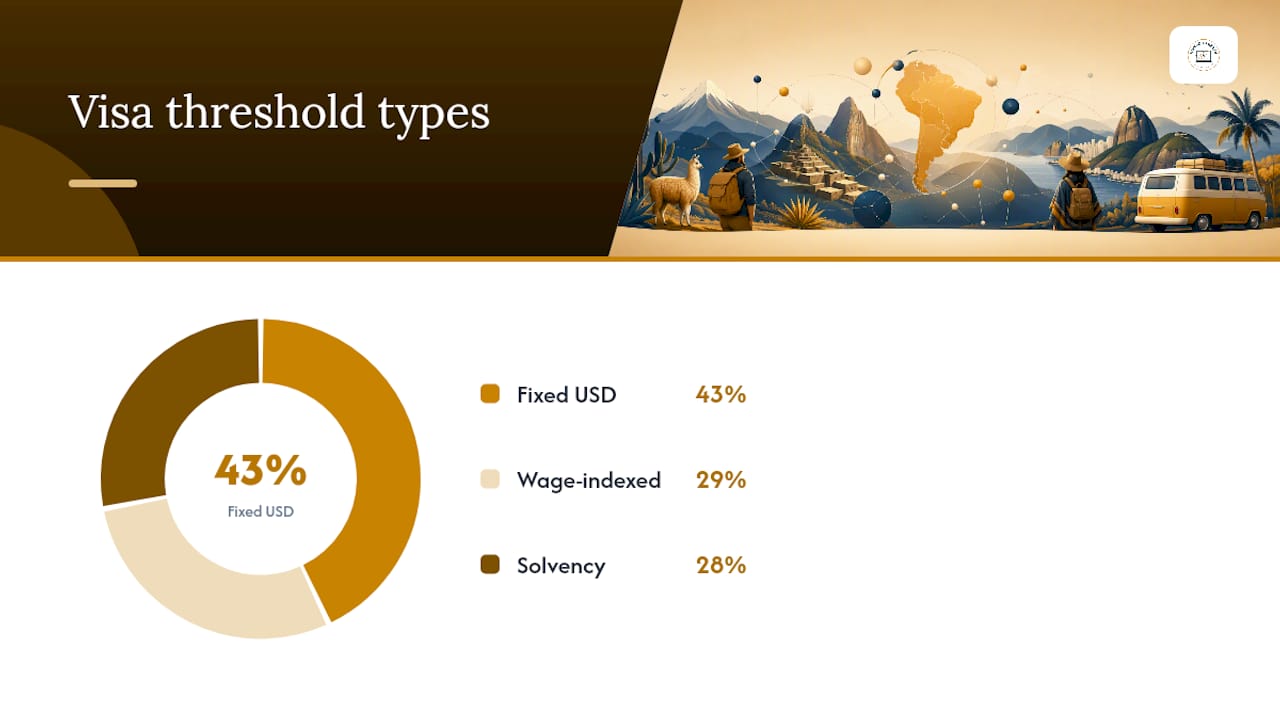
Income model is the first fork in the road. Brazil and Panama use fixed-dollar benchmarks ($1,500/month or $18,000 in savings for Brazil; roughly $36,000/year for Panama), which means your qualifying number doesn’t move year to year. Colombia and Ecuador use wage-indexed formulas tied to local minimum wage figures, so the bar can creep upward annually. Mexico and Argentina lean on solvency and case-by-case consular judgment rather than one clean number.
-
Fixed-USD threshold: Brazil, Panama, Costa Rica
-
Wage-indexed threshold: Colombia, Ecuador
-
Solvency/consular discretion: Mexico, Argentina
A useful way to think about the region: Brazil, Colombia, and Mexico represent three distinct operational models, according to policy analysis on Latin American nomad visa programs — a fixed-USD benchmark, a wage-indexed test, and a solvency-based temporary resident route that can eventually lead toward permanent residency. If you want a fast, predictable process for a year or two, Brazil’s flat figure is easier to plan around. If you’re thinking long-term and don’t mind Mexico’s consular variance, the temporary resident route opens a door that nomad-specific visas typically don’t.
Duration and renewability shape your tax exposure just as much as your travel plans. Colombia’s two-year Visa V sounds generous, but staying that long in one place makes tax residency almost unavoidable under most local tests. Argentina’s 180-day-plus-extension structure keeps you moving, which some nomads prefer specifically to avoid crossing residency thresholds anywhere.
Health insurance duration is not a formality. Insurance length can quietly cap your visa’s effective duration even when the law allows for longer. If Colombia grants a two-year visa but your policy only covers 12 months, immigration authorities may match your approved stay to the shorter of the two windows, according to practitioner guidance on Colombia’s nomad visa requirements. Buy insurance that covers your full intended stay, not just the minimum required to submit the application.
Application channels vary by country in ways that affect your timeline. Colombia and Brazil both offer online submission through consular portals. Argentina and Panama tend to require more in-person steps or additional local registration after arrival. Every country that grants entry still expects some form of local registration once you’re there, whether that’s Brazil’s Federal Police check-in or Colombia’s residency card pickup.
The tax question deserves its own line, separate from everything above: a visa is an immigration document. It says nothing about your tax obligations. Reporting on Latin American nomad programs consistently flags the 183-day rule and center-of-vital-interests tests as the real risk, since most countries in the region use one or both standards to determine tax residency independent of your visa status. Spend more than half the year in a country, or build your primary economic and family ties there, and you may owe local taxes even if your visa never suggested you would.
What Documents Do You Need Before Applying for a Nomad Visa?
Most rejections don’t happen because someone was ineligible. They happen because a document was formatted wrong, expired early, or came from the wrong level of government. Working through a checklist before you touch an application portal saves weeks.
-
Valid passport with at least six months of remaining validity beyond your intended stay.
-
Passport-style photos meeting the destination country’s exact specifications (background color and size requirements differ by country).
-
Employer or client service contract, notarized where the destination country requires it, clearly showing the remote nature of the work.
-
Three consecutive months of bank statements meeting or exceeding the required income floor, not just a single strong month.
-
Apostilled and translated documents for any paperwork issued outside the destination country, including criminal record certificates.
-
Federal-level criminal background certificate, not a state or municipal one, when the destination country requires it.
-
Compliant health insurance naming the specific coverages required (often including repatriation or medical evacuation) and running for your full intended visa term.
-
Proof of fee payment, kept as a receipt or confirmation screenshot.
-
Completed application form screenshots or confirmation numbers from the relevant online portal.
The single most common documentary failure is submitting a state or local criminal record when the destination requires a federal one. US applicants, for example, frequently submit a state police clearance when the country actually wants an FBI Identity History Summary. Authorities routinely reject the wrong document type outright rather than asking for a correction, which can cost weeks of resubmission time.
Two other patterns cause frequent denials. Some applicants try to prove income by averaging several months together rather than showing the required threshold in each individual month, which fails Colombia’s Visa V review in particular. Others buy health insurance that expires before their visa term ends, only to have their approved stay quietly shortened to match.
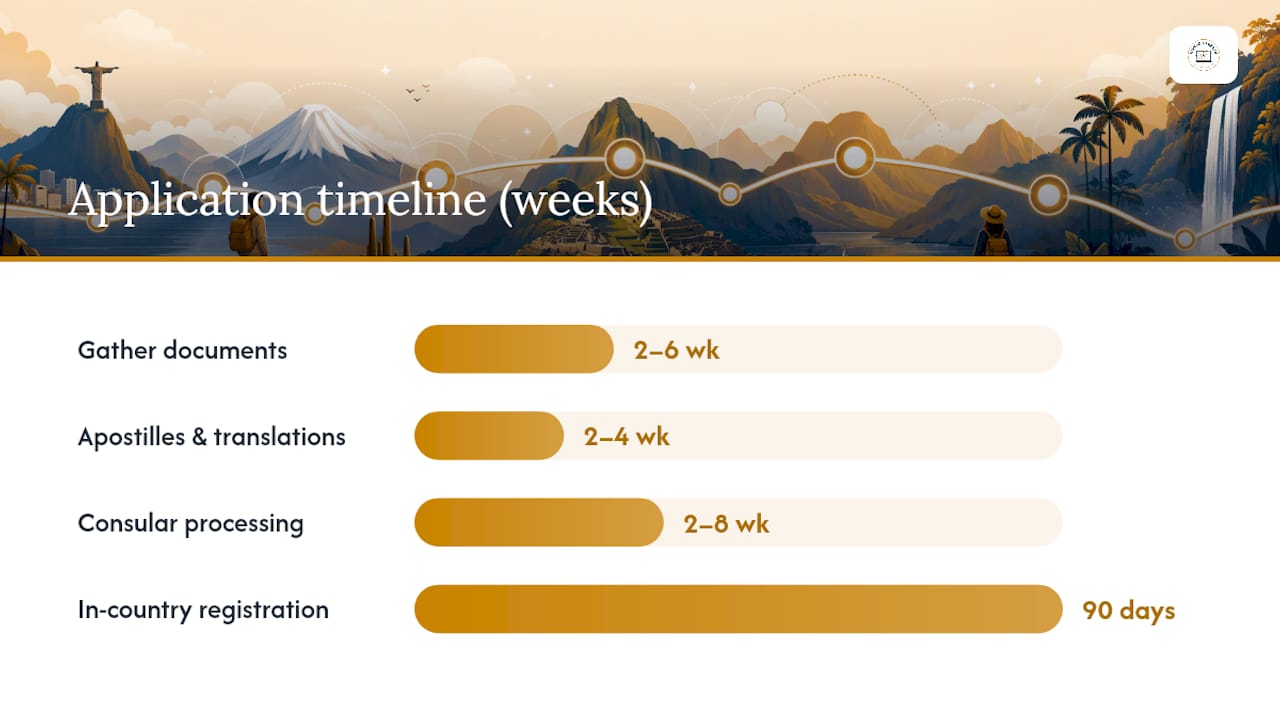
A realistic timeline looks like this: two to six weeks to gather documents, another two to four weeks for apostilles and certified translations, then two to eight weeks of processing time depending on the country, followed by in-country registration where required (Brazil’s 90-day Federal Police window being the clearest example).
Pro Tip: Build a digital packet with certified translations ready before you pick a target country. Nomad Careers’ remote job checklist outlines the income documentation formats employers commonly issue, which overlaps significantly with what immigration officers expect to see.
Where Should Nomads Live and What Does It Cost?
Accommodation costs swing dramatically across the region, and the gap often has less to do with country and more to do with neighborhood. A one-bedroom apartment in a well-connected part of Medellín or Buenos Aires can run a fraction of what the same square footage costs in Florianópolis or Montevideo’s Pocitos district. Short-term furnished rentals aimed at remote workers have become common in cities with existing nomad communities, and monthly rates typically undercut nightly Airbnb pricing once you commit to 30 days or more.
Brazil’s smaller coastal cities and Colombia’s secondary cities (Medellín over Bogotá, for instance) tend to offer better value than capital cities without much of a livability tradeoff. Buenos Aires remains one of the most affordable major capitals in the region for renters paying in foreign currency, largely because of Argentina’s ongoing currency volatility, though that same volatility makes budgeting unpredictable month to month.
Longer leases usually require a local guarantor or a larger upfront deposit, something landlords across the region use to offset the risk of renting to someone without local credit history. Many nomads solve this by starting with a furnished short-term rental for the first one to three months, then negotiating a longer, cheaper lease once they’ve established local relationships and can show a landlord proof of consistent income.
How Reliable Is Internet Access for Remote Work in South America?
Connectivity quality varies far more by city tier than by country border. Major urban centers, Bogotá, São Paulo, Buenos Aires, Santiago, Montevideo, generally offer fiber connections comparable to what you’d find in mid-sized cities in North America or Western Europe. Coworking spaces in these cities routinely advertise redundant connections specifically because power outages, not internet outages, are the more common disruption.
Smaller towns and coastal or rural areas tell a different story. Connection speeds drop, and outages last longer when they happen. Nomads working in places like Ecuador’s smaller coastal towns or Argentina’s Patagonian region often keep a mobile hotspot with a local SIM as backup, since mobile data networks in South America have expanded faster than fixed broadband infrastructure in many areas.
A practical habit worth adopting: test any rental’s actual connection speed before signing a lease longer than a week, using a speed test app on-site rather than trusting a listing’s advertised numbers. Landlords and short-term rental hosts routinely overstate connection quality, and the difference between “advertised” and “actual” speed is often the deciding factor in whether a location works for video calls during business hours back in your client’s time zone.
What Local Laws and Customs Should Remote Workers Know?
Working remotely for a foreign employer while physically present in a South American country almost always requires the correct visa category. Working on a tourist visa, even remotely for a company with no local presence, technically violates most countries’ immigration rules, and enforcement has tightened as governments have built out dedicated nomad categories specifically to capture and regulate this activity.
Local labor law rarely applies to nomad visa holders since, by design, these visas require foreign-source income and generally prohibit local employment or invoicing local clients. Colombia’s Visa V is explicit about this: local work is off-limits regardless of how the visa was obtained.
Cultural rhythms also shape how well remote work actually functions day to day. Business hours in much of South America run later into the evening than in North America or Northern Europe, and lunch breaks in some countries, particularly parts of Argentina and Chile, run longer than a typical US workday allows for. Video call scheduling across time zones benefits from building in that flexibility rather than assuming a strict nine-to-five rhythm on the other end.
How Does Double Taxation Work for Nomads in South America?
The 183-day rule gets most of the attention, but it’s not the only mechanism that can trigger tax residency. Several countries in the region also apply a center of vital interests test, looking at where your family lives, where your primary bank accounts sit, or where you maintain a permanent home, even if you haven’t crossed the day-count threshold. Analysis of nomad visa programs across the region consistently flags this dual-test structure as the source of tax risk that visas themselves don’t address.
Double taxation treaties add another layer worth understanding before you commit to a long stay. Several South American countries maintain tax treaties with the US, Canada, the UK, and EU member states, designed specifically to prevent the same income from being taxed twice. Whether a treaty actually helps you depends on your specific income type, employment structure, and how long you’ve been resident where. Freelancers invoicing directly are often treated differently than salaried employees on foreign payroll, so a treaty that shields one nomad’s income might not apply cleanly to another’s.
The safest approach is treating tax residency and immigration status as two entirely separate questions from day one, and consulting a tax professional familiar with both your home country’s rules and your destination’s specific treaty terms before you approach any 183-day mark.
Nomad Careers helps remote professionals find verified work-from-anywhere jobs that come with the kind of stable, well-documented foreign income these visa applications require. If you’re still weighing which country fits your situation, the full country-by-country visa guide breaks down over 65 programs beyond South America, and the remote job checklist walks through exactly what documentation employers typically provide to support your application.
Where Can You Verify These Visa Rules Directly?
Before filing anything, confirm current requirements directly with the source, since fees, thresholds, and processing times shift over time.
-
VITEM XIV — Brazil’s immigration policy portal for official income thresholds and registration rules
-
Brazil’s digital nomad visa consular guidance for application channel details
-
Colombia’s official visa application portal for current Visa V income figures and online filing
-
Argentina’s Migraciones portal for transitory residence terms and extensions
-
Fragomen’s practical guide to Brazil’s nomad visa for practitioner-level application steps
-
RioTimes’ analysis of Latin American nomad visa fine print for the gap between marketing claims and legal reality
-
Move to Paraguay’s regional residency comparison for a broader look at alternative long-term stay routes
This article is general information, not a substitute for advice from a qualified lawyer. Consult a qualified legal professional about your own circumstances before acting on anything here.