A transparent job posting names the countries or regions you’re permitted to work from, states time-zone or overlap expectations, discloses visa and sponsorship posture, defines the contract and payment model, and gives a realistic hiring timeline. That level of disclosure exists for a practical reason: it cuts down on wasted applications, sets clear compliance expectations upfront, and moves you toward an offer instead of a dead end.
TL;DR:
Job listings that specify permissible jurisdictions, time-zone requirements, and visa sponsorship details help you avoid legal and tax issues after accepting an offer.
Verifying employer identity through domain checks and asking for sponsorship terms in writing can prevent wasting time on fraudulent or vague postings.
Avoid listings that request payment upfront, ask for financial or personal details early, or lack clear application steps to protect yourself from scams.
Platforms like Nomad Careers verify listings manually, providing verified badges and detailed disclosures that reduce your risk when applying for remote roles.
Salary ranges, benefits, and career growth opportunities should be clearly stated to evaluate the true value and progression potential of remote roles.
The Transparent Job Postings Checklist: Fields Every Listing Should Include
Most job boards still publish listings that say “remote” and stop there. That single word tells you nothing about whether you can legally do the job from where you live, or whether the company will let you move once hired. Open job descriptions go further, and job postings with salary range disclosure are only one piece of a much larger transparency puzzle.
Here’s what to look for before you spend an hour on an application:
-
Permissible operating jurisdictions. The posting names specific countries or regions where you’re allowed to work, not just “remote” as a vague catch-all.
-
Time-zone requirements. It states overlap windows (for example, “4 hours overlap with Pacific Time”) or specific meeting hours you’d need to keep.
-
Visa or sponsorship stance. It says plainly whether the employer sponsors work visas, uses an Employer of Record (EOR), or requires you to already hold work authorization where you live.
-
Contract type and payment details. It specifies employee, contractor, or EOR status, along with currency and pay cadence.
-
Role scope. It lists seniority level, concrete deliverables, and any travel or on-call expectations.
-
Hiring timeline. It gives a realistic window from application to start date, including time for visa or EOR processing if relevant.
-
Verification cues. Look for an official company domain email, a named hiring manager, or a verified-listing badge from the job board itself.
Pro Tip: Save the listing as soon as you find it, screenshots included. Employers edit or delete postings after complaints, and you’ll want the original wording if a dispute over sponsorship or pay comes up later.
Why Location and Sponsorship Clarity Actually Matters
Vague listings don’t just waste your time. They create real financial and legal exposure once you accept an offer. When a posting omits sponsorship details, mismatches between the role and your visa eligibility commonly surface only after an offer is made, which is exactly when they cause missed start dates and abandoned hires, according to Boundless’s analysis of EOR compliance.
Assessing role-to-visa fit early in the hiring process avoids costly false starts, since location is the first decision that determines everything else about a cross-border hire, per Teamed’s 2026 guidance on sponsorship rules.
There’s also a quieter risk: tax and payroll exposure. “Remote” without a named jurisdiction can leave both you and the employer unclear on where taxes are owed or whether the company has created an unintended legal presence in your country. A posting that names its permissible jurisdictions upfront signals an employer that has already worked through those questions, which usually means fewer surprises for you down the line.
How to Verify a Listing Before You Apply
Treat every promising listing like a claim you need to test, not a fact you accept. This five-step sequence takes about fifteen minutes and catches most problems before you invest more time.
-
Run the quick-scan check first. Does the posting name a jurisdiction, a time-zone requirement, and a sponsorship stance? If two of three are missing, move on unless the company is otherwise well known to you.
-
Verify the poster’s identity. Check that the recruiting email comes from the company’s actual domain, not a lookalike or a free webmail address. Display names are trivial to fake, so inspect the exact sender domain and cross-check it against the company’s official site before replying with any personal information.
-
Evaluate the contract model. Note whether the employer mentions an EOR or says “contractors only.” An EOR relationship doesn’t automatically include visa sponsorship for you, so don’t assume it.
-
Get sponsorship details in writing. If the listing claims visa sponsorship, ask directly who pays the fees and what the expected timeline looks like. Ask this in writing, since EOR platforms often describe sponsorship options that require separate confirmation of cost and timing.
-
Document the start-date assumptions. If your start date depends on a visa or work permit being approved, get written confirmation of what happens if that approval is delayed.
Pro Tip: Copy this exact message when a listing is vague on sponsorship: “Can you confirm which jurisdictions this role can be performed from, whether sponsorship is available, who covers any visa fees, and the expected timeline from offer to start date?” A serious employer will answer within a day or two. Silence is itself useful information.
Red Flags: When to Walk Away From a Listing
Some warning signs are common enough that they deserve a permanent place in your mental checklist. The Federal Trade Commission’s guidance on job scams outlines the patterns that show up again and again in fraudulent postings:
-
Pay-to-apply requests. Any listing that asks for money before you’re hired, whether framed as a “training fee” or “background check fee,” is a scam.
-
Reshipping or equipment-purchase tasks. Being asked to receive and forward packages, or to buy equipment and get “reimbursed,” is a classic fraud pattern.
-
Fake-check schemes. You receive a check for more than your first paycheck and are told to wire back the difference. The check will bounce after the wire clears.
-
Instant offers with no interview. A real hiring process involves at least one conversation. An offer with zero screening is a signal to stop.
-
Requests for sensitive financial data early. Bank account numbers or Social Security numbers have no place in an initial application.
If you spot any of these, stop responding, report the listing to the platform that hosted it, and keep every email and screenshot in case you need to file a report later.
How Nomad Careers Verifies Listings and Cuts Your Risk
Manual verification is the part most job boards skip, because it’s slower than letting employers self-publish. Nomad Careers checks each listing by hand before it goes live, confirming the fields that matter most to a remote applicant.
A verified badge on Nomad Careers means someone has already confirmed:
-
The listing names permissible jurisdictions and time-zone expectations, not just the word “remote.”
-
The hiring manager and company domain check out, reducing your exposure to spoofed recruiters.
-
Sponsorship or contract terms are stated clearly enough to act on.
A verified badge tied to manual checks like these functions as a genuine trust signal for nomads evaluating unfamiliar employers, since it maps directly to the disclosure fields you’d otherwise have to chase down yourself. Pair that with the Remote Job Application Checklist, which walks you through the same verification steps covered above before you hit submit. Browsing verified work-from-anywhere listings is the fastest way to see what a fully disclosed posting actually looks like.
What Salary Disclosure Should Look Like in a Remote Listing
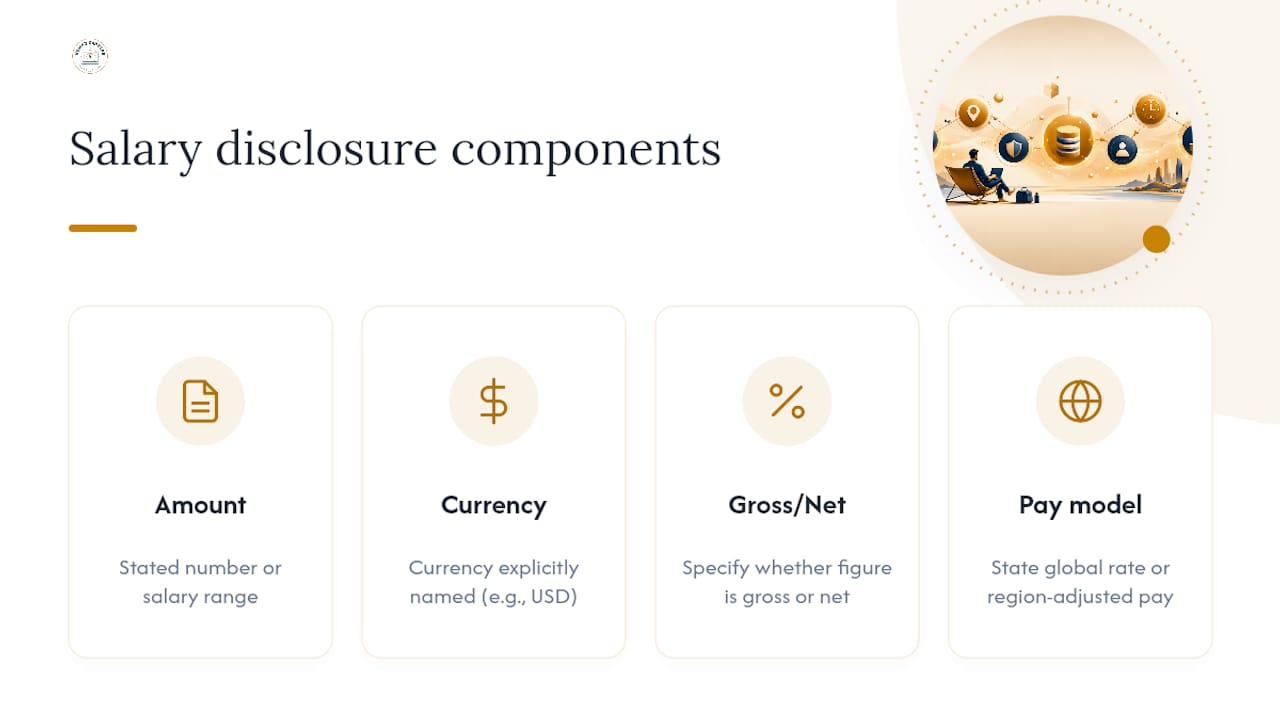
A number, or at least a range, belongs in every listing you’re serious about. Salary in job ads matters more for remote and international roles than for local ones, because currency, cost of living, and tax treatment can vary enormously between where the company is based and where you might be working from.
Look for a stated range rather than “competitive salary” or “based on experience.” A transparent listing also clarifies the currency (a $70,000 salary means something different if it’s USD versus a weaker local currency) and whether the figure is gross or net. Some employers state a single global rate; others adjust pay by region. Neither approach is wrong, but the posting should say which one applies to you, since an unstated pay model is one of the more common sources of post-offer disappointment.
If a listing omits pay entirely, that’s not automatically disqualifying, but it’s a reason to ask directly and early, ideally before a first call. An employer that hesitates to give you even a range once asked directly is telling you something about how the rest of the process will go.
Benefits and Perks: What a Complete Listing Discloses
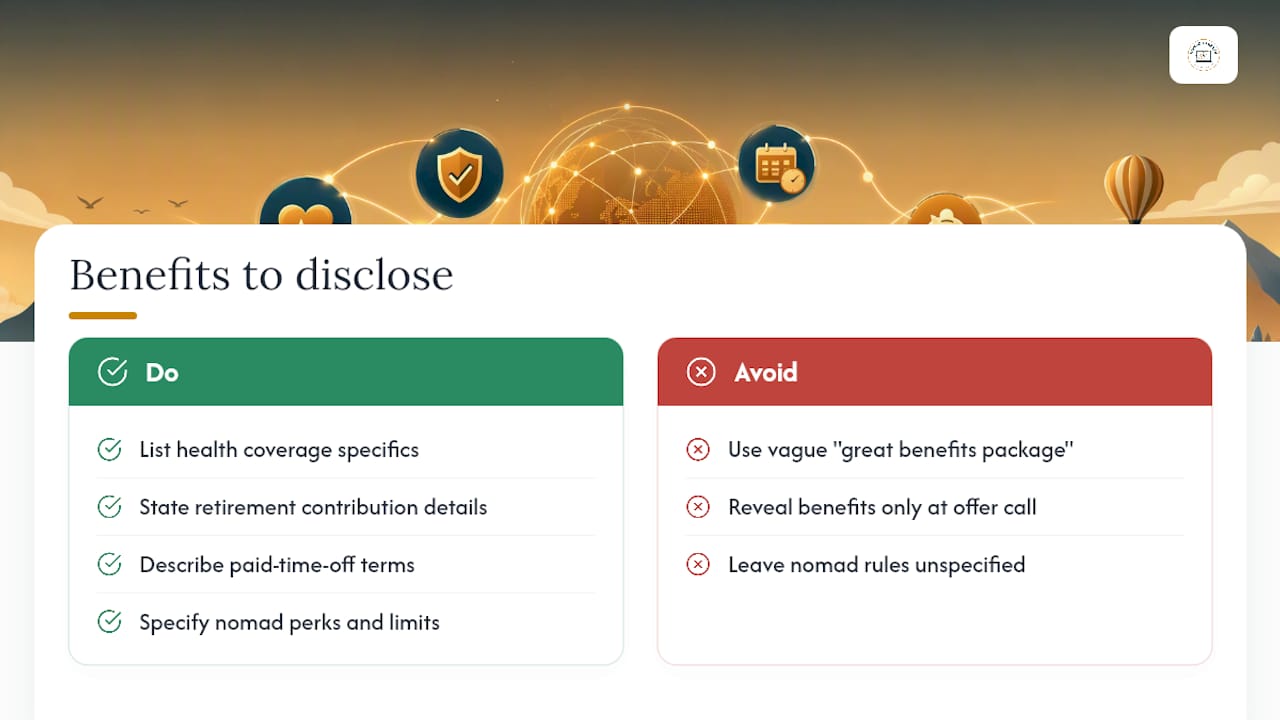
Salary is only part of total compensation, and honest hiring practices extend the same clarity to benefits. Health coverage, retirement contributions, paid time off, and equipment stipends should appear in the listing itself, not surface for the first time during an offer call.
For nomads specifically, a few benefits categories matter more than they would for office-based employees. Does the company provide or reimburse international health insurance? Is there a stipend for coworking space or travel? Are there limits on how many countries you can work from in a year, and does the benefits package change if you cross certain thresholds? A listing that addresses these specifics is telling you the employer has hired remote workers before and thought through what they actually need.
Vague phrasing like “great benefits package” without detail usually means the details haven’t been worked out yet, or the company doesn’t consider it worth stating upfront. Either way, ask for the specifics in writing before you accept anything.
Diversity and Inclusion Commitments Worth Taking Seriously
A diversity statement that reads as a single boilerplate sentence tacked onto the bottom of a listing tells you little. Clear commitments look different: they name specific practices, like structured interview scorecards, salary bands applied consistently across candidates, or accommodations processes for applicants with disabilities.
For a nomadic workforce spread across multiple countries and cultures, this matters practically as well as ethically. A company that has thought through inclusion for a distributed team usually addresses things like accessible communication norms across time zones, and whether performance reviews account for the fact that not everyone shares a native language with headquarters. Listings that name concrete practices, rather than repeating the phrase “we value diversity,” are worth more of your attention.
Matching Your Skills to What the Role Actually Requires
Required qualifications should separate what’s mandatory from what’s a bonus. A listing that stacks fifteen “requirements” without distinguishing must-haves from nice-to-haves is either poorly written or designed to discourage all but the most confident applicants, and neither is a great sign.
Look for specificity: “3+ years building React applications” tells you more than “strong front-end skills.” For remote-specific roles, the best listings also state whether prior distributed-team experience is required or simply preferred, since that experience genuinely predicts who adapts well to asynchronous work. If a listing asks for skills that seem disconnected from the actual role scope described elsewhere in the posting, treat that mismatch as a small red flag worth clarifying before you apply.
What a Clear Application Process Looks Like
Detailed application instructions save you from guessing. A transparent posting tells you exactly what to submit, whether that’s a resume, cover letter, portfolio links, or writing samples, and in what format. It also tells you where to send it, ideally through a tracked application system rather than a bare email address with no confirmation.
Watch for postings that specify next steps after you apply: an estimated response window, the number of interview rounds, and who you’ll be speaking with at each stage. Employers serious about hiring well tend to also explain what happens if you’re not selected, even briefly. If the instructions are missing or contradictory (a form that asks for information the job description never mentioned needing), treat that as a data point about how organized the hiring process will be overall.
Career Growth: What to Look for Beyond the Starting Role
A transparent posting says something about where the role could lead, not just what it pays on day one. That might mean a stated path from individual contributor to team lead, a defined review cycle with criteria for promotion, or budget for courses and certifications relevant to the role.
For remote and nomadic workers, growth signals matter differently than they might in an office. Ask whether advancement requires relocating, whether leadership roles are open to fully remote employees, and whether the company has actually promoted remote hires into senior positions before. A listing that addresses these questions directly, even briefly, tends to come from a company that has built real infrastructure for distributed careers rather than treating remote work as a temporary arrangement.
Find Verified, Transparent Remote Roles With Nomad Careers
Reading through checklists and red flags helps you evaluate any listing you find, but the faster path is starting with listings that have already been checked. There are platforms that manually verify postings before publication and focus exclusively on genuine work-from-anywhere roles rather than jobs that turn out to require relocation or fixed office hours once you dig in.
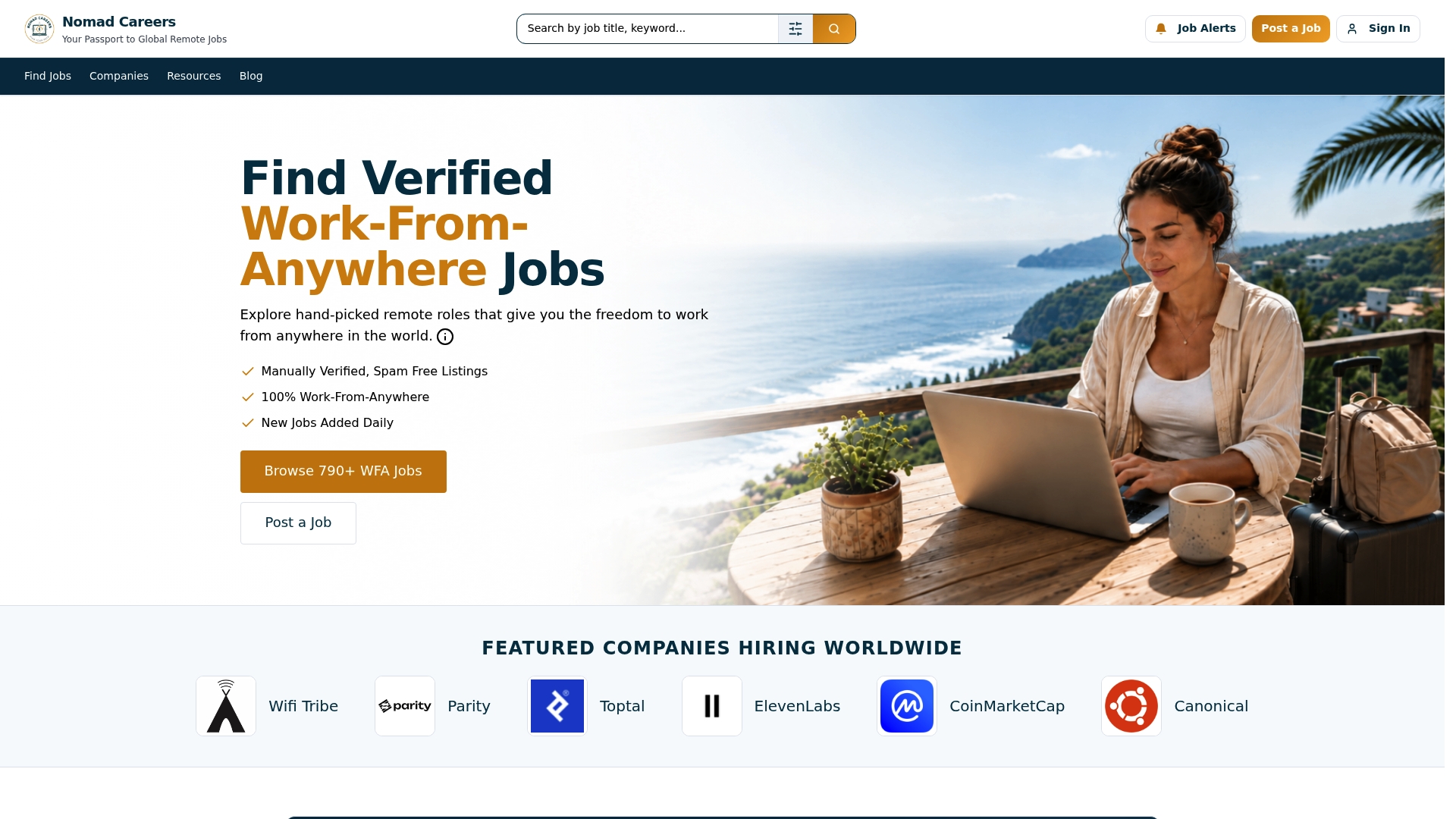
Manual review means the disclosures covered throughout this article, jurisdiction, time zone, sponsorship posture, contract type, are checked before a listing reaches you, cutting out the guesswork that comes with unverified boards. If you want a structured way to evaluate any offer that lands in your inbox, start with the Remote Job Application Checklist, then browse current verified listings to see the level of detail a properly disclosed posting should have. For employers hiring across borders, the platform’s compliance playbook covers what a transparent hiring process looks like from the other side of the table.