Portugal, Spain, Estonia, and Croatia lead Europe’s digital nomad visa options in 2026 and each solves a different problem. Portugal wins for those chasing eventual EU residency, Spain balances a moderate income bar with real tax planning, Estonia suits nomads who already run a company through e-Residency, and Croatia offers the simplest short-term stay with a genuine tax break. Eligibility, income thresholds, and tax treatment still depend heavily on your nationality and income structure, so treat the country snapshots below as your starting checklist, not the final word.
TL;DR:
Portugal remains the top choice for long-term EU residency with a visa requiring around 3,680 euros monthly income and a two-year initial stay.
Spain offers a one-year permit with income typically a few thousand euros per month, and benefits from the Beckham Law, but freelancers often do not qualify for the flat tax rate.
Croatia provides a straightforward, short-term visa with tax-exempt income, but it does not renew or lead to permanent residency, requiring departure after 12 to 18 months.
Estonia’s digital nomad visa demands a higher monthly income of about 4,500 euros net, but it allows a sole 12-month stay without renewal options.
Proper documentation, including consistent income proof and apostilled civil documents, is essential, and applicants should plan for processing times that can extend beyond two months.
Table of Contents
- Best European Digital Nomad Visa by Goal
- Country Snapshots: The Top 10 European Digital Nomad Visas
- Portugal (D8 Digital Nomad Visa)
- Spain (Digital Nomad Visa)
- Greece (Digital Nomad Visa)
- Croatia (Digital Nomad Visa)
- Estonia (Digital Nomad Visa)
- Italy (Digital Nomad Visa)
- Malta (Nomad Residence Permit)
- Czech Republic (Digital Nomad Program)
- Latvia (Digital Nomad Visa)
- Hungary (White Card)
- What Documents Do You Need Before Applying?
- How Long Does the Digital Nomad Visa Application Take?
- How Do Nomad Visas Affect Your Tax Residency?
- What Do Costs, Insurance, and Banking Look Like on the Ground?
- How Nomad Careers Simplifies the Income Proof Problem
- Does Brexit Change Anything for UK Nationals?
- What Trips Up Most Digital Nomad Visa Applications?
- Sources
Best European Digital Nomad Visa by Goal
Choosing a digital nomad visa Europe program isn’t really about finding “the best” one. It’s about matching a country’s rules to what you actually want out of the move. Someone chasing a five-year path to an EU passport has different priorities than someone who just wants six tax-free months on the Adriatic coast.
If your goal is long-term EU residency, Portugal’s D8 visa is the strongest option on the table. It renews, it stacks toward permanent residency, and it doesn’t require you to abandon a growing freelance business to qualify. If your goal is balancing income requirements with tax planning, Spain’s Digital Nomad Visa gives you up to five years of stay and, for some employees, access to a flat tax rate under the country’s special regime. If you want the cleanest, most tech-forward setup, Estonia’s combination of e-Residency and its dedicated nomad visa lets you run an EU-registered company while living somewhere else entirely, a structure few other countries replicate. And if you want the easiest short-term entry with a genuine tax perk, Croatia’s temporary stay permit for digital nomads comes with a stretch of tax-free income and comparatively light paperwork, even though it doesn’t renew into anything longer.
Here’s how the four stack up on the numbers that actually decide eligibility:
| Country | Income requirement | Max stay | Renewable / path to residency | Tax notes |
|---|---|---|---|---|
| Portugal | About €3,680/month (4x minimum wage) | 2 years initial | Yes, renewable, leads to permanent residency | IFICI regime replaced NHR; confirm current eligibility |
| Spain | An income requirement generally around mid-thousands of euros per month for the main applicant | 1 year, extendable to 5 years total | Yes, renewable | Beckham Law flat rate available for some employees, not freelancers |
| Estonia | About €4,500/month net | Up to 12 months | No, single-term visa | Standard Estonian income tax applies once resident |
| Croatia | Roughly €2,300 to €2,600/month depending on year | 12 to 18 months | No, does not renew or lead to residency | Income earned under the permit is tax-exempt in Croatia |
These figures shift year to year and by nationality, so check the official page for your target country before you build a moving plan around any single number. A recent industry roundup on European nomad visa options reaches a similar conclusion: Portugal, Spain, Greece, and Croatia dominate the conversation, but the right pick still depends on your income type and how long you plan to stay.
Country Snapshots: The Top 10 European Digital Nomad Visas
Every European country with a nomad visa uses its own income formula, its own stay length, and its own quirks around renewal. Below are the ten programs that come up most often in 2026 searches, with the details that actually matter for a decision.
Portugal (D8 Digital Nomad Visa)
-
Income requirement: About €3,680 per month, calculated as four times Portugal’s minimum wage
-
Stay length: Initial residence permit runs two years
-
Renewability: Renews and counts toward five years of residency, after which permanent residency or citizenship becomes possible
-
Application fee and timeline: Fees vary by consulate, typically in the €75 to €180 range; processing commonly takes 60 to 90 days
-
Tax notes: Portugal replaced its old Non-Habitual Resident regime with the IFICI scheme in 2024, and eligibility rules have kept shifting into 2026. Anyone counting on a specific tax rate should confirm current terms with a Portuguese tax advisor before relocating.
Portugal remains the most credible route to actual EU residency among nomad-specific visas, and that’s the whole reason it tops so many shortlists as explained in this complete guide to the digital nomad lifestyle. The tradeoff is paperwork: expect to submit tax returns, proof of address, and a Portuguese bank statement, on top of the standard income documents.
Spain (Digital Nomad Visa)
-
Income requirement: Typically a few thousand euros per month for the main applicant, with additional amounts for dependents
-
Stay length: Initial permit lasts one year if applied for from outside Spain, or three years if applied for as a residence permit from within Spain
-
Renewability: Renews in two-year increments up to five years total, matching Spain’s consular guidance
-
Application fee and timeline: Roughly €80 in consular fees; processing has stretched due to volume, often running 30 to 60 days or longer at busy consulates
-
Tax notes: Spain’s Beckham Law offers a flat 24% rate on Spanish-source employment income for qualifying new residents, but it was built for salaried employees relocating with a foreign employer. Freelancers and business owners frequently don’t qualify, a distinction that trips up a lot of applicants who assume the flat rate applies to everyone.
Spain’s program has become one of the highest-volume nomad visas in Europe since it launched in 2023, which is part of why processing times have lengthened.
Greece (Digital Nomad Visa)
-
Income requirement: Around €3,500 per month for the primary applicant
-
Stay length: Initial visa covers 12 months
-
Renewability: Convertible to a two-year residence permit, renewable after that
-
Dependents: Spousal and dependent add-ons apply, typically increasing the income floor by 20% for a partner and 15% per child
-
Tax notes: Greece offers a 50% income tax reduction for qualifying new tax residents for up to seven years, aimed at attracting exactly this kind of relocation
Greece’s appeal is largely lifestyle. Lower costs outside Athens, a well-established expat scene on islands like Crete, and a genuinely useful tax incentive make it a strong pick for anyone prioritizing quality of life over the fastest path to an EU passport.
Croatia (Digital Nomad Visa)
-
Income requirement: Roughly €2,300 to €2,600 per month, adjusted periodically
-
Stay length: 12 to 18 months depending on when you apply within the permit cycle
-
Renewability: Does not renew directly and doesn’t lead to permanent residency. Most holders must leave for six months before reapplying.
-
Application fee and timeline: Modest fees, generally under €100; Croatia’s interior ministry publishes detailed procedural guidance for the application
-
Tax notes: Income earned under the permit is exempt from Croatian income tax, one of the more generous short-term tax perks in Europe
Croatia is the visa to pick if you want a straightforward, well-documented process and don’t mind that it’s a dead end for long-term residency. The non-renewable structure is the single biggest thing people misunderstand about this program.
Estonia (Digital Nomad Visa)
-
Income requirement: About €4,500 net per month, one of the higher thresholds on this list
-
Stay length: Up to 12 months, single term
-
Renewability: Not renewable as the same visa type; applicants typically need to reapply after a gap
-
Application fee and timeline: Processed through Estonian embassies, generally within 30 days
-
Tax notes: Standard Estonian income tax applies once you meet local residency criteria; the visa itself doesn’t carry a special tax break
Estonia’s e-Residency program is separate from the Digital Nomad Visa, and mixing them up is common. E-Residency lets you register and run an Estonian company remotely from anywhere in the world; it does not grant you the right to live in Estonia. The Digital Nomad Visa does that, but requires its own income proof. Together, they suit founders who want an EU-based company structure alongside a temporary physical stay.
Italy (Digital Nomad Visa)
Italy introduced a dedicated digital nomad visa with an income requirement generally cited around €28,000 annually (roughly €2,300/month), aimed at highly skilled remote workers and freelancers. Applications route through Italian consulates, and the permit typically runs one year with renewal possible if conditions are still met. Documentation demands tend to run heavier than in Portugal or Croatia, including proof of prior remote work experience and specialized qualifications.
Malta (Nomad Residence Permit)
Malta’s residency programs, detailed on the national residency portal, include a nomad-specific track requiring proof of remote income, generally around €2,700 per month. The permit typically runs one year and is renewable up to a total of three years. Malta’s English-speaking environment and EU membership make it an easier adjustment for many English-speaking applicants than countries requiring immediate local-language fluency.
Czech Republic (Digital Nomad Program)
The Czech Digital Nomad Program, run through CzechInvest, targets skilled remote workers and freelancers from a defined list of eligible countries rather than opening to all nationalities. Income requirements and documentation vary by applicant category, and the program leans more toward freelancers in specific professional fields than a blanket remote-work visa. It’s worth checking the eligible-country list early, since this program isn’t universally open the way Portugal’s or Croatia’s visas are.
Latvia (Digital Nomad Visa)
Latvia’s digital nomad visa requires proof of income around 2.5 times the national average gross salary, which has generally landed near €3,300 to €3,700 per month depending on the year. The visa is issued for up to one year and is not renewable as the same category, similar to Estonia’s approach. Latvia’s application volume remains far lower than Spain’s or Portugal’s, which can mean faster processing at the consulate level.
Hungary (White Card)
Hungary’s White Card visa requires monthly income of roughly €3,000 and is aimed squarely at remote employees and freelancers working for non-Hungarian entities. The initial permit covers one year, renewable once for an additional year, capping total stay at two years without a separate residency track. Hungary’s lower cost of living relative to Western Europe makes the income bar comparatively easier to clear in practice, even though the nominal threshold looks similar to other countries on this list.
What Documents Do You Need Before Applying?
Every one of these programs asks for some version of the same core paperwork, even though the exact combination and required certifications vary by consulate. Building this file before you pick a consulate appointment saves weeks.
-
Valid passport with at least six months of remaining validity beyond your intended stay.
-
Passport photos meeting the destination country’s specific size and background requirements.
-
Proof of foreign income, structured differently depending on your work type: freelancers typically submit signed client contracts and the last three to six months of invoices; salaried remote employees submit an employment contract plus recent payslips; business owners submit company registration documents and either payroll or dividend records showing personal income.
-
Bank statements, usually the last three to six months, showing consistent deposits that match your claimed income.
-
Proof of health insurance valid in the destination country, meeting a minimum coverage amount, often €30,000.
-
Criminal record check from your country of residence, frequently required to be apostilled and translated.
-
Proof of accommodation, such as a lease agreement or hotel booking covering your initial stay.
-
Certified translations of any document not issued in the destination country’s official language, often required to come from a sworn or court-certified translator.
Dependents typically need their own set of documents: marriage or birth certificates, apostilled and translated, plus proof of relationship for anyone joining the primary applicant.
Pro Tip: Call or email the specific consulate you’ll be applying through, not just the country’s general immigration site, before you start collecting documents. Individual consulates sometimes add local requirements, like a notarized cover letter or extra photocopies, that don’t appear on the national guidance page.
How Long Does the Digital Nomad Visa Application Take?
The timeline runs in four broad phases, and the biggest variable is almost always document preparation, not government processing.
-
Pre-application (2 to 6 weeks): Gather income proof, get translations and apostilles done, secure health insurance, and book your consulate appointment. Some countries, including Portugal and Estonia, allow parts of this process online; others require an in-person consulate visit from the start.
-
Submission and biometrics (same day): At your appointment, you’ll submit your full document set, pay the application fee, and typically have fingerprints and a photo taken as part of biometric registration.
-
Processing (4 to 12 weeks): Spain and Portugal have seen longer waits due to application volume, sometimes stretching past 90 days. Estonia and Croatia tend to move faster, often landing within 30 to 45 days when the file is complete on the first try.
-
After approval: Collect your visa or residence card, then handle local registration, which usually means registering your address with municipal authorities, applying for a local tax number, and enrolling in the national health system or activating your private policy. Skipping local registration is one of the most common reasons nomads run into fines or renewal problems later.
How Do Nomad Visas Affect Your Tax Residency?
The single most misunderstood rule across every digital nomad visa Europe program is the 183 day threshold. Spend more than roughly half the year in most European countries and you typically become a tax resident there, regardless of what your visa is called or what income you earn from abroad. That threshold isn’t identical everywhere; some countries count differently, and a few trigger residency through “center of vital interests” tests even before you hit 183 days.
-
Spain’s Beckham Law offers a flat 24% rate on Spanish-source employment income, but it’s built for employees with a foreign employer, not freelancers or business owners. Confusing eligibility here is one of the most common and costly mistakes applicants make.
-
Portugal’s shift from NHR to IFICI changed who qualifies for reduced tax treatment, and the rules have kept moving through 2025 and 2026. Don’t assume the tax benefits you read about in an older article still apply.
-
Croatia’s tax exemption only covers income earned during the specific permit period, and it disappears the moment your permit lapses or you exceed the stay limit.
-
US citizens carry an added layer: American tax obligations don’t disappear just because you’re living abroad. The IRS still requires citizens and resident aliens abroad to file, even when foreign-earned income exclusions reduce what’s owed.
Get a tax opinion from a professional licensed in your destination country before you commit to a full year abroad, not after. The cost of that consultation is small compared to discovering, eight months into a move, that you owe tax in two countries on the same income.
What Do Costs, Insurance, and Banking Look Like on the Ground?
Your monthly budget needs to clear the visa’s income floor with room to spare, and where you land in Europe changes that math substantially.
-
Western Europe (Portugal’s cities, Spain’s coast, Malta) runs higher, often €1,800 to €2,800 per month for a single nomad covering rent, food, and basics.
-
Eastern and Southeastern Europe (Croatia outside Dubrovnik, Latvia, Hungary, the Czech Republic) can land closer to €1,000 to €1,600 per month for a similar lifestyle.
-
Health insurance needs to meet each country’s minimum coverage threshold, commonly €30,000, and providers offering international nomad-specific policies are generally easier to get approved with a consulate than short-term travel insurance.
-
Banking matters more than most applicants expect: consulates want statements that clearly show consistent deposits, so an international account or a well-documented business account for e-Residency company owners tends to move applications faster than scattered personal transfers.
-
Connectivity is rarely an issue in the hub cities, Lisbon, Porto, Split, Tallinn, and Budapest all have dense co-working scenes, though smaller towns can mean hunting for reliable fiber.
The most popular European nomad destinations tend to cluster around exactly this combination: decent connectivity, an established expat community, and costs that leave breathing room under the visa’s income requirement.
How Nomad Careers Simplifies the Income Proof Problem
The hardest part of most applications isn’t the visa form. It’s proving that your income is real, foreign, and stable enough to satisfy a consulate officer who’s never heard of your employer. A verified remote job with a documented contract and consistent payslips solves that problem far more cleanly than freelance income spread across five different clients.
Some job boards manually verify listings, which can help provide employment records with signed offer letters, clear pay structures, and legitimate companies that consulates recognize. Readers narrowing down a country can also cross-reference 65+ countries offering digital nomad visas to see how income thresholds stack up before committing to one application.
Does Brexit Change Anything for UK Nationals?
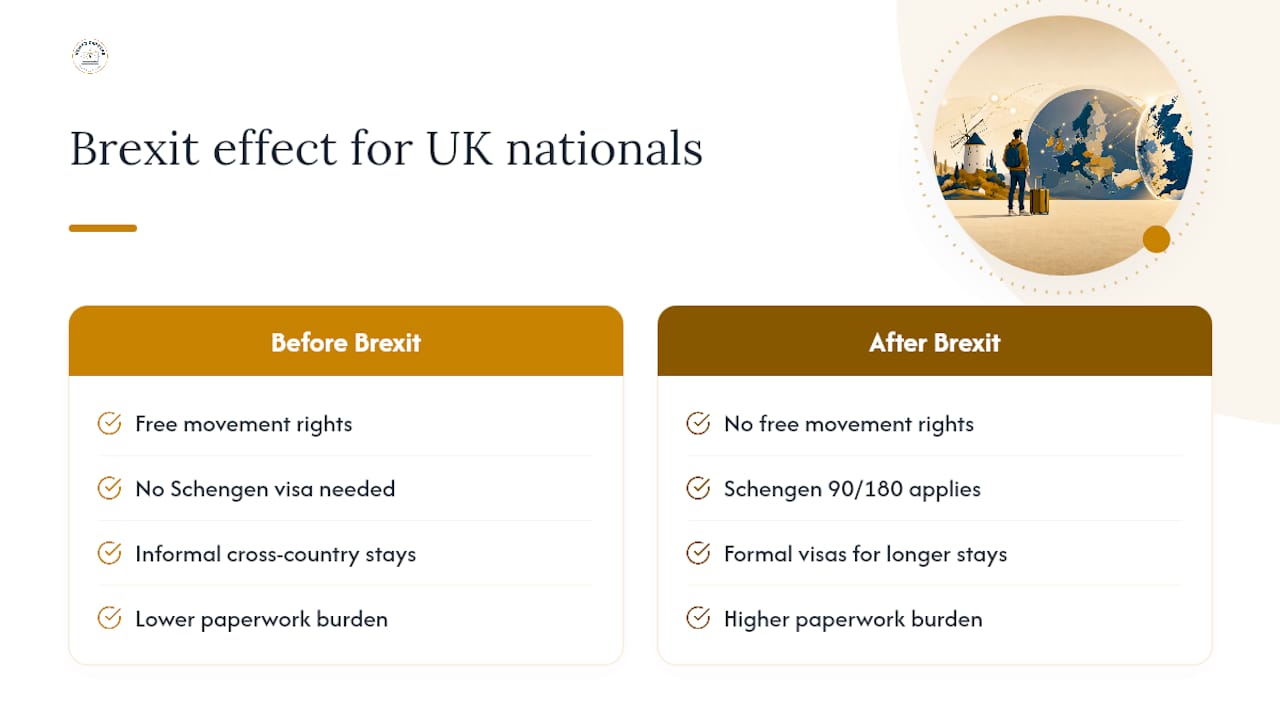
Brexit removed the free movement rights UK citizens once had across the EU, which means British nationals now apply for European digital nomad visas the same way any other non-EU applicant does. No exemptions, no shortcut queue.
Practically, this shows up in a few specific ways. UK nationals lost the automatic right to work and live anywhere in the EU without a visa, so a British freelancer who used to split time between Portugal and Spain informally now needs a formal visa for stays beyond 90 days in any 180-day window under the Schengen rule. That 90/180 day cap applies regardless of intent, and it catches people who assumed short repeated trips wouldn’t count against them.
The upside is that UK nationals qualify for every digital nomad visa Europe country on this list under the same terms as applicants from the US, Canada, or Australia. Portugal, Spain, Croatia, and the rest don’t distinguish against UK citizens specifically. The paperwork burden is simply heavier than it was before 2021, since a UK passport no longer functions as an EU entry pass. Anyone relocating from the UK should also check whether their existing private pension, ISA, or investment accounts remain straightforward to manage while classified as a tax resident elsewhere, since some UK providers restrict account access for non-resident customers.
What Trips Up Most Digital Nomad Visa Applications?
Most rejections and delays trace back to a small handful of repeatable mistakes, not bad luck or an unreasonable consulate officer.
Income documentation that doesn’t match the required format is the most common issue. A freelancer submitting a single large invoice instead of a consistent monthly pattern often gets flagged, because consulates want to see stability, not a one-time payout. Fix this by presenting at least three to six months of steady deposits before you apply.
Missing or incorrect apostilles on criminal record checks and civil documents cause avoidable delays. Apostille requirements vary by country of origin, and processing an apostille itself can take two to four weeks in some jurisdictions, a timeline people frequently forget to build into their schedule.
Underestimating processing time leads to booked flights and signed leases before a visa is even approved. Spain and Portugal, in particular, have seen application backlogs stretch well past their published estimates during peak seasons.
Confusing eligibility for special tax regimes, especially Spain’s Beckham Law, causes people to plan a move around tax savings they never actually qualify for. Verify eligibility with a tax professional before, not after, submitting your visa application.
Skipping local registration after arrival creates problems at renewal time. Municipal registration and tax number applications aren’t optional add ons; they’re usually a prerequisite for accessing healthcare and renewing your permit later.