For most small U.S. teams under 50 employees, OnPay is the strongest Gusto alternative on price and simplicity; Rippling is the pick for startups that need HR, IT, and payroll unified; Justworks or TriNet fit founders who want PEO-level benefits access; and Deel is the right call the moment you hire an employee abroad. If you are running a U.S.-only team with fewer than 50 people and Gusto’s predictable per-employee pricing already works for you, staying put is a legitimate choice. The table below maps each alternative to the company shape it fits best.
Gusto’s Simple plan starts at a monthly base fee plus a per-employee charge, with higher tiers priced accordingly and Premium available on custom pricing. That transparency is genuinely hard to match. Where Gusto falls short is multi-state complexity, international employee payroll (contractor payments reach 120+ countries, but native global employee payroll is U.S.-only), and the kind of HR depth that growing teams eventually need. The alternatives below address each of those gaps.

The table below covers every SERP-consensus entrant. Pricing examples reflect common published ranges; modular vendors can stack significantly higher depending on which modules you activate.
| Platform | Best For | Pricing Snapshot | Payroll Features | HR Features | PEO Available | Multi-State Support | Key Differentiator |
|---|---|---|---|---|---|---|---|
| OnPay | Cost-sensitive small U.S. teams | Flat rate pricing; $6 per employee per month | Full-service, automated tax filing, garnishments | Benefits admin, onboarding | No | Yes, all 50 states | Predictable flat-rate floor below Gusto |
| Rippling | Tech-forward startups needing HR+IT+payroll unified | Core ~$8/employee/mo; payroll module adds ~$8; IT/device ~$10; total often $35–$50/employee/mo | Full payroll, tax filing, contractor support | Full HRIS, benefits, onboarding | No (EOR available) | Yes, global | Deep IT provisioning and unified employee lifecycle |
| ADP Run | Organizations needing strong compliance and garnishment support | Quote-based; typically $59–$150+/mo base + per-employee | Full payroll, garnishments, tax filing | HR tools, compliance | No | Yes, all 50 states | Long market track record, strong compliance |
| Paychex / Paychex Flex | Growing SMBs wanting HR depth and dedicated specialists | Quote-based; starts ~$39/mo + per-employee | Full payroll, tax filing, garnishments | Full HR suite, dedicated HR specialist option | No | Yes, all 50 states | Dedicated specialist access; broad HR feature set |
| QuickBooks Payroll | Companies already on QuickBooks | Core $45/mo + $6/employee; Premium $80/mo + $8/employee | Full payroll, tax filing | Basic HR, benefits | No | Yes, all 50 states | Native QuickBooks accounting sync |
| Justworks | Startups wanting richer group benefits via PEO | ~$59–$99/employee/mo (PEO model) | Full payroll via PEO | Benefits admin, onboarding, compliance | Yes (PEO) | Yes | PEO co-employment; large-group benefits access |
| Deel | Companies hiring employees or contractors across many countries | Contractor from $29/contractor/mo; EOR from $599/employee/mo | Contractor payroll, EOR payroll, tax compliance | Onboarding, compliance | EOR (not traditional PEO) | Global (150+ countries) | Largest EOR and contractor-country coverage |
| BambooHR | Companies wanting HRIS depth separate from payroll | Pricing not publicly listed; quote-based | Payroll add-on available | Full HRIS, onboarding, performance | No | Yes (with payroll add-on) | HRIS-first; pairs well with external payroll tools |
| Square Payroll | Retail and hourly-first Square merchants | $35/mo + $6/employee (employees); $6/contractor/mo | Full payroll, tax filing | Basic HR | No | Yes, all 50 states | Tight Square POS integration |
| TriNet | Firms wanting PEO-level benefits and HR outsourcing | Quote-based; typically $80–$150+/employee/mo | Full payroll via PEO | Full HR outsourcing, benefits | Yes (PEO) | Yes | PEO expertise; established benefits access |
| Paylocity | Mid-market employers needing richer HR workflows | Quote-based | Full payroll, tax filing | Full HRIS, performance, learning | No | Yes, all 50 states | Feature depth for established HR teams |
| SurePayroll | Very small businesses and accountants | ~$19.99/mo + $4/employee | Full payroll, tax filing | Basic HR | No | Yes, all 50 states | Accountant-friendly; low entry cost |
| Papaya Global | Companies requiring global payroll and EOR in multiple jurisdictions | EOR from ~$650/employee/mo; payroll from ~$25/employee/mo | Global payroll, EOR, contractor | Onboarding, compliance | EOR | Global (160+ countries) | Global payroll/EOR specialization |
| ADP Global Payroll | Large organizations with multinational payroll | Quote-based | Global payroll, tax compliance | HR tools | No | Global | Scale and global compliance reach |
| TimeTrex | Businesses prioritizing time & attendance for hourly workforces | Free open-source tier; cloud plans vary | Payroll with time integration | Scheduling, attendance | No | Yes | Strong time-tracking and scheduling |
| Remote | Employers hiring employees abroad needing EOR | EOR from $599/employee/mo; contractor from $29/contractor/mo | EOR payroll, contractor payments | Onboarding, compliance | EOR | Global (180+ countries) | EOR coverage; transparent published pricing |
| Workstream | Businesses managing large hourly workforces across locations | Quote-based | Payroll, tax filing | Hiring, scheduling, onboarding | No | Yes | Hiring-to-pay workflow for hourly teams |
| Homebase | Small businesses focused on scheduling and time tracking | Free scheduling tier; payroll add-on ~$39/mo + $6/employee | Payroll via integration | Scheduling, time clock | No | Yes | Scheduling-first; payroll integrations |
| Thera | Payments-first workflows; YC-backed modern payroll | Pricing not publicly listed | Payroll, contractor payments | HR tools | No | Yes | YC-backed; payments-first approach |
| Warp | Scaling startups seeking multi-state payroll support | Pricing not publicly listed | Full payroll, multi-state tax | HR tools | No | Yes, multi-state focus | Positioned for growth-stage startup payroll |
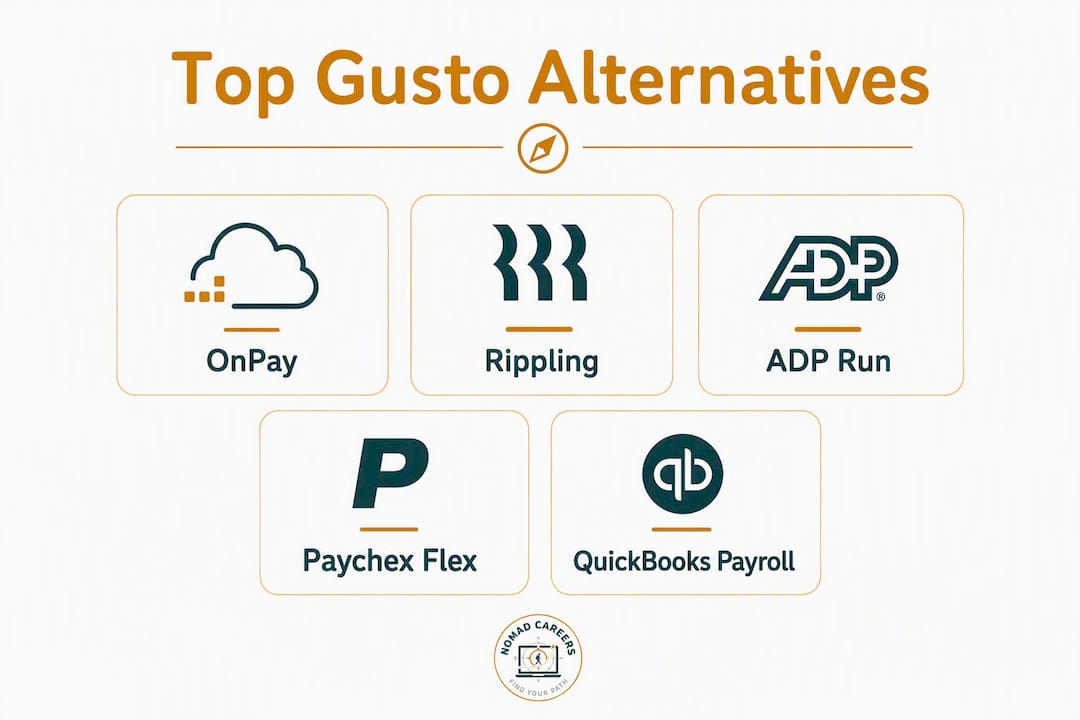
When Gusto remains the better choice: If your team is U.S.-only, under 50 employees, and you value predictable per-employee pricing with minimal setup friction, Gusto’s Simple or Plus plan is hard to beat. The alternatives above earn their place only when you have a specific gap: lower cost, international hires, PEO benefits, or HR+IT consolidation.
Pros/cons snapshot for the top shortlist picks:
- OnPay: Pro: flat-rate pricing with no modular surprises; full-service tax filing included. Con: fewer HR features than Gusto Plus; no PEO option.
- Rippling: Pro: unmatched HR+IT+payroll unification; global EOR available. Con: modular pricing stacks quickly to $35–$50/employee/mo for multiple modules.
- Justworks: Pro: PEO co-employment unlocks large-group health benefits. Con: higher per-employee cost than payroll-only tools; co-employment model is not right for every founder.
- Deel: Pro: broadest EOR and contractor-country coverage for international hires. Con: EOR pricing starts around $599/employee/mo, which is cost-prohibitive for small domestic teams.
Table of Contents
- Profiles: what does each platform actually offer?
- OnPay
- Rippling
- ADP Run
- Paychex / Paychex Flex
- QuickBooks Payroll
- Justworks
- Deel
- BambooHR
- Square Payroll
- TriNet
- Paylocity
- SurePayroll
- Papaya Global
- ADP Global Payroll
- TimeTrex
- Remote
- Workstream
- Homebase
- Thera
- Warp
- How do you choose the right Gusto alternative for your company?
- Decision framework by company shape
- Questions to ask every vendor on a demo
- Red flags to watch for
- Migration checklist and timeline
- Payroll-first vs. unified platforms: what the tradeoffs actually look like
- Key Takeaways
- What the right pick usually comes down to
- Sources and further reading
- Recommended
- How do the top Gusto alternatives compare at a glance?
Profiles: what does each platform actually offer?
OnPay
OnPay targets cost-sensitive small U.S. teams that want full-service payroll without the modular pricing risk. Its flat-rate structure keeps costs predictable at $6 per employee per month, and automated tax filing across all 50 states is included. Benefits administration and basic onboarding are built in. There is no PEO option. Migration from Gusto is generally low-effort: OnPay provides data import tools and most teams go live within a few days.
Switching effort: Low. Estimated time to live: 3–5 business days.
Rippling
Rippling is an operations platform, not just a payroll tool. It combines HR, IT device and app provisioning, and finance modules in a single system. For a 10-person startup, the core platform starts around $8/employee/mo, but adding payroll, IT management, and benefits administration can bring the total to $35–$50/employee/mo. That cost is justified when you need unified provisioning: a new hire gets their laptop, software access, and payroll enrollment from one workflow. Implementation typically runs 2–8 weeks depending on module count.
Switching effort: Medium to high. Estimated time to live: 2–8 weeks.
ADP Run
ADP Run suits organizations that need entrenched payroll processes, garnishment handling, and broad compliance coverage. Pricing is quote-based, which means you will need to negotiate. The platform’s long track record is its main credential: ADP has processed payroll for decades and its compliance infrastructure reflects that depth. HR tools are available but feel secondary to the payroll engine.
Switching effort: Medium. Estimated time to live: 1–3 weeks.
Paychex / Paychex Flex
Paychex scales from small businesses to mid-market employers and offers a dedicated HR specialist option that Gusto does not match. Paychex Flex is the self-serve version; full Paychex adds hands-on HR support. Both cover all 50 states for payroll and tax filing. Pricing is quote-based, so request a line-item breakdown before signing.
Switching effort: Medium. Estimated time to live: 1–3 weeks.
QuickBooks Payroll
If your accounting already runs on QuickBooks, this is the lowest-friction payroll option. The native sync eliminates manual journal entries and reconciliation errors. The Core plan runs $45/mo plus $6/employee; Premium is $80/mo plus $8/employee. HR features are thin compared to Gusto Plus, but the accounting integration is genuinely tight.
Switching effort: Low (for existing QuickBooks users). Estimated time to live: 1–3 days.
Justworks
Justworks and TriNet operate as PEOs, which means they become the employer of record for benefits purposes. That co-employment model unlocks large-group health plan rates that a 15-person startup could never access independently. The tradeoff is cost: expect $59–$99/employee/mo, which is materially higher than payroll-only tools. Justworks is suitable when richer benefits access is the actual problem you are solving, typically involving higher per-employee costs.
Switching effort: Medium. Estimated time to live: 2–4 weeks.
Deel
Deel is purpose-built for international hiring. It supports EOR services in 150+ countries and contractor payments globally. Gusto’s native employee payroll is U.S.-only; Deel fills that gap directly. EOR pricing starts around $599/employee/mo, which reflects the local statutory compliance Deel assumes on your behalf. For domestic-only teams, Deel is overkill.
Switching effort: Low for contractor setup; medium for EOR. Estimated time to live: 3–7 days for contractors; 2–4 weeks for EOR.
BambooHR
BambooHR is an HRIS first. It handles onboarding, performance management, and employee records with more depth than Gusto’s HR tools, but it is not a standalone payroll processor. Most teams pair it with a dedicated payroll tool. Pricing is quote-based. The right fit is a company that wants to separate its HRIS from its payroll engine and manage each with a best-of-breed approach.
Switching effort: Low to medium. Estimated time to live: 1–2 weeks.
Square Payroll
Square Payroll makes sense for retail and food-service businesses already using Square for payments. The POS integration means tips, hours, and pay are connected without manual data transfer. At $35/mo plus $6/employee for W-2 workers, pricing is competitive. HR features are minimal.
Switching effort: Low (for Square merchants). Estimated time to live: 1–3 days.
TriNet
TriNet is a full PEO with an established service model and broad benefits access. Like Justworks, it assumes co-employment. TriNet tends to serve slightly larger small businesses and offers industry-specific HR expertise. Pricing is quote-based and typically higher than payroll-only platforms.
Switching effort: Medium. Estimated time to live: 2–4 weeks.
Paylocity
Paylocity targets mid-market employers that have outgrown basic payroll tools and need richer HR workflows: performance management, learning, and engagement features alongside payroll. It is a strong fit for companies with a dedicated HR team. Pricing is quote-based.
Switching effort: Medium. Estimated time to live: 2–4 weeks.
SurePayroll
SurePayroll is a full-service payroll option, with a flat-rate structure of $19.99 per month plus $4 per employee. It is accountant-friendly and straightforward, which makes it a good fit for very small businesses that need basic payroll processing without extra features.
Switching effort: Low. Estimated time to live: 2–4 days.
Papaya Global
Papaya Global specializes in global payroll and EOR across 160+ countries. It is built for companies managing payroll in multiple jurisdictions simultaneously. EOR pricing starts around $650/employee/mo; managed payroll starts around $25/employee/mo. For domestic-only teams, this is not the right tool.
Switching effort: Medium. Estimated time to live: 2–4 weeks.
ADP Global Payroll
ADP’s global payroll solution targets large organizations with multinational payroll operations. It brings ADP’s compliance infrastructure to international payroll. Pricing is quote-based and typically suited to organizations with significant headcount and dedicated payroll staff.
Switching effort: High. Estimated time to live: 4–12 weeks.
TimeTrex
TimeTrex leads with time and attendance, not payroll. It is a strong fit for businesses with complex hourly scheduling needs. An open-source tier is available; cloud plans vary. Payroll is available but secondary to the time-tracking engine.
Switching effort: Low to medium. Estimated time to live: 1–2 weeks.
Remote
Remote offers EOR services in 180+ countries and publishes its pricing transparently: EOR from $599/employee/mo and contractor management from $29/contractor/mo. That pricing clarity is a genuine differentiator among EOR providers. For employers hiring employees abroad, Remote and Deel are the two most direct comparisons.
Switching effort: Low for contractors; medium for EOR. Estimated time to live: 3–7 days for contractors; 2–4 weeks for EOR.
Workstream
Workstream is built for businesses managing large hourly workforces across multiple locations. It connects hiring, scheduling, and payroll in a single workflow, which reduces the manual handoffs that slow down high-volume hourly operations. Pricing is quote-based.
Switching effort: Medium. Estimated time to live: 1–3 weeks.
Homebase
Homebase starts as a scheduling and time-clock tool, with payroll available as an add-on. The free scheduling tier makes it accessible for very small hourly teams. The payroll add-on runs approximately $39/mo plus $6/employee. It integrates with several payroll processors if you prefer to keep scheduling and payroll separate.
Switching effort: Low. Estimated time to live: 3–5 days.
Thera
Thera is a YC-backed platform with a payments-first approach to payroll and workforce management. Specific pricing is not publicly listed. It is worth evaluating for founders who want a modern, payments-oriented payroll tool and are comfortable with an earlier-stage product.
Switching effort: Low to medium. Estimated time to live: 1–2 weeks.
Warp
Warp is positioned specifically for growth-stage startups managing multi-state payroll complexity. Pricing is not publicly listed. If your team is scaling across states quickly and Gusto’s multi-state handling is the specific friction point, Warp is worth a demo.
Switching effort: Low to medium. Estimated time to live: 1–2 weeks.
Pro Tip: Before requesting demos, list every state where you currently have employees and every state where you plan to hire in the next 12 months. Vendors handle multi-state tax registration and filing very differently, and that list will immediately reveal which platforms can serve you without manual workarounds.
How do you choose the right Gusto alternative for your company?
Decision framework by company shape
Start with your hiring geography and headcount trajectory, not the feature list.
- U.S.-only, under 50 employees, payroll-first: OnPay or SurePayroll. Both offer full-service payroll at a lower or comparable cost to Gusto with no modular pricing risk.
- Multi-state U.S. employer: ADP Run, Paychex Flex, or Warp. All three handle multi-state tax registration and filing natively.
- Scaling startup needing HR+IT unification: Rippling. The unified provisioning model justifies the higher per-employee cost once you have IT device management and app access to coordinate.
- Benefits-driven startup: Justworks or TriNet. PEO co-employment is the only way to access large-group health plan rates at small-team headcount.
- International hires (employees, not just contractors): Deel, Remote, or Papaya Global. These are EOR providers; they assume local statutory compliance that a U.S. payroll processor cannot handle.
Questions to ask every vendor on a demo
- What is the all-in per-employee monthly cost at my current headcount, and what triggers a price increase?
- Are there modules I will likely need in 12 months that are not included in the base price?
- How do you handle mid-month headcount changes — is billing prorated or retroactive?
- Which states do you file payroll taxes in natively, and which require manual registration on my part?
- What is your EOR country coverage, and what is the per-employee cost in the countries I need?
- What accounting, time-tracking, and benefits broker integrations are available, and are any of them add-on fees?
- What are your support hours and guaranteed response SLAs for payroll errors?
- In what formats can I export my payroll history, employee records, and PTO balances if I switch later?
- What security certifications do you hold — SOC 2 Type II, GDPR, or others relevant to my data?
Red flags to watch for
- Quote-only pricing with a minimum 12-month commitment and no published rate card.
- Retroactive billing for mid-month headcount additions (common in modular platforms).
- No dedicated migration support or parallel payroll run option.
- Vague answers on tax-error remediation: who pays penalties if a filing is late or incorrect?
- Mobile app with limited functionality — if your managers approve timesheets on mobile, test the app before signing.
Migration checklist and timeline
What to prepare before you switch:
- Export all historical pay runs (at minimum the current calendar year).
- Download W-2 and 1099 data for the prior two years.
- Collect employee IDs, Social Security numbers, pay rates, and direct deposit details.
- Export current PTO balances and accrual policies.
- Note all active benefits enrollments and carrier contacts.
- Confirm your payroll tax account numbers for every state where you have employees.
Staged timeline:
| Team size | Data export | Parallel payroll run | Benefits cutover | Final switch |
|---|---|---|---|---|
| Under 10 employees | 1–2 days | 1 pay cycle | 1–2 weeks | Week 3–4 |
| 10–50 employees | 3–5 days | 2 pay cycles | 2–4 weeks | Week 5–8 |
| 50+ employees (scaling) | 1–2 weeks | 2–3 pay cycles | 4–6 weeks | Week 8–12 |
Run at least one parallel payroll cycle before cutting over fully. Discrepancies are far easier to resolve when both systems are still active.
Payroll-first vs. unified platforms: what the tradeoffs actually look like
The core strategic choice is not about features. It is about company lifecycle: payroll-first tools for teams that want predictable cost and quick setup; unified platforms for teams planning rapid hires, IT device management, or global expansion within 12–18 months.
For a 10-person U.S.-only startup, a payroll-first tool like OnPay or Gusto keeps monthly costs low and setup under a week. A unified platform like Rippling with multiple modules can cost significantly more per employee per month, resulting in a substantially higher total monthly cost for the same team — a meaningful difference at that scale. The unified platform earns its cost when you need to provision laptops, manage SSO access, and run global payroll from one system. At 10 people with no IT complexity, you are paying for capability you will not use.
The reverse mistake is equally common: a 120-person tech company that stays on a payroll-first tool and manages IT provisioning, benefits brokering, and HRIS in three separate systems. The integration overhead and manual reconciliation eventually cost more in staff time than the platform savings.
“Module fatigue is a real long-term cost issue — evaluate likely future modules and model total cost of ownership rather than only the base price. Larger HR platforms can quickly compound per-employee costs as modules are added; small teams often benefit from best-of-breed stacks instead.”
Source: Rippling & Gusto Top Alternatives, Fit Small Business
A related mistake is confusing the desire for better benefits with the need for a PEO. Those are different purchase decisions. If your team wants richer health plan options, a PEO like Justworks or TriNet is the answer. If you just want payroll to run more reliably, a PEO adds co-employment complexity you do not need.
EOR and global payroll are also distinct services. An EOR assumes co-employment and local statutory benefits for your international employees. A contractor payroll service pays invoices and issues 1099s but does not provide employee benefits or statutory payroll compliance. Choosing the wrong one creates legal exposure.
Pro Tip: Request a sample invoice from every vendor you are evaluating — not a pricing page, but an actual invoice for a team at your current headcount with the modules you would realistically activate. That single document reveals retroactive billing policies, module stacking costs, and fee structures that sales calls routinely obscure. Forecasting total cost of ownership requires modeling headcount growth and likely modules, not just the base rate.
Key Takeaways
The strongest Gusto alternative depends entirely on your company shape: payroll-first tools win on cost and simplicity for small U.S. teams, while unified platforms and EOR providers serve teams with multi-state complexity, international hires, or HR+IT consolidation needs.
| Point | Details |
|---|---|
| Match platform to lifecycle | Payroll-first tools suit U.S.-only teams under 50; unified platforms justify their cost at 50+ with IT and global needs. |
| Model total cost of ownership | Rippling’s modular pricing can reach $35–$50/employee/mo; always request a sample invoice before committing. |
| PEO vs. payroll-only | Justworks and TriNet unlock large-group benefits via co-employment; that is a different purchase decision from switching payroll processors. |
| Run a parallel payroll cycle | Migrate in stages: export data, run one to two parallel cycles, then cut over to reduce error risk. |
| Nomadcareers for remote hiring | Employers building a remote-first team can use Nomadcareers to source verified, work-from-anywhere candidates alongside any payroll platform they choose. |
What the right pick usually comes down to
Most founders overthink this decision. The payroll platform that fits a 12-person U.S.-only SaaS startup is not the same one that fits a 60-person company with employees in four countries and a dedicated IT team managing 80 laptops. The mistake is evaluating platforms on feature lists rather than on the specific friction point driving the switch.
If cost is the issue, OnPay or SurePayroll will almost always solve it without adding complexity. If multi-state tax filing is the friction, ADP Run, Paychex Flex, or Warp are worth a demo. If international employees are the gap, Deel and Remote are the two most direct comparisons — and the distinction between EOR and contractor payroll matters enormously before you sign. If benefits access is the real problem, Justworks or TriNet are the correct category, not a payroll upgrade.
One practical step that most buyers skip: ask every vendor for their support escalation path for a payroll error on a Friday afternoon. The answer tells you more about real service quality than any SLA document. Vendors with dedicated support teams and clear tax-error remediation policies are worth a modest premium over those that route everything through a ticket queue.
Sources and further reading
These are the primary sources used for pricing data, comparative claims, and strategic framing in this article. Selection criteria: relevance to small-business payroll, coverage of multi-state and EOR use cases, transparent pricing examples, and editorial analysis of platform tradeoffs.
- Rippling & Gusto Top Alternatives — Fit Small Business
- Gusto vs Rippling Pricing and Features Comparison — Workology
- Gusto vs Rippling — G2 Compare