An international contractor controls how, when, and where work gets done and operates as an independent business, while an employee works under company direction and integration. That single distinction determines who withholds taxes, who pays for benefits, and who absorbs the legal risk if a government disagrees with your label. Misclassifying the relationship is the most common and most expensive mistake in cross-border hiring, and it almost always traces back to skipping a local-law check before the contract gets signed.
TL;DR:
Misclassifying contractors as employees can lead to substantial back taxes, retroactive benefits, penalties, and legal costs, especially if local laws are overlooked.
The primary factor distinguishing contractors from employees is control; contractors decide their methods, while employees follow employer instructions.
Many jurisdictions, including the US and UK, apply strict tests like the ABC test or IR35 to determine accurate worker status, often presuming employment unless proven otherwise.
Red flags such as exclusivity, use of company email, or full-time hours by a contractor indicate a higher risk of misclassification and potential legal challenges.
Accurate classification depends on objective criteria like control, substitution ability, tools, and invoicing, backed by proper documentation to withstand audits and disputes.
International Contractor vs Employee: Comparing the Core Differences
The line between contractor vs employee international status comes down to six factors that every tax authority and labor board examines in some form. Control matters most: employees follow instructions on how work happens, while contractors decide their own methods and typically serve other clients at the same time. Everything else, including who pays into the tax system and who absorbs termination risk, flows from that starting point.
| Factor | Contractor | Employee |
|---|---|---|
| Level of control | Sets own hours, methods, and tools | Follows employer direction and schedule |
| Tax and payroll responsibility | Self-reports and pays own taxes | Employer withholds and remits payroll taxes |
| Benefits and statutory protections | None required; negotiated privately | Paid leave, social contributions, often health coverage |
| Typical payment model | Invoices per project or milestone | Fixed salary or hourly wage, regular payroll cycle |
| Termination complexity | Governed by contract terms, usually simple | Notice periods, severance, and local labor law apply |
| Misclassification risk | Rises with exclusivity and long tenure | Not applicable, though “employee” status can be disputed the other way |
A few scenarios sit in a gray zone that trips up even experienced hiring teams:
-
A contractor who works exclusively for one company for over a year, with no other clients.
-
A “contractor” using company email, Slack, or a corporate laptop for daily tasks.
-
Someone paid a flat monthly retainer that functions identically to a salary.
The Economic Policy Institute’s research on misclassification shows that misclassifying workers is widespread and produces substantial back-tax and benefits liabilities for employers once discovered. That’s the financial reality behind a label that looks like a paperwork detail but rarely stays one.
What Legal Tests Decide Contractor vs Employee Status?
Governments don’t rely on what your contract says. They apply structured tests built around the day-to-day reality of the work, and knowing which test applies in your hiring jurisdiction changes how you should write the engagement from day one.
The economic reality test, used broadly across U.S. federal agencies, asks whether the worker is economically dependent on one company or genuinely runs an independent business. The IRS applies a similar behavioral, financial, and relationship-based framework to decide whether someone is an employee or a self-employed contractor, weighing who controls the work, who bears financial risk, and how permanent the relationship looks.
The ABC test, used in California and several other U.S. states, flips the burden: workers are presumed employees unless the company proves all three prongs (independence from control, work outside the usual course of business, and an independently established trade). California’s ABC test guidance makes clear that failing even one prong means employee status applies by default.
Country-specific notes worth knowing before you hire:
-
United Kingdom: IR35 and off-payroll rules can tax “disguised employees” even when they’re engaged through a limited company, shifting liability depending on who determines status, per Gov.
-
European Union: The Platform Work Directive creates a legal presumption of employment for certain platform-based workers, with member states transposing rules since December 2024.
-
Canada: The CRA weighs control, tool ownership, and profit/loss chance to distinguish employee from self-employed status.
-
Australia: Fair Work and the ATO flag “sham contracting” when a genuine employment relationship is disguised as a contract, and warn that ABN registration alone doesn’t prove contractor status.
Pro Tip: Keep a running file of evidence that signals genuine independence, invoices with variable amounts, proof of other active clients, a business registration number, and a website or portfolio. A contract alone won’t save you in an audit; a paper trail showing real independence will.
What Does Misclassification Actually Cost Employers?
Getting international labor contracts wrong isn’t a technicality you fix with an apology letter. Tax authorities that reclassify a contractor as an employee typically go back and recalculate everything as if the relationship had been correct from day one.
Direct costs tend to include:
-
Back payroll taxes and employer-side social contributions for the full misclassification period.
-
Retroactive benefits liabilities, including paid leave and pension contributions the worker never received.
-
Fines and interest penalties layered on top of the recalculated tax bill.
-
Legal fees defending the classification decision, win or lose.
Indirect costs pile on quietly. A single successful challenge often triggers a broader audit of every contractor on the books, not just the one worker who complained. Reputational damage among remote talent networks can also make future hiring harder, particularly in tight talent markets where word travels fast. EPI’s research on misclassification confirms this is not a rare edge case; it’s a persistent, costly pattern across industries that lean heavily on contract labor.
Certain patterns reliably attract regulator attention: a contractor working full-time hours indistinguishable from staff, someone using company-issued equipment and accounts, and exclusivity clauses that prevent the worker from taking other clients. Any one of these alone might be defensible. Two or three together usually aren’t.
How Do You Decide Between Contractor and Employee?
Before you post a role or sign a contract, run the relationship through a short set of objective criteria. This is where global contractor compliance gets practical instead of theoretical.
-
Control: Do you dictate hours, methods, and daily process, or does the worker decide how the work gets done?
-
Substitution: Could the worker send a qualified substitute to do the job, or must it be that specific person?
-
Exclusivity: Does the worker serve other clients, or are you their only source of income?
-
Tools and equipment: Who supplies the laptop, software licenses, and workspace?
-
Payment pattern: Is pay tied to invoices and deliverables, or does it look like a recurring salary?
-
Integration: Is the work central to your core business (a developer at a software company) or peripheral (a graphic designer for a one-off campaign)?
Before extending an offer, ask directly and request documentation to back the answers:
-
“Do you work with other clients currently, and can you share a sample invoice?”
-
“Are you registered as a business or sole proprietor in your country?”
-
“Do you carry your own liability or professional insurance?”
-
Request a business registration number, a professional website or portfolio, and proof of an existing invoicing pattern.
Watch for red flags that suggest the role should be an employee position instead: the person will work full-time hours indistinguishable from staff, they’ll need a company email address and internal system logins, or they push back on invoicing you like a business would invoice any other client. Any of these should stop the process and trigger a second look, ideally with local counsel or through an Employer of Record.
Pro Tip: When a role is genuinely full-time, ongoing, and integrated into daily operations, don’t force it into a contractor structure to save on payroll taxes. The short-term savings rarely survive a first audit, and rebuilding trust with a reclassified worker costs more than doing it right initially.
Which Contract Clauses Actually Protect You?
A well-drafted contract won’t override the facts on the ground; authorities in every jurisdiction look past the paper to how the work actually functions day to day. That said, the right clauses still matter enormously for reducing disputes and protecting what you’re paying for.
Essential clauses for any international contractor agreement:
-
IP assignment: State explicitly that all deliverables, code, or creative work transfer to your company upon payment, not upon some vague “completion.”
-
Deliverables and scope: Define outcomes, not hours, to reinforce that you’re paying for results rather than time.
-
Right of substitution: Include language allowing the contractor to delegate work, since this is one of the strongest legal signals of independence.
-
Invoicing requirements: Require formal invoices with a business or tax ID, not casual payment requests.
-
Termination terms: Spell out notice periods and conditions for ending the engagement, kept simpler than employee termination but still clear.
-
Governing law: Specify which country’s law applies, since cross-border disputes without this clause get expensive fast.
Paper contracts help establish intent, but they don’t determine classification on their own. Authorities examine the actual working relationship over what the document says, which is exactly why the clauses above need to match reality, not just describe an ideal.
Payment practices reinforce the paperwork. Insist on formal invoices, confirm how VAT or local service tax applies to the engagement, settle on a payment currency upfront, and keep records of every transaction. A contractor with an inconsistent, ad hoc payment history looks a lot more like an employee than one with dated, numbered invoices tied to specific deliverables. For a sense of what a solid contractor agreement looks like in practice, Legalec’s contractor agreement templates offer a useful structural reference.
Contractor, EOR, or Local Entity: Which Should You Choose?
Once you know a role needs employee-level protections, you have three operational paths, and each trades speed against long-term cost differently.
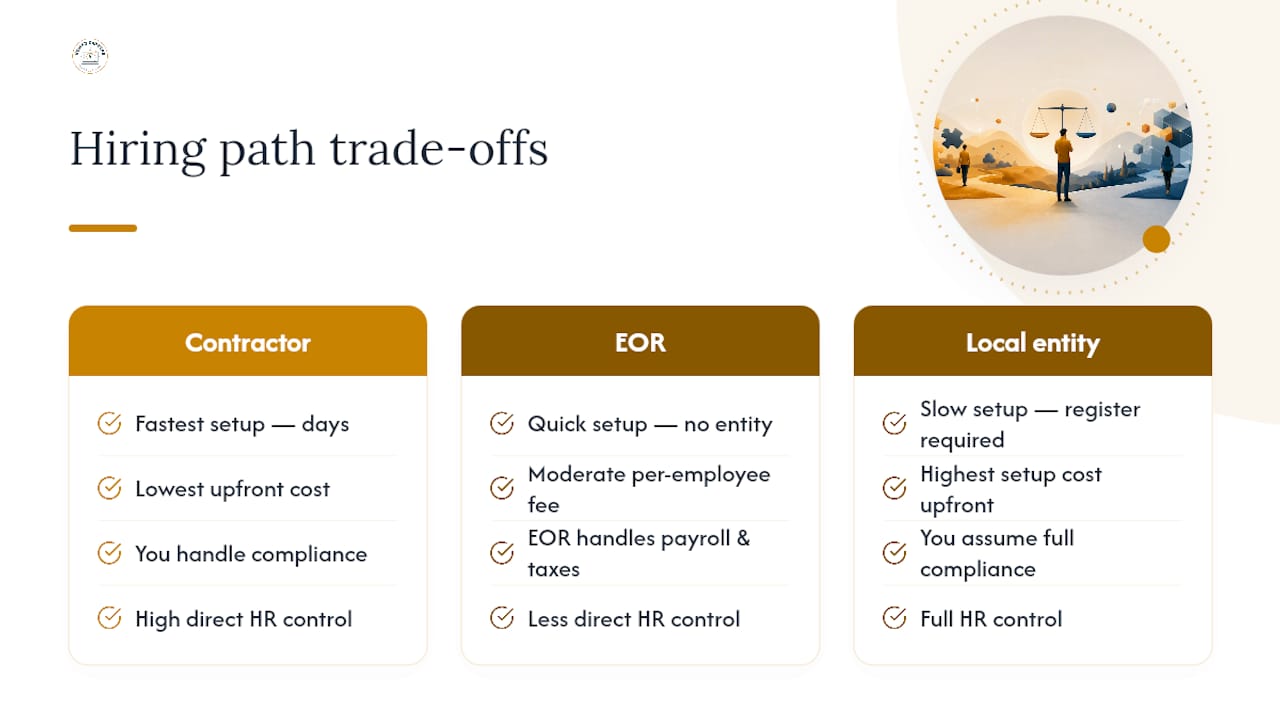
Direct contractor engagement is fastest and cheapest upfront: sign a contract, start work within days, no registration required anywhere. It only works when the role genuinely meets contractor criteria; forcing a full-time role into this model is where most misclassification cases originate.
Employer of Record (EOR) services let you hire someone as a legal employee in their country without setting up your own entity there. An EOR handles local payroll, benefits, and tax withholding, cutting your compliance burden significantly, though you’ll pay a per-employee service fee and typically have somewhat less direct control over HR mechanics. Using an EOR removes the need to form a local entity, per this EOR guide, though it doesn’t excuse you from classifying contractor relationships correctly elsewhere in your workforce.
Local entity incorporation makes sense once you’re hiring at volume in one country. It’s slower and more expensive to set up but gives you full control and, over time, the lowest per-employee cost.
A practical operational checklist applies across all three: draft compliant contracts, register for relevant tax obligations, confirm payroll mechanics, and consult local counsel before scaling. For a deeper walkthrough of compliance steps when hiring remotely, see this global remote hiring playbook.
What the Research Says About International Hiring Risk
Jurisdictions share similar factor-based logic, control, integration, financial independence, but differ sharply in how they presume status and how aggressively they enforce it, which means a contractor structure that’s safe in one country can be indefensible in another. Key takeaways worth keeping close:
-
The IRS, CRA, ATO, and Fair Work Australia all examine control and integration, but the burden of proof shifts depending on the jurisdiction.
-
ABC-style tests, as used in California, presume employment unless every independence criterion is met, a stricter standard than most federal tests.
-
The EU’s Platform Work Directive signals a broader regulatory trend toward employment presumptions for gig-style arrangements.
Getting the role definition right before you post it matters just as much as getting the contract right afterward. Nomad Careers’ verified job listings and employer resources help hiring teams write clearer remote job specs from the start, reducing the ambiguity that often precedes classification disputes.
How Does This Affect Cross-Border Employment Regulations?
Hiring across borders means navigating international labor law that wasn’t designed with remote work in mind, and the gaps show up fastest at the edges of contractor arrangements. Most labor codes were written assuming a worker physically reports to a workplace in the country whose laws apply. Remote contractors break that assumption, and regulators are still catching up unevenly.
The practical effect is that a single global contractor policy rarely survives contact with more than two or three countries. A contract clause that’s fully enforceable in one jurisdiction may be void or reinterpreted in another, particularly around non-compete terms, IP assignment defaults, and termination notice. The EU’s move toward employment presumptions for platform workers is one sign of where this is heading. Expect similar tightening in other regions as governments notice how much tax revenue flows through unregistered cross-border contractor payments.
For hiring managers, the practical response is treating each country as its own compliance project rather than applying one contract template globally. A contractor agreement that works for a Canadian developer needs different governing-law and tax-withholding language than the same role filled from Germany or Australia. Companies that scale internationally without adjusting per country tend to discover the gaps only after a dispute or audit forces the issue, at which point retrofitting compliance is far more expensive than building it in from the first hire.

Does Hiring Contractors Create Permanent Establishment Risk?
Permanent establishment (PE) risk is the possibility that your company’s contractor relationship in another country creates enough of a business presence there to trigger corporate tax obligations, even without an office or entity. This risk sits separately from worker misclassification, though the two often surface together in an audit.
Tax authorities generally look at whether the contractor has authority to negotiate contracts on your behalf, whether they represent your company to customers, and how integrated their work is into your core revenue activities. A freelance graphic designer doing occasional projects rarely creates PE exposure. A contractor effectively running your sales operation in their country is a different story entirely, regardless of what the contract calls them.
Employees carry a related but distinct PE risk: a full-time employee working from a home office abroad can itself trigger a taxable presence in that country, separate from any contractor questions. This is one reason EOR arrangements have grown popular for genuine employee hires abroad; the EOR entity absorbs the local employment relationship, which can reduce (though not eliminate) PE exposure tied to that specific worker.
The safest posture is treating PE risk as a tax question distinct from classification, and looping in tax counsel whenever a contractor’s role starts looking like it represents your company rather than simply performing services for it.
How Do Work Permits and Visas Differ for Contractors vs Employees?
Immigration compliance splits sharply along the contractor/employee line, and this is one area where the difference isn’t subtle at all. Employees generally need sponsored work visas tied to the employing entity, a process that requires a local legal presence and often months of processing time. Contractors working remotely from their own country typically need no work authorization from your country at all, since they’re not physically working within your borders.
The complication arrives when a contractor relocates, say, a contractor decides to work from your company’s home country for a few months. At that point they may need visitor status, work authorization, or in some cases a digital nomad visa, depending on the destination country’s rules and how long they intend to stay. Treating this as a non-issue because “they’re just a contractor” is a common and costly assumption; immigration authorities care about physical presence and work activity, not contract labels.
Employees relocating internationally face the more familiar sponsored-visa pathway, usually requiring the employer (or an EOR acting as the legal employer) to file for work authorization before the employee starts. This process is slower but generally clearer, since immigration authorities have well-established frameworks for employer-sponsored labor. Contractors moving between countries operate in murkier territory, often relying on tourist or business-visitor status that technically restricts the type of work they can perform locally. Hiring managers bringing contractors into in-person meetings or short-term projects abroad should confirm visa requirements for that specific trip rather than assuming contractor status exempts anyone from immigration rules.
How Do Onboarding and Offboarding Differ Internationally?
Onboarding a contractor internationally is typically fast: sign the agreement, confirm payment details and invoicing setup, and start work, often within days. Onboarding an employee abroad, by contrast, usually involves registering with local tax authorities, setting up payroll withholding, enrolling in mandatory benefits programs, and, if using an EOR, executing a separate employment agreement between the worker and the EOR entity. That process commonly takes one to three weeks depending on the country.
Offboarding shows the starkest contrast. Ending a contractor relationship usually just requires following the notice period stated in the contract, often as short as two weeks, with no severance obligation in most jurisdictions. Ending an employee relationship abroad can trigger statutory notice periods, mandatory severance calculated by tenure, and in some countries, government approval before termination is even valid. France, Germany, and several other EU countries impose meaningful procedural hurdles on employee terminations that simply don’t exist for contractor offboarding.
This gap is exactly why some companies default to contractor structures for roles that should be employees, hoping to sidestep termination complexity. It backfires when a “contractor” relationship that functioned like employment for two years gets challenged at offboarding, and a labor board retroactively applies employee termination protections the company never planned for. Building the classification decision correctly at onboarding avoids this exposure entirely at the exit.
What Disputes Commonly Arise, and How Are They Resolved?
The most frequent dispute in international contractor arrangements is a worker claiming they were functionally an employee and demanding back pay for benefits, overtime, or severance they never received. These claims typically surface after termination, when a contractor who worked exclusively and full-time for a company suddenly has strong incentive to challenge their classification retroactively.
Resolution mechanisms vary by country but generally follow one of two paths. Labor boards or employment tribunals handle disputes in countries with strong worker-protection frameworks, examining the actual working relationship regardless of contract language. Civil courts handle disputes framed as straightforward contract breaches, IP ownership disagreements, or non-payment, which tend to move faster and cost less than employment tribunal proceedings.
Arbitration clauses in contractor agreements can redirect disputes away from public tribunals and into private, faster resolution, though enforceability varies: some countries limit how much a contract can waive statutory employment-tribunal rights, particularly when a worker is later found to have been misclassified. A well-drafted governing-law clause matters here too, since it determines which country’s dispute-resolution framework applies when the contractor and company are based in different jurisdictions.
The most effective dispute prevention isn’t a clever clause; it’s getting the classification right from the start and documenting genuine independence throughout the engagement. Companies that maintain clean invoicing records, confirm the contractor serves other clients, and avoid exclusivity language rarely face successful reclassification claims, because the paper trail matches the working reality.
Getting the legal side right is only half the job. Finding candidates who genuinely understand remote work, and clearly stating whether a role is contract work vs full-time employment before you ever interview anyone, prevents a huge share of disputes before they start. Some job boards manually verify listings so employers posting remote roles can reach candidates looking for genuine work-from-anywhere positions rather than sorting through spam.