An effective remote hiring process rests on four things: a published geo policy, async-first screening, compliance settled before an offer goes out, and a structured 30-60-90 onboarding plan. Most companies get the sourcing and interviews right and still lose candidates at the finish line. Expect the full cycle to run several weeks, with the biggest risk sitting in the compliance gap between “yes” and signed contract.
TL;DR:
Publishing a clear geo and compensation policy upfront prevents late-stage offer collapse caused by legal or payroll uncertainties.
Sourcing strategies should be role-specific, targeting niche communities for technical roles and LinkedIn for sales, to improve candidate relevance and cost-efficiency.
Using asynchronous screening with written prompts and paid trial projects improves remote candidate evaluation and reduces early dropout rates.
Conducting live interviews with a structured agenda focused on problem-solving and candidate fit is more effective than traditional lengthy conversations.
Final compliance decisions, such as tax treatment and employment classification, must be settled before extending any job offer to avoid delays and legal risks.
What Are the Stages of a Remote Hiring Process?
A remote hiring process follows the same logical spine as any hiring workflow, but the sequencing changes because you can’t rely on a hallway conversation to catch a mismatch. Roles.at’s distributed hiring guide and Lessie.ai’s seven-step framework both converge on the same idea: define your policy before you write the job post, and don’t leave compliance for the end.
Here is the sequence that holds up across company sizes:
-
Define geo and comp policy. Decide which countries or states you’ll hire in and what you’ll pay before anyone sees the role.
-
Write the remote job description. Spell out overlap hours, tools, and eligibility so unqualified applicants self-select out.
-
Source globally. Combine broad platforms with niche remote-specific boards and targeted outreach.
-
Screen asynchronously. Use written prompts or short recorded responses to filter for communication quality before scheduling any live call.
-
Run live interviews in overlap windows. Reserve real-time conversation for culture fit and collaborative problem-solving.
-
Resolve compliance and extend a location-aware offer. Settle employee-versus-contractor-versus-EOR questions before you talk numbers.
-
Onboard with a documented 30-60-90 plan. Assign a buddy and set measurable milestones.
Steps one through four can happen almost entirely without a live meeting, which is where most teams save time. Step five needs real-time overlap, even if it’s just 45 minutes. Step six is where international hires add the most delay: cross-border payroll setup or an Employer of Record (EOR) agreement can take one to three weeks depending on the country. If you’re hiring in a single time zone with an existing entity, you can compress the whole cycle to under three weeks. Add a new country and a new compliance structure, and a longer hiring cycle becomes realistic.
Why Publishing Geo Policy Prevents Offer-Stage Collapse
Offer-stage collapse happens when a company falls in love with a candidate, negotiates for weeks, and then discovers it has no legal way to pay them. Roles.at’s guidance is blunt about this: ambiguity over what “remote” actually means is one of the primary operational risks in distributed hiring, and it’s almost entirely preventable.
Fix it at the job description stage, not the offer stage. Decide, before you post the role, which countries or states are eligible, what overlap hours you require, and whether comp is location-adjusted or flat. Publishing your compensation philosophy, even as a range, does more to reduce late-stage attrition than any amount of interview polish. Candidates who know the band up front don’t waste three interview rounds only to walk away at the offer call.
Your remote job description checklist should include:
-
Eligible countries or states, stated explicitly (not “remote friendly”)
-
Required overlap hours in a named time zone, such as “4 hours overlap with 9 a.m. to 1 p.m. ET”
-
Core tools the role uses daily (project management, communication, code repositories)
-
Equipment provided versus equipment the candidate must supply
-
Any travel expectations, even if rare
-
Compensation band or a clear comp philosophy statement
Pro Tip: Treat your geo policy as a living document, not a one-time decision. Revisit it every quarter as your payroll and EOR relationships expand into new countries, and update job templates immediately so recruiters never post an outdated eligibility list.
Where Should You Source Remote Candidates by Role Type?
Sourcing strategy should track the role, not a one-size-fits-all channel list. A senior engineer and a customer support lead don’t hang out in the same corners of the internet, and treating them identically wastes budget.
-
Technical and engineering roles: niche remote job boards, developer communities, and GitHub-adjacent outreach tend to outperform generic boards.
-
Sales and customer-facing roles: LinkedIn outbound and referral networks generally produce stronger candidates than open posting alone.
-
Operations, support, and administrative roles: dedicated remote-only job boards with manually verified listings, like Nomad Careers, filter out the noise that floods generic postings.
-
Creative and marketing roles: portfolio-driven communities and targeted social outreach, paired with a job post that shows rather than tells what the work looks like.
For outbound, structure your messaging around specifics: name the actual project or team, state the overlap hours plainly, and avoid vague “join our mission” language that reads as templated. Track channel performance by cost-per-qualified-applicant, not just volume. A board that produces ten low-fit applicants is worse than one that sends you two strong ones.
When you write the actual job post, targeting language matters as much as the channel. “Remote, U.S. only, 4-hour EST overlap” filters far more effectively than “remote-friendly,” and it saves your recruiting team hours of disqualifying unqualified applicants by hand. If you’re building candidate-facing materials, resume guidance built for remote roles can also help you write job posts that speak the same language candidates are using to apply.
How Do You Screen Remote Candidates Without Wasting Interview Time?
Screening is where remote hiring should look most different from in-office hiring, and where most companies still default to old habits. A phone screen doesn’t tell you whether someone can write a clear async update or manage their own time without a manager walking by their desk. A written or recorded exercise does.
Here’s a practical framework:
-
Send a 10 to 30 minute async screen first. A short written prompt (two to three questions relevant to the role) or a 5 minute recorded video response works well; for practical ideas and examples on using video in candidate outreach, see 10 Recruitment Video Ideas That Actually Get Applications. This step alone filters out candidates who can’t communicate clearly in writing, which is the skill remote work depends on most.
-
Move finalists to a paid trial project. Timebox it to two to four hours of real work, tied to an actual problem the role will face, and pay candidates fairly for their time regardless of whether you hire them.
-
Score everything with a structured rubric. Use the same three to five criteria for every candidate: communication clarity, independent problem-solving, technical or functional competence, and collaboration signals.
-
Debrief against the scorecard, not gut feeling. Every interviewer rates the same categories, which makes comparing candidates faster and fairer.
RemoteTeamer’s research is direct on this point: structured assessments and paid trials better predict remote performance and reduce early departures compared with unstructured interviews. Unstructured conversations reward charisma. Structured ones reward the ability to actually do the job.
Async steps double as work samples. A candidate’s recorded answer or written response shows you their communication style directly, rather than asking you to infer it from small talk on a video call. If you want candidates to submit stronger portfolio material at this stage, point them to portfolio-building guidance for remote applicants so the work samples you receive are actually comparable across candidates.
How Should Live Remote Interviews Be Structured?
Live interviews should do less than most companies ask them to do. Save real-time conversation for what async steps can’t cover: how someone thinks under mild pressure, how they handle ambiguity, and whether the team actually wants to work with them.
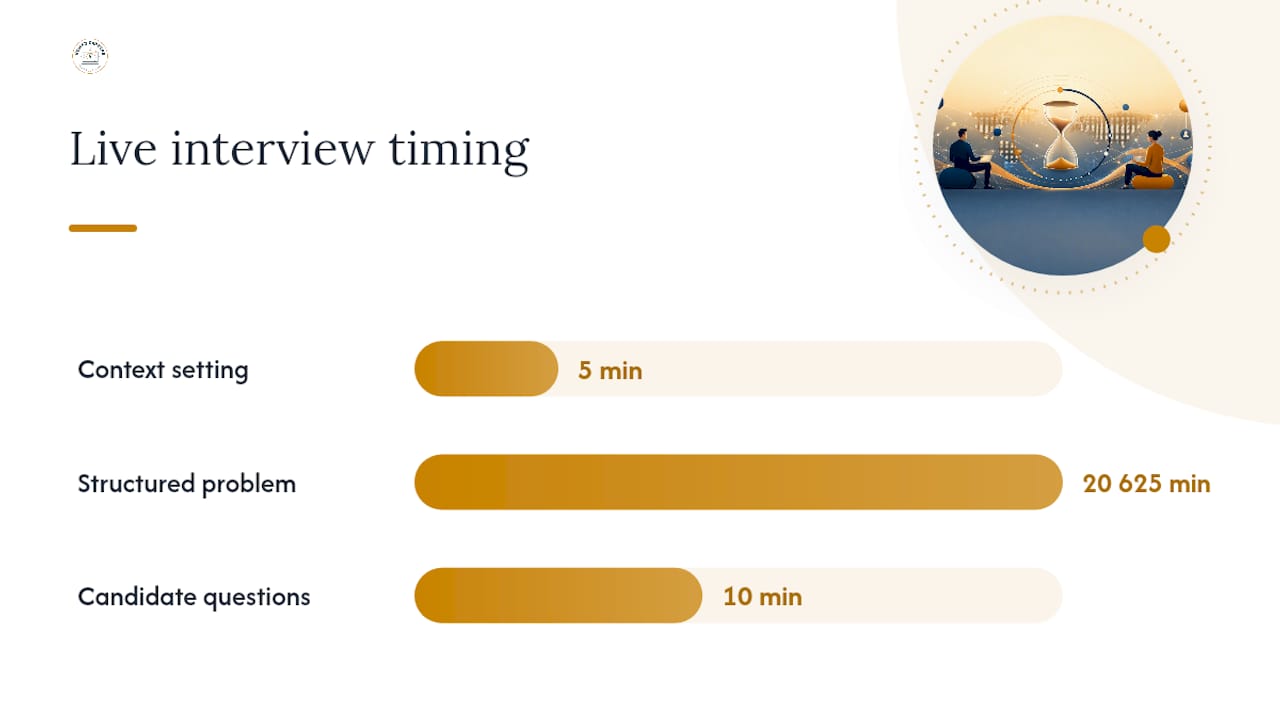
A repeatable 30 to 45 minute flow looks like this:
-
First 5 minutes: context setting, no scoring, just rapport and agenda confirmation.
-
20 to 25 minutes: a structured problem or scenario relevant to the role, scored live against the shared rubric.
-
10 minutes: candidate questions, treated as a genuine two-way conversation, not a formality.
Assign each interviewer a specific role in advance, whether that’s technical depth, collaboration signals, or culture fit, so you’re not getting three redundant impressions of the same 20 minutes.
Scheduling deserves more care than most teams give it. Cluster interviews inside a genuine overlap window between candidate and interviewer time zones, and never ask a candidate in Manila to join a 7 a.m. call because it’s convenient for a team in Chicago. That’s not a minor courtesy; it’s a signal about how the company treats time zones once someone is hired.
Pro Tip: Send the interview agenda and the scorecard categories to candidates ahead of time. It sounds like it gives away the test, but it actually produces better signal: prepared candidates perform closer to their real ability, which is what you’re trying to measure anyway.
What Compliance Decisions Have to Happen Before the Offer?
The offer stage is where good candidates get lost to slow paperwork, and where legal risk quietly accumulates if you skip steps. Lessie.ai’s guidance is clear that most offer-stage failures trace back to misclassifying employment status or failing to budget for local payroll and benefits before the candidate says yes.
Clear these items before you extend an offer:
-
Currency and pay cadence: confirm which currency the offer is denominated in and how often payroll runs in that country.
-
Tax treatment and benefits: know whether statutory benefits (leave, health coverage, pension contributions) apply in the candidate’s location.
-
Equipment and IP clauses: decide who ships equipment, on what timeline, and confirm your IP assignment clause holds up under local law.
-
Security requirements: clarify data access and device security expectations before day one, not after.
For structure, an EOR is usually the fastest path for a single hire in a new country. Opening a local entity only makes financial sense once you’re hiring at scale there, given the setup cost and ongoing compliance overhead. A compliance playbook for cross-border remote hiring walks through this decision in more depth. Start payroll registration and equipment shipping the moment you extend an offer, not after signature, because both routinely take longer than hiring managers expect.
What Does a Strong 30-60-90 Remote Onboarding Plan Look Like?
Onboarding is where remote hires either become productive fast or drift for months without anyone noticing. A documented plan closes that gap. Here’s a structure that works across most functions:
-
Before day one: ship equipment, provision accounts, and send a welcome packet with the first week’s schedule so the new hire isn’t waiting on IT during their first hour.
-
Week 1: assign a buddy, schedule intro calls with core collaborators, and give one small, completable task that produces a visible result by Friday.
-
Week 4: the new hire should have shipped one real piece of work and documented it in your team’s knowledge base.
-
Week 8: the new hire runs a meeting or leads a small project independently, with the buddy stepping back to an advisory role.
-
Week 12: a formal check-in against the original 30-60-90 goals, with a documented decision on next-quarter priorities.
The buddy’s job isn’t just answering questions. It’s proactively checking in twice a week for the first month and flagging confusion before it becomes disengagement.
| Milestone | Owner | Measurable artifact |
|---|---|---|
| Day 1 | Hiring manager | Equipment received, accounts active |
| Week 1 | Buddy | First small task shipped |
| Week 4 | New hire | One documented deliverable |
| Week 8 | New hire + buddy | Independently led meeting or project |
| Week 12 | Hiring manager | Formal 30-60-90 review completed |
Document every decision made during onboarding, even small ones, in a shared space. Async handovers only work if the next person doesn’t have to ask the same question twice. If you’re onboarding someone who applied through a public listing, a pre-apply checklist shared during onboarding also helps set expectations that carry over from the hiring process itself.
What Tools and Metrics Actually Matter for Remote Hiring?
Most companies over-buy tools before they’ve even hired their first remote employee. Roles.at’s recommendation is to pick one system per category and resist adding more until you’ve outgrown it, since most SMBs over-buy hiring tools before they’ve optimized the process those tools are supposed to support.
A minimum viable stack covers four categories:
-
Communication: one primary chat tool and one video tool, not three competing ones.
-
Documentation: a shared knowledge base where onboarding decisions and process notes actually live.
-
Project management: a single system of record for tasks, not a patchwork of spreadsheets.
-
Hiring: an applicant tracking system (ATS), a scheduler that handles time zones automatically, and one payroll or EOR partner to start.
Track four metrics to know whether your process is healthy: time-to-fill, offer-accept rate, first-quarter retention, and misclassification incidents. A dropping offer-accept rate almost always points back to unclear geo policy or compensation surprises, not weak candidates. Remote work adoption isn’t a passing trend, either. Gartner reports that 82 percent of company leaders plan to allow remote work at least some of the time, which means the process you build now is infrastructure, not a temporary fix.
How Nomad Careers Supports Employers Building a Remote Hiring Process
Nomadcareers exists because too many “remote” job listings turn out to have hidden location restrictions or vague eligibility once a candidate applies. Every listing on the platform goes through manual verification before it’s published, which filters out the mismatched applications that come from ambiguous postings and saves recruiting teams hours of unqualified screening.
For employers building or refining a remote hiring process, Nomadcareers offers a set of practical resources beyond job posting itself: a remote resume guide that shows what strong remote applications look like, a pre-apply checklist candidates can use to self-screen before submitting, and a compliance playbook covering the EOR-versus-contractor-versus-entity decision in more depth than a single article can.
Employers posting on the platform reach candidates who already understand the eligibility and overlap-hour expectations before they apply. That reduces the volume of clearly ineligible applications that otherwise clog the top of a hiring funnel. If you’re posting a role or refining eligibility language, Nomad Careers’ verified job board is built around exactly the geo-policy clarity this article recommends.
Where to Read More on Remote Hiring Compliance and Trends
For deeper reading beyond this playbook: Gartner’s survey data confirms the scale of leadership commitment to remote work. Forbes’ analysis covers why the shift is structural rather than temporary. Roles.at’s distributed hiring guide is the most complete operational playbook for geo policy and tooling. Lessie.ai’s seven-step guide lays out the compliance sequencing in more detail. RemoteTeamer’s screening research backs the case for paid trials over unstructured interviews.