Slow travel for digital nomads works when the job comes first and the itinerary comes second. The reliable path runs through career-first roles that are asynchronous or deliverable-based, paired with vetted listings and predictable systems for connectivity, banking, and compliance. The top levers are role type, employment structure, and logistical prep done before you land. A manually verified source like Nomadcareers removes much of the guesswork in finding roles that genuinely travel with you.
TL;DR:
Jobs in software development, project management, data work, marketing, or consulting are most suitable for long-term slow travel due to their asynchronous and deliverable-based nature.
Verifying if roles have country restrictions or payroll limitations before applying is essential, as many “remote” listings are region-locked despite marketing claims.
Infrastructure such as reliable internet, multicurrency banking, international health insurance, and fixed routines is critical for sustained and productive long stays.
Transitioning gradually over three to nine months, including securing clients and finalizing logistics, minimizes financial and logistical risks.
Respecting local customs, using local businesses, and understanding visa or digital nomad visa requirements ensures responsible and legal long-term stays.
Which Jobs and Contracts Actually Support Long Stays?
Slow travel depends less on your destination and more on how your income is structured. A job that requires daily synchronous meetings in one time zone will fight you every time you try to stay somewhere for six weeks instead of six days. The fix is to treat your nomad life as a career arrangement built around deliverables and measurable outputs, not logged hours. That framing, backed by Forbes’ guidance on becoming a digital nomad, is the single biggest predictor of whether someone can stay somewhere for a season rather than a week.
Some career categories travel better than others. Software development, product and project management, data and AI work, marketing and SEO, consulting, education, and retained freelance work all tend to produce output that can be reviewed asynchronously. Roles tied to real-time customer support, live sales floors, or heavy internal coordination rarely do.
Employment structure matters just as much as job category:
-
Global-first W-2 roles: employers built to hire across borders, but payroll systems often still restrict which countries you can legally work from.
-
Contractor or freelance arrangements: the most flexible on paper, though income can be less predictable and you carry your own tax and insurance obligations.
-
Agency or retainer work: a middle ground that trades some autonomy for steadier income.
-
Hybrid models: a base salary plus project bonuses, common in consulting and technical fields.
Each structure carries its own friction. Payroll limits can block you from working legally in a given country even with employer approval. Synchronous meeting requirements quietly erode the time-zone freedom that makes slow travel possible in the first place. Greenback Tax Services’ research on job categories also notes that a large share of nomads end up self-employed, which shifts tax exposure onto the individual rather than an employer.
How Do You Find and Vet Roles That Allow Multi-Month Stays?
Job boards labeled “remote” often mean “remote within one country.” That gap between the label and the reality is the single most common reason nomads get blindsided mid-lease. An analysis of the current hiring market found that many postings marketed as work-from-anywhere are quietly restricted by payroll systems, tax registration, or internal policy, according to Freefreedom’s breakdown of the remote work market.
Start your search on platforms that manually vet listings rather than aggregate every post tagged “remote,” since verification catches most of the region-locking before you waste an application. A platform built its listing process around exactly this problem. It screens postings for genuine location flexibility rather than trusting the job title.
Once you have a role in sight, work through this before you sign anything:
-
Ask directly whether the employer has country restrictions tied to payroll or legal entity setup.
-
Confirm how payments are processed and whether that changes if you relocate mid-contract.
-
Get a specific number for expected overlap hours, not a vague “some flexibility.”
-
Ask if a trial relocation or short pilot period is allowed before a permanent move.
-
Clarify whether benefits, bonuses, or equity are tied to a specific location or residency status.
Watch for job posts that mention “remote” only in the title while the body specifies a metro area, or contracts that reference a single state’s labor law with no mention of international work. Both are signs the flexibility is cosmetic.
Pro Tip: Ask the hiring manager, “Which countries has this role been performed from in the past year?” A real answer with specifics is a good sign. A vague “we’re flexible” usually is not.
Negotiation works best when you frame location freedom as a productivity asset, not a personal favor. Point to your deliverables, propose a defined overlap window, and offer a short trial period so the employer can see the arrangement working before committing long term.
What Setup Makes a Long Stay Actually Work?
A long stay lives or dies on infrastructure you rarely think about until it fails. Build redundancy before you need it, not after your internet drops during a client call.
-
Connectivity: a primary ISP or coworking membership, a mobile hotspot as backup, a VPN for secure access, and automated cloud backups of your work.
-
Banking and payments: a multicurrency card, a reliable invoicing system, and email-based billing that doesn’t depend on a local bank branch.
-
Insurance and health: an international health plan, a small emergency fund set aside separately, and basic research on local care options before you arrive, not after you need them.
-
Time-zone routines: fixed core hours, clear async handoffs, and tools that log your availability so teammates aren’t guessing.
Self-employment adds its own layer of complexity here. Greenback Tax Services notes that U.S. nomads can exclude up to $130,000 of foreign-earned income in 2025 under the FEIE, but that exclusion doesn’t touch self-employment tax, which still applies regardless of where you’re sitting when you invoice a client. Nomadcareers’ own digital nomad tax guide breaks down how that distinction plays out for U.S. citizens working abroad.
A practical routine matters as much as the tools. A business travel perspective from Wild Foodz makes the case that predictability, not novelty, is what keeps extended stays productive. Slow travel rewards boring, repeatable systems far more than spontaneity.
What Does a 3 to 9 Month Transition Plan Look Like?
You don’t need to quit your job on a Friday and land in Lisbon on a Monday. A staged transition protects your income while you test whether the lifestyle actually fits how you work.
-
Months 1 to 3: keep your core income intact while you secure one outside client or negotiate a short multi-week stay with your current employer. Treat this as a pilot, not a leap.
-
Months 3 to 6: convert early traction into a retainer relationship, or push for a formal global-first clause in your employment agreement. Set a savings runway target, ideally three to six months of expenses, before you extend any stay past a month.
-
Months 6 to 9: diversify beyond a single client or employer, finalize your banking and insurance setup, and start planning stays measured in months rather than weeks.
Measure the pilot the same way you’d measure any business decision: track income stability, client response times, and whether your employer actually approved the arrangement in writing rather than verbally. A structured evaluation approach that checks these metrics before a bigger move catches problems while they’re still cheap to fix. Nomadcareers’ beginner roadmap and its comparison of freelance versus remote employment structures are both useful checkpoints at the three and six month marks.
How Do You Build Community During an Extended Stay?
Staying somewhere for two months instead of two weeks changes your social math entirely. Short-term travelers lean on hostels and tour groups; slow travelers need something closer to a real social routine, because isolation compounds fast when you’re working alone in an apartment in a city where you don’t yet know anyone.
Coworking spaces solve two problems at once: reliable internet and a built-in social layer. Most coworking hubs in nomad-heavy cities run regular events specifically because they know their members are transient and looking for connection. Language exchanges, recurring meetups, and local sports or hobby groups tend to produce deeper relationships than nomad-specific social apps, mostly because you’re mixing with residents rather than only other short-term visitors.

The pace of slow travel actually helps here. A two or three-month stay gives you enough repetition, the same coffee shop, the same gym class, the same weekly meetup, to move from stranger to familiar face. That repetition is the part fast travel never allows. Set a light social goal for each new stay: one recurring activity and one new contact per week is enough to avoid the isolation that catches a lot of first-time nomads off guard.
How Do You Travel Responsibly in the Places You Stay?
Slow travel puts you in a strange middle position. You’re not a tourist passing through for three days, but you’re also not a resident with local ties and local tax obligations. That gap creates real obligations even though your legal status usually doesn’t change.
Learning even basic greetings and courtesy phrases in the local language changes how you’re received almost immediately, and it signals you’re not just passing through for a photo. Spending at neighborhood businesses instead of exclusively at nomad-oriented cafes and coworking chains puts money into the local economy your stay is actually part of. Housing choice matters too: renting through channels that compete directly with long-term local housing stock, rather than short-term platforms designed for local residents, can strain the same neighborhoods you’re hoping to enjoy for months at a time.
Responsible practice also means respecting the limits of your welcome. A visa or residence permit tells you how long you’re legally allowed to stay, but it says nothing about local sentiment toward long-staying foreigners in a given neighborhood. Reading local news coverage of the effects of remote workers on housing costs in your destination, a real issue in several popular nomad hubs in recent years, gives you a more honest picture than the polished coworking marketing usually offers.
How Do You Handle Visas and Residence Permits for Slow Travel?
Every country sets its own rules for how long you can stay and under what status, and there is no shortcut that clears this differently. Some countries permit tourist-status stays of 90 days but explicitly prohibit any local work, even remote work for a foreign employer, under that status. Others have built dedicated digital nomad visas specifically to legalize the arrangement you’re describing.
The distinction that trips people up most often is between being allowed to be somewhere and being authorized to work while there. Many nomads stay on tourist status while working remotely for a foreign employer, a gray area that’s rarely enforced but also rarely explicitly protected. A dedicated digital nomad visa, where available, removes that ambiguity and usually comes with a defined income threshold, proof of remote employment, and a fixed validity period, often six months to two years depending on the country.
Because these rules vary enormously by jurisdiction and change without much notice, check the specific requirements for your target country before treating any stay as a locked plan. Nomadcareers’ directory covering more than 65 countries with digital nomad visa programs is a practical starting point for comparing income minimums and permit lengths side by side before you commit to a lease.
How Do You Budget for a Slow Travel Lifestyle?
Slow travel budgeting looks nothing like backpacker budgeting, and confusing the two is one of the fastest ways to overspend or underprepare. A month-long stay lets you negotiate monthly rental rates instead of nightly ones, which usually cuts accommodation costs by a wide margin compared to hotel or short-term rental pricing.
Three cost categories deserve dedicated tracking: housing, which drops sharply with longer commitments but requires a security deposit and sometimes a local bank account; recurring subscriptions like coworking memberships and VPN or software tools, which are fixed regardless of income; and a genuine emergency buffer for medical issues, flight changes, or a client payment that arrives late. That third category is the one first-time nomads underfund most often.
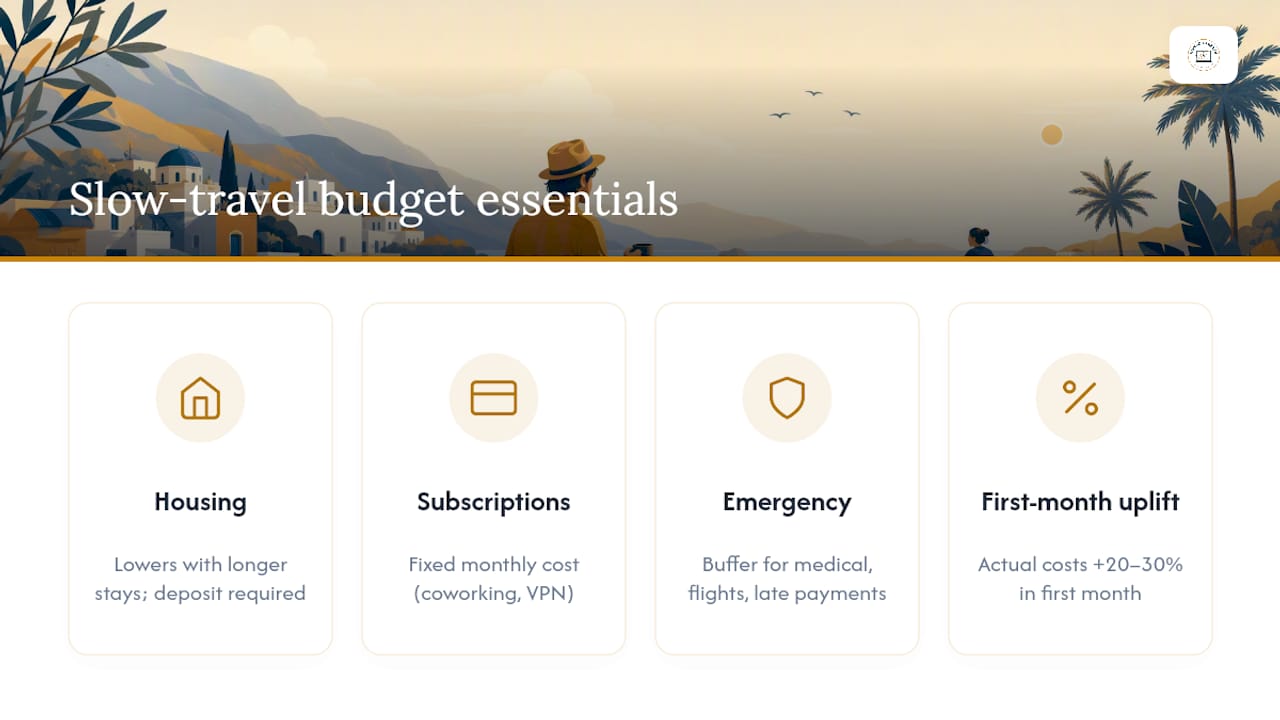
Popular nomad destinations cluster in Western Europe, Southeast Asia, and Latin America, and cost of living swings dramatically between those regions, which is exactly why your destination choice should follow your budget and income stability, not the other way around. Build a monthly spending target before you book anything, then track actual spending against it for the first month in any new location. Most nomads find their real costs run 20 to 30 percent higher than their first estimate, simply because setup costs (deposits, local SIM cards, initial grocery stocking) hit hardest in week one.
Find Verified Roles That Actually Support Long Stays
There are alternatives to scrolling generic job boards hoping a “remote” tag means what it says. Listings that go through manual verification specifically to catch country restrictions and payroll limits can help you spend less time filtering junk postings and more time applying to roles that actually fit a multi-month stay.
Start by browsing the current verified remote work-from-anywhere listings, filtering for roles that mention async workflows or deliverable-based output rather than fixed-hour availability. Set up a job alert so new verified postings land in your inbox instead of you checking boards manually every few days. Before you apply, run your application against the remote job application checklist to catch the same red flags covered above, then treat your first application as the pilot: one role, one honest test of whether the arrangement holds up once you’re actually living the schedule it promised.