Most searches for “visa sponsorship remote” actually mean one thing: how do you legally work from abroad without an employer sponsoring a local work visa? The answer is a digital nomad visa, a freelance permit, or a compliant short stay, not corporate sponsorship. The two checks that matter most before you book a flight are your tax residency status and whether your employer restricts international travel for legal reasons. This guide covers both, plus a checklist and where to find genuinely portable jobs.
TL;DR:
Most digital nomad visas require proof of foreign income, private health insurance, and a clean criminal record, with income thresholds and renewal rules varying by country.
Getting approved for a visa does not automatically establish tax residency, which depends on factors like the 183-day rule or domicile tests, and can lead to unexpected tax obligations.
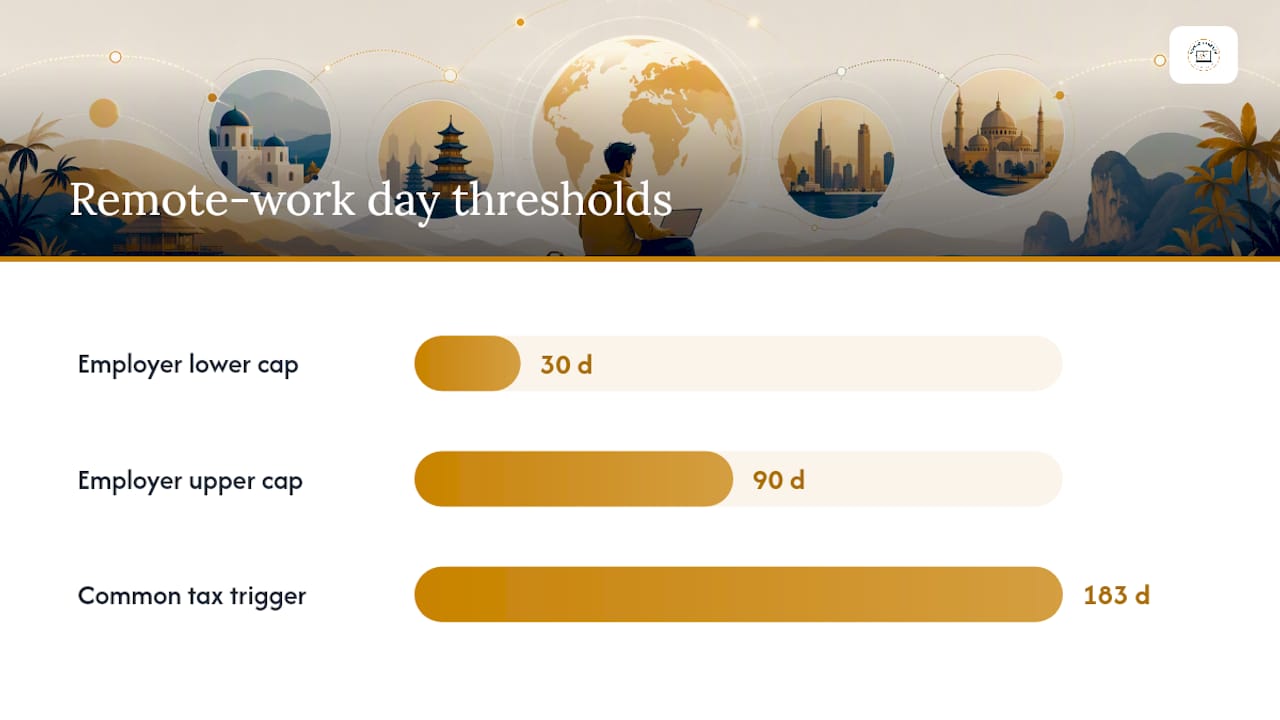
Employers often restrict international remote work to 30-90 days annually to avoid permanent establishment risks and tax complications; confirming written policies before leaving is crucial.
Contractor or project-based roles tend to support genuine location independence better than traditional employment, which can trigger payroll and tax classification issues.
Verified remote job listings specifically for nomad visas have transparent details about payroll countries and travel limits, helping applicants avoid roles with hidden location restrictions.
What Does “Visa Sponsorship Remote” Mean in This Guide?
This article is not about an employer petitioning for your work authorization in a new country. That process, governed by agencies like USCIS in the US, applies to people relocating permanently into a local job market. It has nothing to do with location independence.
Here, “visa sponsorship remote” refers to the legal pathways that let you keep your existing remote job, or freelance client base, while living in another country: digital nomad visas, self-employment permits, and compliant tourist stays. If you already have remote income and want to work from Lisbon, Mexico City, or Bali without breaking immigration law, this is your guide. If you need a company abroad to sponsor your employment and relocation, look elsewhere.
This distinction matters because the compliance requirements are completely different. Nomad visas ask you to prove foreign income and insurance. Employer-sponsored visas ask a local company to prove you fill a labor gap. Confusing the two leads people to apply for the wrong permit or, worse, work illegally on a tourist stamp.
What Are the Best Nomad Visa Options?
Many countries now offer a dedicated digital nomad visa, and the category splits into three practical types.
-
Digital nomad visas are built specifically for remote employees and freelancers with foreign clients, usually valid for one year with renewal options.
-
Freelance or self-employment visas target independent contractors and require proof of active client contracts rather than a single employer letter.
-
Long-stay financially independent permits don’t mention remote work at all but accept passive income or savings as proof you can support yourself.
Income thresholds vary widely, typically requiring verified foreign earnings alongside private health insurance and a clean criminal background check. Portugal, Croatia, Spain, and Mexico each run programs with different durations and renewal rules, and Croatia’s version has offered a time-limited tax exemption in some cases, while others tax nomad income according to local rules, as explained in a 2026 tax guide. You can compare eligibility across more than 65 countries currently running these programs to see which fits your income and nationality.
The one thing every applicant misses: getting the visa approved does not settle your tax situation. Visa approval and tax residency are two separate legal questions, and the next section explains why that gap catches so many nomads off guard.
How Does Tax Residency Work if You Work Remotely Abroad?
The 183-day rule is the most common trigger for tax residency worldwide, but it is far from universal. Some countries use different day counts, domicile tests, or a “center of vital interests” standard that can make you tax resident even if you never hit 183 days, according to guidance on remote work legalities. Treaty tie-breaker clauses can also override a simple day count when two countries both claim you.
A second risk sits with your employer, not you. Permanent establishment (PE) happens when your ongoing presence in a country creates enough business activity there that tax authorities treat your employer as operating locally, exposing that employer to corporate tax filings it never planned for. This is exactly why many companies cap international remote work at 30 to 90 days a year regardless of what your visa allows.
Your employment classification changes the math too. Genuine independent contractors generally fit nomad visas more cleanly than employees do, because a contractor relationship rarely creates PE risk the way payroll integration does, per research on work visas for global hiring. If your company controls your hours, provides your equipment, and folds you into internal systems, tax authorities may reclassify you as an employee regardless of your contract title, which drags visa and tax consequences along with it.
Before you book anything, confirm these points in writing with HR or your own contract:
-
Which countries, if any, are excluded from remote travel.
-
Whether your payroll country changes if you work abroad long term.
-
A written cap on days abroad per year, and who tracks it.
-
Whether your visa or country of residence needs to be reported to your employer’s compliance team.
Pro Tip: Ask HR for their international remote work policy in writing before you apply for any visa. A verbal “sure, go for it” from your manager means nothing if payroll or legal audits your location a year later.
Predeparture Checklist: What to Confirm First
Work through these steps in order, since each one depends on the last.
-
Get employer sign-off in writing, or start shifting toward contractor status with clients if your current employer won’t approve travel.
-
Choose your visa route and gather the paperwork: income statements, private health insurance, and a police background check.
-
Set up day tracking immediately. If you’re a US citizen, note that the Foreign Earned Income Exclusion sits around $132,900 for 2026, but qualifying requires meeting the 183-day rule or bona fide residence test, so track your exits and entries precisely.
-
Book a consultation with an international CPA before you file anything, not after.
-
Set up practical infrastructure: a multi-currency bank account, a mail-forwarding service, an unlocked phone plan, and international health coverage. Readers weighing coverage options in Europe can review freelancer health insurance in Germany as one example of what a compliant policy looks like.
-
Keep records of every contract, invoice, and travel date. If you get audited on either side, this is what saves you.
Nomadcareers’ remote work tools and resources page collects several of these banking and insurance options in one place if you’d rather not build the list from scratch.
How Do You Spot a Genuinely Portable Remote Job?
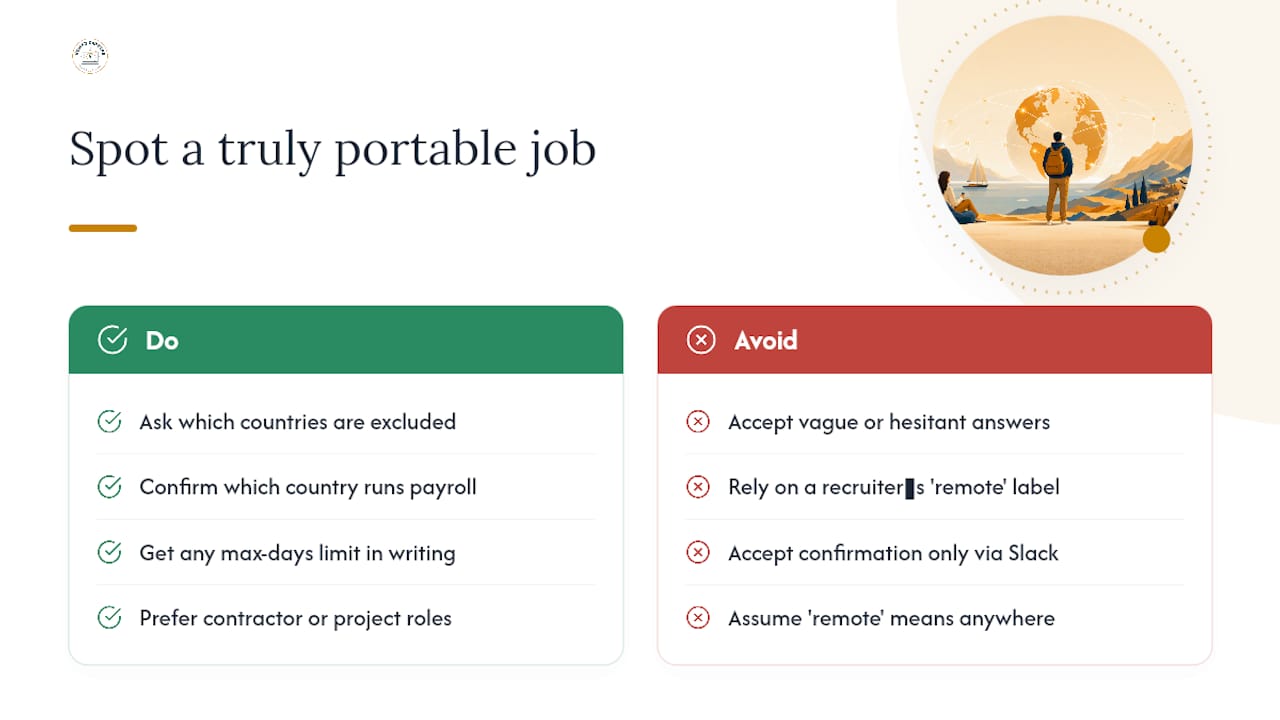
Job posts say “remote” constantly. Very few mean “remote from anywhere, indefinitely.” An insight from FreeFreedom notes that many candidates assume “remote” includes living abroad, when HR often restricts it to short travel windows purely to avoid the PE and tax exposure covered above.
Ask three questions before you get past the first interview: Which countries are excluded from this role? What country does payroll run through? Is there a written maximum number of days I can work outside my home country? A hiring manager who hesitates or gives a vague answer is telling you the role isn’t actually portable.
Contractor arrangements and project-based freelance work generally travel better than full employee status, since they sidestep the payroll and PE questions that trip up traditional employment. Confirm this in writing wherever possible, not through a Slack message that disappears in a month. Nomadcareers built its verified listing process around exactly this gap: every job on the platform is manually checked so “remote” actually means what it claims, instead of relying on a vague label a recruiter typed into a form.
Where to Verify Visa and Tax Rules Before You Apply
Never take a blog post’s word for country-specific rules, including this one. Cross-check details against primary sources.
-
USCIS for the official US distinction between work-authorized visas and visitor status.
-
Each country’s own immigration ministry site for current nomad visa income thresholds and renewal terms.
-
An international CPA or tax adviser for a personalized read on treaty tie-breakers and day-count exceptions.
Sources
-
How to Work Remotely from Another Country Legally in 2026 | WhereNext
-
The Legalities of Remote Work: Visa, Tax, and Work Rights for the Globally Mobile Professional
-
How to work remotely from abroad — 2026 guide (CompassDraft)
FAQ
What Is a Digital Nomad Visa?
A digital nomad visa is a legal permit letting remote employees or freelancers with foreign income live in a country while working for clients or employers based elsewhere. More than 60 countries offer one, typically requiring proof of foreign income, health insurance, and a clean background check.
Does a Nomad Visa Mean I’m Exempt From Local Taxes?
No. Visa approval and tax residency are separate legal tests, and most countries apply the 183-day rule or a similar threshold regardless of your immigration status. Some nomad programs include temporary tax exemptions and others don’t, so check the specific country’s tax office before you assume anything.
Can I Work Remotely on a Tourist Visa?
Generally, no. Performing paid work on a tourist visa is typically a violation in most countries and can lead to deportation or future entry bans, which is exactly why dedicated nomad visas exist.
How Do I Find Jobs That Actually Allow Working From Anywhere?
Ask hiring managers directly about excluded countries, payroll location, and any written cap on days abroad before you accept an offer. Nomadcareers manually verifies every listing on its jobs directory so “remote” reflects the employer’s actual travel policy, not just a label.
How Much Does Nomadcareers Cost to Use?
Job seekers browse and apply to verified listings for free. Employers posting roles can start with self-serve options or upgrade to visibility add-ons; current pricing for Nomad Pro plans is listed on the site.